Act 0 · Null Witness
Chapter 0.1
Trust
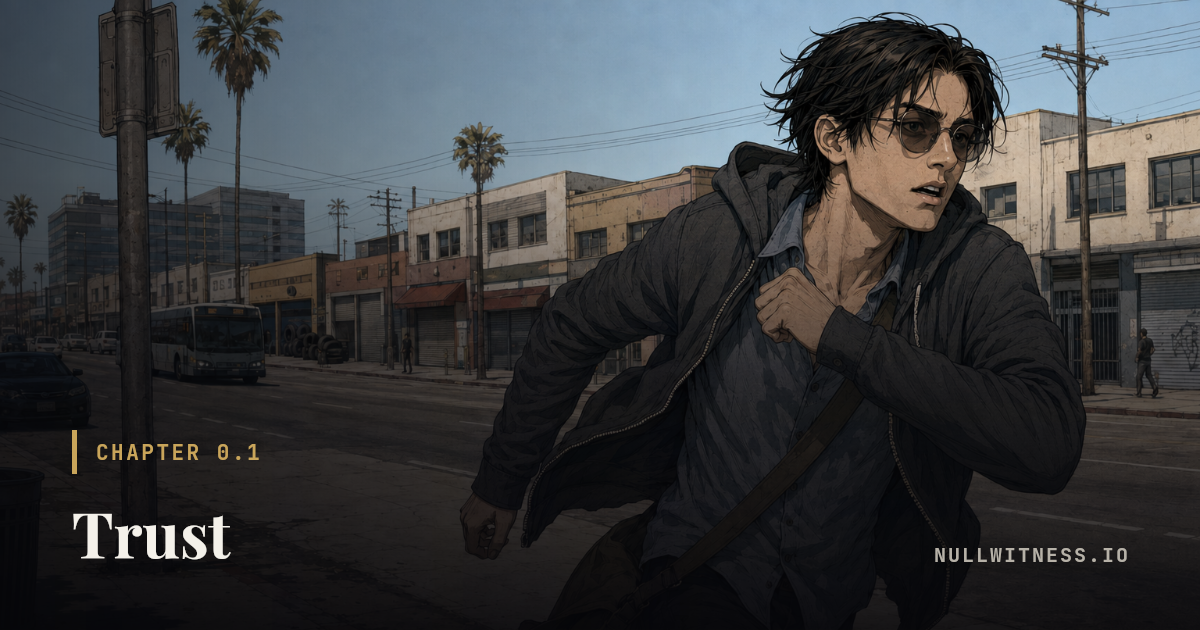
The alarm on my watch had gone off eleven minutes ago, and I’d been running for nine of them.
This was not as impressive as it sounds. I ran the way most people do things they’re bad at and too proud to admit, fast enough to look like I knew what I was doing, slow enough that anyone watching could tell I didn’t. Lincoln Boulevard at two in the afternoon in the middle of May was not the ideal track for this kind of performance. The sidewalk was full of people walking at a normal human pace to their normal human destinations, blissfully unaware that the gangling idiot weaving between them was technically late to what might generously be described as the most important interview of his adult life.
I checked my watch again. Eleven minutes. Twelve now.
Shit.
The sun was doing that thing it does in LA where it acts like a personal grievance. My transition lenses had gone dark about thirty seconds after I left the apartment and had not once considered going clear since. Through the amber tint, the city looked like a photograph left too long in a developer tray: bleached sidewalks, palm trees bending slightly in a wind coming off the ocean that you could smell but not quite feel, the persistent background haze that wasn’t quite smog and wasn’t quite marine layer and was in practice just the atmosphere LA wears because it’s decided that’s who it is now.
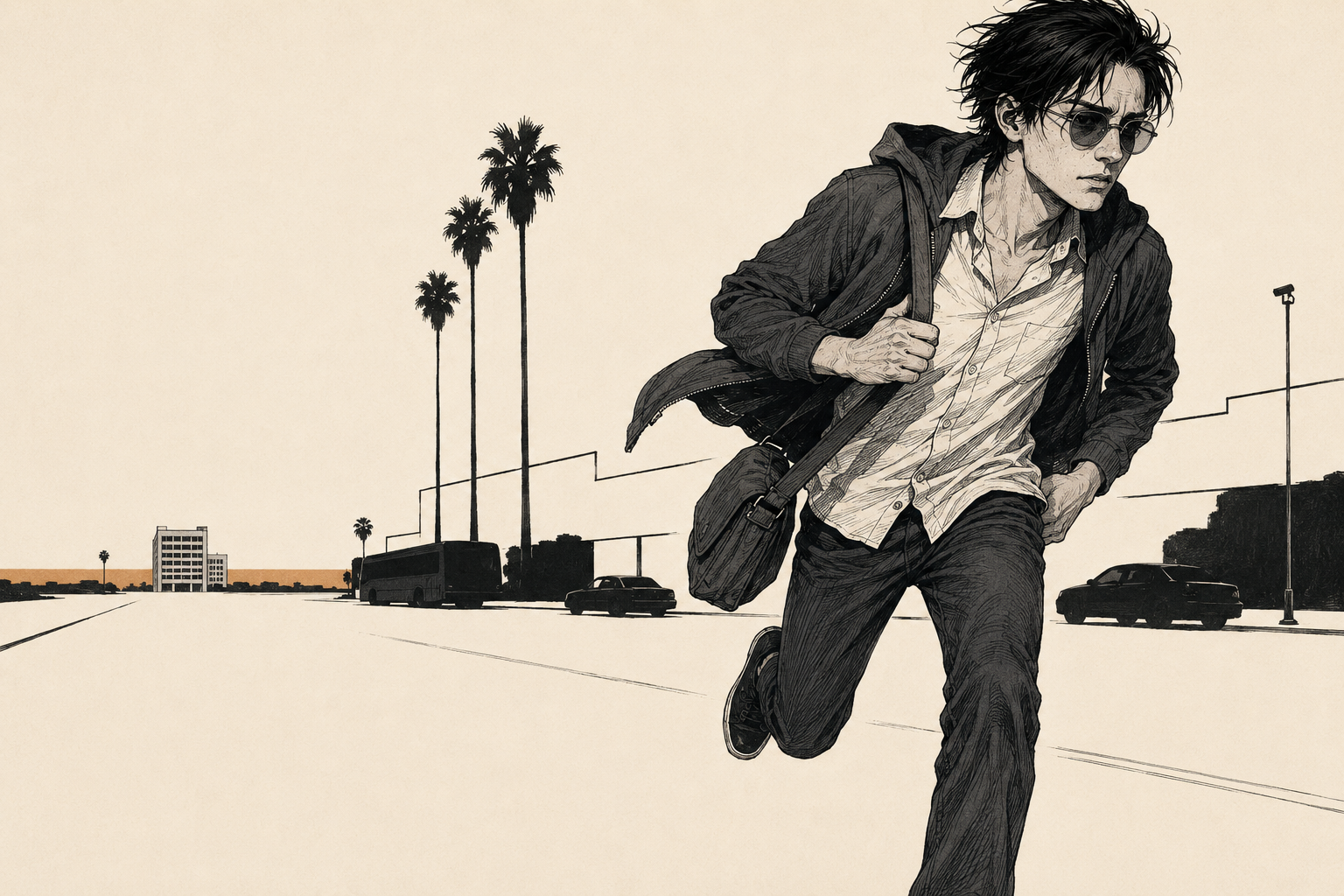
Lincoln Boulevard, Santa Monica · twelve minutes late
Three blocks out I could see the building. Four stories of glass and poured concrete, the kind of architecture that tries very hard to communicate serious professionals work here without spending enough money to actually be convincing about it. The Spaces logo was on the door. Co-location workspace. The fact that Sigil Systems, a company that by all available public information employed somewhere north of eight hundred people and held active infrastructure contracts with the Pacific Compact Security Commission, was conducting hiring interviews out of a co-location workspace was, I had decided, not worth thinking too hard about right then.
I had enough problems.
I slowed to something that could technically be called a jog in the last half-block and stopped completely at the door, one hand on the glass, catching my breath. The city noise dropped as I pushed inside, foot traffic and electric bus hum and the distant processed voice of some compact’s public address system reminding pedestrians on Santa Monica that their biometric transit pass needed renewal, all of it replaced by the curated ambient calm of a space designed to make you feel like productivity is possible.
It was very pleasant. I resented it immediately.
A note, while I’m catching my breath.
I know what you’re thinking. You’re thinking: here is a person who showed up twelve minutes late and is sweating through a hoodie to a job interview at one of the most influential cybersecurity firms operating in the western hemisphere, and you want to know how someone gets to this point. What sequence of decisions, what accumulation of choices and non-choices, produces a twenty-four-year-old with a circuit tattoo and a one-page resume standing in the lobby of a co-location office space on Arizona Avenue trying to look like he meant to arrive this way.
I will tell you. I have time. The interview is already ruined.
But I’m getting ahead of myself.
The attendant at the front desk was maybe twenty-two, with the practiced warmth of a job that requires her to treat everyone who walks through that door like they belong there regardless of evidence to the contrary. She looked up from her terminal and produced the smile.
“Good afternoon. How can I help you?”
“Hi.” I unzipped my hoodie while I talked, because the button-down underneath was at least nominally professional and the hoodie was currently doing me no favors. “I’m Cade Voss. I’m here to see Jeff Forcythe.”
Something flickered behind the smile when she checked her notes. Just a flicker, she recovered fast, she was good at this, but I caught it. Twelve minutes late registered on a front desk attendant the same way it registers on everyone: as information about the kind of person you are.
“Of course. He’s been expecting you.” She gestured toward the staircase on the far side of the atrium. “Second floor, fourth space on the right.”
“Thank you.”
I took the stairs faster than necessary. Above the cafe, the second floor opened into a long row of semi-private workspace booths, divided by shoulder-height partitions. I scanned right and found him at the fourth, blue blazer over a pinstripe shirt, neatly trimmed beard, the posture of a man who was typing on a laptop but was mostly performing the act of typing on a laptop while he waited for the person who was supposed to be there twelve minutes ago.
He looked up. He smiled. He glanced at the clock mounted on the far wall before the smile finished forming.
I saw the glance. There was no universe in which I was not going to see the glance.
“Cade Voss?” He stood, extending a hand.
“That’s me.” I shook it. His grip was the grip of a man who has been coached on handshakes. “I’m sorry about the time.”
“Jeff Forcythe.” He waved it off, gestured to the seat across from him. “Don’t worry about it. Sit down.”
I sat. The bench was harder than it looked. I unzipped my hoodie the rest of the way, which revealed approximately nothing impressive, a pale blue button-down that ran eleven dollars and had been ironed once, possibly by someone else, possibly years ago. Jeff Forcythe studied the shirt the way a doctor reads an x-ray he already knows the diagnosis of. Then he took in my face, briefly and completely, and I had the sensation of being read rather than seen.
“I appreciate you coming in,” he said, opening a thin binder. Inside, my resume sat on top of a stack of others. It was, I noted with grim clarity, the thinnest one in the pile by a meaningful margin. “Our actual offices are in renovation, longer than planned, as these things go.” The explanation arrived without friction, the cadence of something said enough times that the saying of it had become unconscious. “Co-location spaces are better for first conversations anyway. Less institutional. Easier to be direct.” He leaned forward with his hands folded. “Easier to have an honest conversation.”
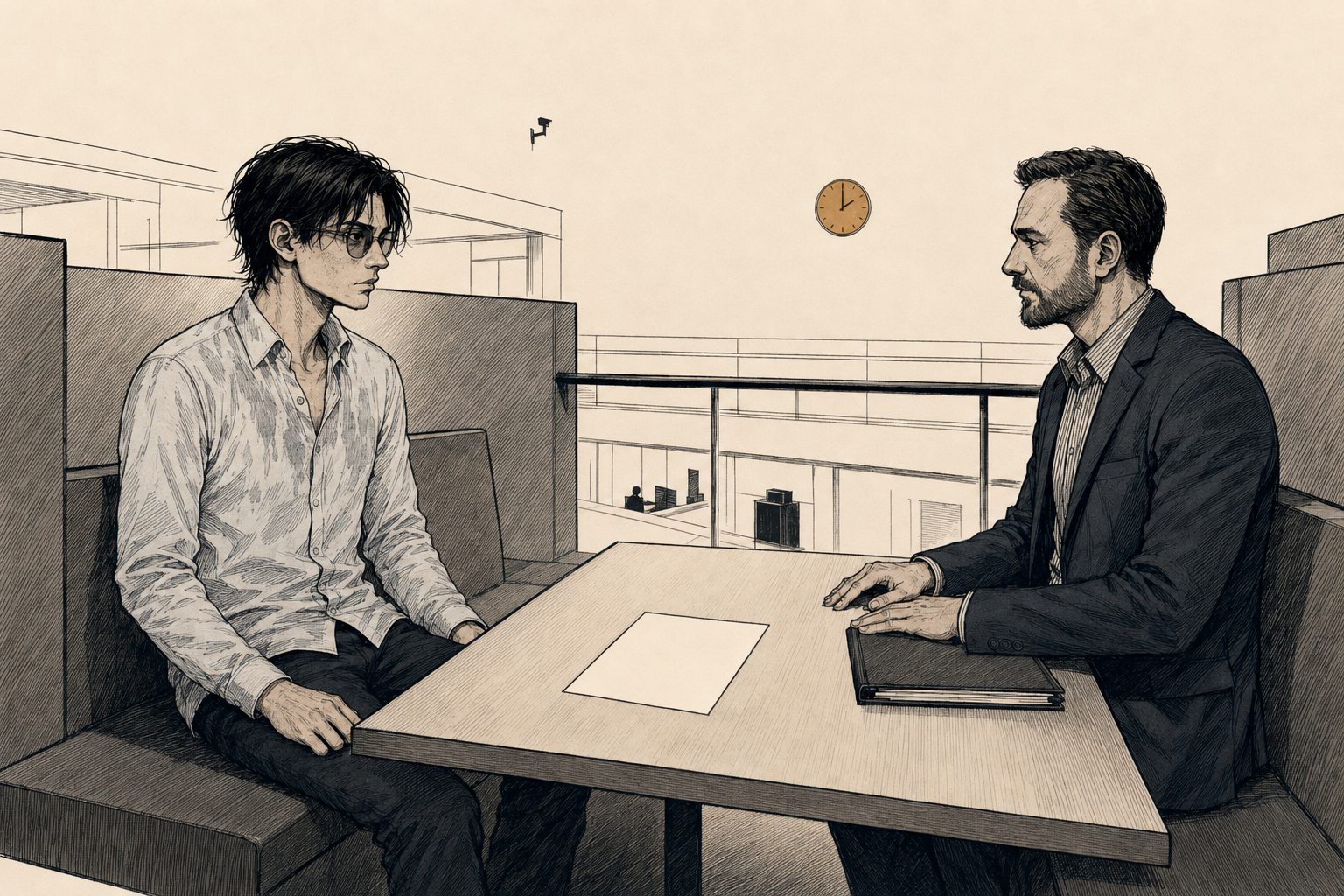
Spaces, Arizona Avenue · the ninth interview in fourteen months
Honest, I thought. Okay.
“The team you’ve applied to, security engineering, has some interesting positions open right now. Walk me through your background. Your resume is light on specifics.”
“Most of my work has been freelance. Bug bounty programs, primarily. Some contracted development.”
“Bug bounty.” He nodded slowly, neither impressed nor dismissive, just filing it as informational. “Volume? Severity range?”
This I could answer. “Thirty-one documented CVEs in fourteen months. Severity range four through nine-point-eight. Six critical. The critical findings were in enterprise network management software, authentication bypass, two pre-auth remote code execution chains, one that allowed pivoting from a guest network segment to production infrastructure without credentials.”
He wrote something. “Which vendors?”
I named three. One of them held Compact infrastructure contracts I had verified before I walked in, because I verify things. His pen paused for half a second.
“And the development work?”
Here it is. The question I could actually answer in full. I felt something loosen in my chest.
“Offensive tooling, primarily. I built a fuzzing engine, genetic algorithm-based, not random. It learns which input patterns the target process handles badly and generates variants of those rather than mutating blindly. I ran it against application binaries, kernel drivers, network protocol stacks. Seventeen of the CVEs came out of it.”
“Pre-auth remote code execution.” He was reading something in the binder, or appearing to. “Do you have experience moving laterally once you have a foothold? Or is your work primarily initial access?”
“Both. I build full chains when the target is interesting. Initial access, privilege escalation, lateral movement, persistence, exfiltration modeling. Bug bounty programs usually want the proof of concept at the entry point and nothing further, but I build the full chain privately to understand what the vulnerability actually enables.”
“Why privately?”
“Because the dangerous part of a vulnerability isn’t always where it is. It’s what you can reach from there.”
He studied me a moment. He seemed to decide, without changing his expression, that I meant it.
“Any experience with mobile platforms?” He said it as a natural follow-on, which it wasn’t. “Android specifically. Or network stack work on constrained hardware.”
I filed the pivot without showing that I was filing it. “Some. The Android security model is interesting at the binder layer, the IPC mechanism has had privilege separation issues that kernel patches keep chasing. I’ve done work in the media parsing stack, userspace and below. Some network driver analysis.” I held the rest back a second. “Nothing submitted through formal channels.”
“Why not?”
“Remediation complexity. The disclosure window creates exposure before a viable patch is ready.” The true reason. Also not the complete one.
He made a note. Longer than the previous ones.
“Your education,” he said. “Walk me through that.”
I knew this was coming. “I was at MIT for two years. Electrical engineering and computer science.”
“Was?”
“I left. Before finishing the program.”
“Voluntarily?”
“Yes.”
“Why?”
The honest answer was somewhere between too long and too complicated and not appropriate for that room. The short answer made me sound like exactly what everyone has assumed since then, someone who couldn’t handle it, who was now sitting in co-location office spaces with a thin resume explaining himself to people with hiring budgets. “It wasn’t the right environment for the work I wanted to do,” I said, which was true and incomplete in equal measure.
Forcythe was quiet for a moment. He tilted his head slightly, weighing whether an answer told him what the answer didn’t say. “The work you’re doing now, the bug bounty programs, the independent tooling. Is all of it disclosed? Through official channels?”
The pause before I answered was half a second long. “My bounty work is fully disclosed through program channels. Vendor notification, CVE registration, coordinated disclosure timelines.”
“And work that falls outside formal bounty programs?”
I held his gaze. He held mine. The question could be asked in exactly this way, conversationally, without accusation, as if it’s a standard line item on a standard form, by someone who already knows the answer and wants to see how you handle it, not what you say.
“I do work that falls outside formal program structures,” I said. “Findings get reported through appropriate channels.” I took a breath. “Eventually.”
He wrote something. I couldn’t read it from that angle.
Somewhere in the last ten minutes the questions changed in kind without the change being announced. The early questions were about capability, what can you do, how do you think, show me the work. These later questions were something else. He was still holding my resume, but he wasn’t reading it anymore. He was reading me.
I had the vocabulary for this from the other direction. Profiling. Building a picture not from what someone says but from the negative space: what they omit, what they reach for when the clean answer isn’t available, how they carry the parts of themselves they haven’t decided to show. I had done it to systems. To networks. To the gap between what a service advertised and what it was actually running underneath.
I couldn’t name what he was doing with it.
“So.” He closed the binder. The clasp was very small in the ambient noise of the atrium. “The honest part of the conversation.”
Not another one, I thought. Please.
“You’re technically more capable than most of what walks through here.” He said this without warmth, a fact, not a compliment. “The CVE volume, the chain work, the reasoning about what a vulnerability enables rather than just what it is. That’s not something we see often.” He let it sit a moment before he went on. “The problem is that none of that matters to a hiring committee when what they’re looking at is a one-page resume with no verifiable employment history, no completed academic credentials, and work they can’t reference-check because it exists under terms that were never fully documented.”
I wanted to tell him the work existed. The CVEs existed. Three of those vendors were in his current client portfolio, I’d checked before I walked in, and my findings were in their security records, a different name, but still mine. I wanted to tell him what I actually was, which was not what that resume said I was, and watch his expression change.
I didn’t. I sat there.
“What you’re capable of and what our process can verify are different things.” He said it with the even delivery of a person who has said a version of this many times and has learned to mean it less each time. “And it isn’t at my discretion. The verification requirements are contractual, clients with their own audit obligations, all the way up the chain.” He opened my resume on the table between us without looking at it. “The process isn’t designed for people who exist outside the structures it recognizes. I understand how someone doing the work you’re describing ends up there.” A pause. “That doesn’t change what the structures require.”
He slid my resume across the table.
“Sean.” He said it like something he wanted to see land.
I blinked. “It’s Cade.”
A half-second. The recalibration, very small. “Cade. Right.” He set his hands flat on the table. “Have a good day, Mr. Voss.”
I took the resume. I stood. I walked toward the staircase without looking at him and I made it almost to the top step before I remembered the entire atrium was open-plan and the attendant at the front desk had had nothing to do for the last twelve minutes except listen to every word of that exchange.
She was very interested in her screen when I walked past.
I handed her my resume. “Can you shred this for me, please?”
She took it without comment and fed it into the machine beside her desk. The sound it made was not satisfying.
“Have a good day, sir,” she said.
“You too.”
Outside, the sun. My lenses went dark immediately. I stood on the sidewalk and looked up at nothing and let out a breath that had been building since I walked in there, a long slow deflation, the sound a person makes when they’ve been holding something up for a while and have finally set it down.
Twelve minutes, I thought. That has to be a record.
I want you to understand something about that room.
It wasn’t the first one. It was the ninth, if you’re counting, and I am absolutely counting. Nine interviews in fourteen months, and every single one has gone some variation of that same way, the resume, the thin look, the well-meaning lecture about certifications and team experience and professional presentation. The advice is always the same. Get certified. Go back to school. Build a record.
What none of them know, and what I am professionally prohibited from telling them, is that I have a record. It just doesn’t exist anywhere they’re allowed to see it.
The name attached to that record is not Cade Voss.
But we’ll get to that.
I checked my watch. The notification had been sitting there for the last forty minutes, which was how long I’d been consciously ignoring it.
[#] Cryptanalysis, Lecture 14 of 22 @ 2:00pm
WAIT’s campus was a twenty-minute walk from there through the Palisades, which meant I was, by the generous application of optimism, five minutes late to a class I had no interest in attending in the first place. I stood on the sidewalk doing the calculation, lecture hall versus the subway home, academic obligation versus the very reasonable desire to go lie face-down on my bed until tomorrow, and the calculation produced the same answer it always does, which was that I would feel equally terrible either way and at least one of these options didn’t add an F to my transcript.
I rolled my sleeves back to the elbow. The circuit tattoo caught the light. I pulled the hoodie zip to my sternum and started walking.
Professor Alan Dietrich had been teaching cryptography at WAIT for eleven years and he looked like he had hated every single day of it. He was one of those academics whose physical appearance had become entirely continuous with his professional disappointment, the permanent furrow, the slightly yellow tinge of the office-dwelling complexion, his suits fitting like they’d been purchased for a slightly larger, more optimistic version of himself. I’d have put him somewhere in his sixties. He treated every student under thirty as a personal affront.
I had known this about him since the second week of the semester, which was why I tried, at the beginning of the third week, to simply not attend anymore.
That did not work out.
“Good afternoon,” he said, not looking up from his desk as I pushed through the lecture hall door. A few heads turned. Most of them went back to their business when they saw it was me, the guy who sits in the back row and types on his laptop for the entire class is not especially interesting. The hall was filling up. I had maybe five minutes before the lecture started. “You’re late, Mr. Voss.”
“I know.” I approached his desk. I’d already got the assignment out of my bag, a mid-term project, fifteen pages stapled, a USB drive clipped to the cover page. Three weeks of work. Finished a week ago, because I finished everything a week ago, because the material was not difficult and I’d been doing cryptanalysis as a hobby since I was sixteen. “I wanted to submit the mid-term.”
He looked at it. Then at me. “The mid-term isn’t due for two weeks.”
“I know. I thought if I turned it in early I could—”
“Attend fewer lectures?”
He said it like something you say to a person you’ve already decided is beyond helping. “The material covered in lectures fourteen through twenty-two,” I told him, because I had looked this up, “is all material I already have working knowledge of. RSA, elliptic curve, zero-knowledge proofs, lattice-based constructions. I thought if I demonstrated that through the project—”
“Put it away.”
I stopped.
“Mr. Voss.” He leaned back in his chair and looked at me over the rim of his glasses with the expression of a man who has had this conversation many times and has stopped finding it interesting. “I have been standing at the front of this room talking to people who think exactly what you think for eleven years. That they already know the important parts. That the lecture is a formality. That their time is more valuable than the education they’re paying for.” He pointed at me, then at the seats. “Sit down. Submit the project on the due date with everyone else. And if I don’t see you in this room for every remaining lecture this semester, I’ll have the prior submissions pulled from the record and you’ll retake the course.”
“You can’t—”
“Watch me.” He went back to his papers. The conversation was over. He had decided the conversation was over, and there is a particular kind of institutional authority that doesn’t argue, it simply continues existing in your way until you stop arguing with it.
I stood there for exactly three more seconds. Then I put the assignment back in my bag and walked up the steps to the back row.
The students near me found other things to look at. A few of them wore a sympathetic look, having had their own versions of that exchange. Most of them just looked relieved it wasn’t them.
I set my bag down. I pulled out my laptop. I opened it.
Fifteen pages, I thought, staring at the skull and crossbones wallpaper while the machine woke up. Three weeks of work. Perfect marks on every prior submission. And the man just told me to sit down like I’m a discipline problem at a middle school.
The injustice of it sat in my chest like a coal. Hot, dense, requiring somewhere to go.
I looked down at the open laptop. Then up at Professor Dietrich, who had opened his own machine at the lecture podium and was preparing his slides with the unhurried authority of a man who knows the class will not start without him.
Then back down at my laptop.
Then at the USB network adapter at the bottom of my bag, with the little antenna folded against its side.
I know, I thought. I know. But hear me out.
Here is the thing about asymmetric key cryptography that most people miss when they’re learning it.
The math works. RSA works. Elliptic curve works. The theoretical framework for public-key infrastructure is genuinely elegant, two keys, one to encrypt, one to decrypt, a lock that only the intended recipient can open. It is a beautiful idea. The professor is not wrong to teach it.
What the professor is wrong about, what the textbook is wrong about, what every certification course I’ve ever looked at is wrong about, is the premise that the math is the problem.
The math is never the problem.
People are the problem. Specifically, the fact that you can build a cryptographically perfect system and then hand the keys to someone who will ignore every warning their browser produces because warnings are annoying and they just want to check their email. You can make the most secure lock in the world and someone will leave the door open.
What I’m about to do is not sophisticated. It is embarrassingly simple. That’s the point.
The network card went into the USB port on the side of my laptop. The antenna unfolded. I opened a terminal, themed, because I’ve always had opinions about terminal aesthetics, black background and a green prompt because some things are traditional for a reason, and pulled up Bettercap.
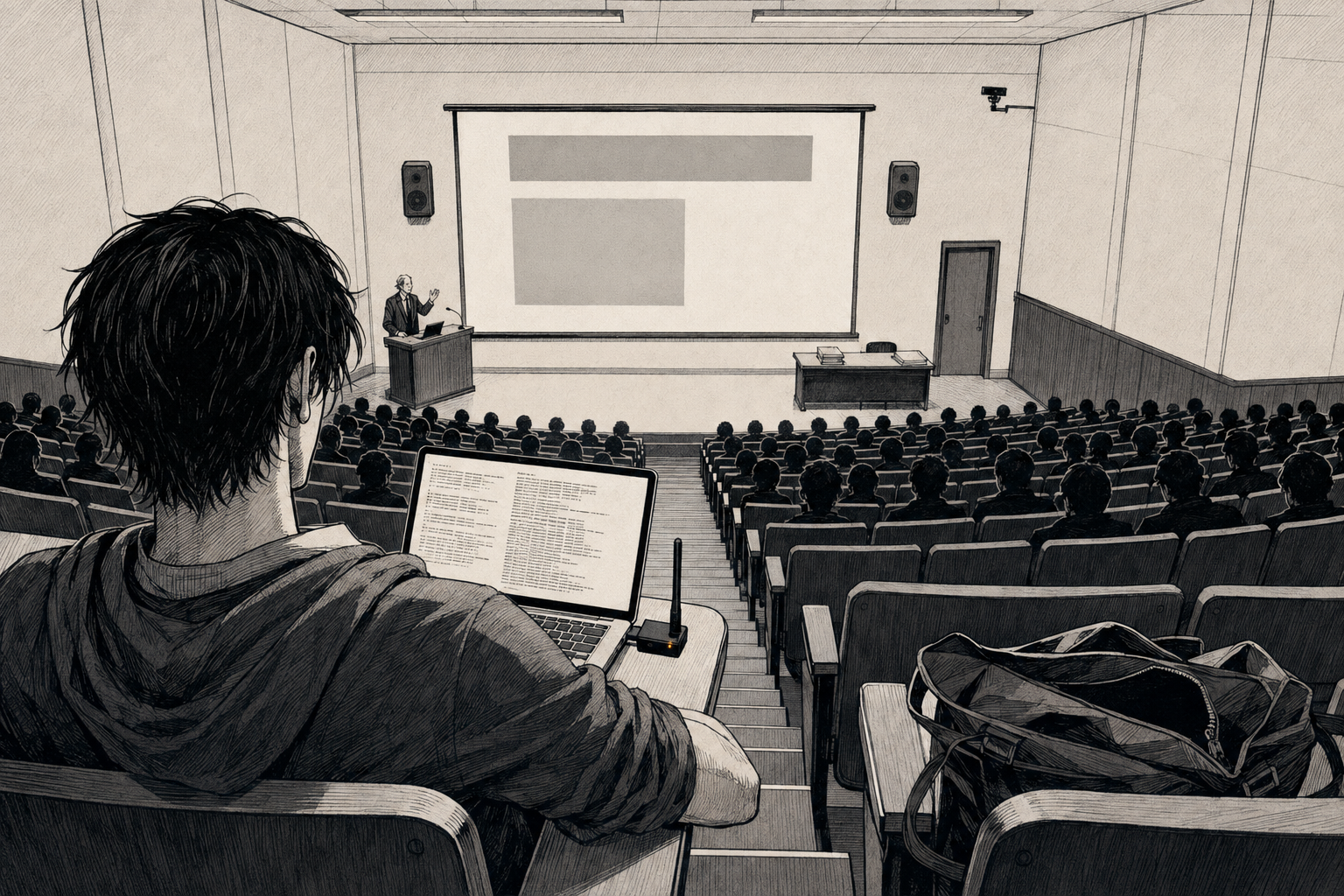
Dietrich's cryptography lecture · the antenna comes out
The outline of it, since you’re here: I lie to the network about who I am. When two machines want to talk they find each other by asking the air (whoever has this address, where are you?) and they believe whatever answers back, because nobody ever put a lock on the mailbox. So I answer twice. I tell Dietrich’s laptop I’m the router; I tell the router I’m his laptop. From then on everything he sends passes through my machine on the way out, and everything the world sends him passes through it on the way back. He has no idea. I’m the clerk who reads the mail before passing it along.
HTTPS is supposed to make the reading pointless. A clerk in the middle should see nothing but ciphertext, but only if his browser insists on it, and Bettercap’s stripping module makes sure it doesn’t. It downgrades him to plain HTTP and serves him the unlocked version of the page. The padlock in the corner goes gray. Or it should. He’d have to look at it to notice.
He won’t look at it. Nobody looks at it. That’s the whole thing.
The WAIT faculty network announced itself immediately. Eleven endpoints. I watched them populate in the scan output, MAC addresses resolving to manufacturer IDs, device types assembling themselves from the handshake traffic like a portrait coming into focus.
One of them was a Dell machine. On the faculty SSID. At the IP address that corresponded to the podium network port.
Hello, professor.
10.2.2.0/24 > 10.2.2.203 » set https.proxy.sslstrip true
10.2.2.0/24 > 10.2.2.203 » https.proxy on
10.2.2.0/24 > 10.2.2.203 » net.sniff on
10.2.2.0/24 > 10.2.2.203 » [endpoint.new] endpoint 10.2.2.1   detected as D9:32:90:EC:09:3C  [router]
10.2.2.0/24 > 10.2.2.203 » [endpoint.new] endpoint 10.2.2.102 detected as D9:32:90:BE:44:20
10.2.2.0/24 > 10.2.2.203 » [endpoint.new] endpoint 10.2.2.214 detected as C4:CD:91:34:E7:15
10.2.2.0/24 > 10.2.2.203 » [endpoint.new] endpoint 10.2.2.31  detected as 28:E7:A9:BB:8E:21
10.2.2.0/24 > 10.2.2.203 » [endpoint.new] endpoint 10.2.2.209 detected as 00:14:22:13:AE:58  [DELL INC.]
Up at the podium, Dietrich had navigated to the university’s faculty media portal to pull up his slides. The lecture hall had filled around me without my noticing, a hundred and sixty, maybe a hundred and eighty students settling into their seats, pulling out tablets and notebooks, doing the pre-class ritual of getting comfortable for something they’d already decided they didn’t want to be at. The sound of the hall filling had a texture of its own, the scrape and thud of fold-down seats, the zip and rustle of bags being opened, the low-frequency murmur of a hundred separate conversations that aren’t quite loud enough to make out individually, the collective sound of a large group of people performing the ritual of readiness.
I ran the OID lookup on the Dell endpoint’s MAC address. Confirmed faculty machine. I set the ARP spoofing targets, the router and the professor’s device, and watched the traffic start routing through me.
10.2.2.0/24 > 10.2.2.203 » set arp.spoof.targets 10.2.2.1,10.2.2.209
10.2.2.0/24 > 10.2.2.203 » arp.spoof on
10.2.2.0/24 > 10.2.2.203 » [net.sniff.mdns] mdns 10.2.2.209: PTR query for _faculty._wmit._tcp.local
10.2.2.0/24 > 10.2.2.203 » [net.sniff.mdns] mdns 10.2.2.209: PTR query for _share._faculty._wmit._tcp.local
10.2.2.0/24 > 10.2.2.203 » [sys.log] [inf] https.proxy creating spoofed certificate for *.waitla.edu:443
Now.
The MDNS queries from his machine were already telling me things, service discovery traffic, the automatic background chatter of a device trying to find what’s around it on the network. His machine was looking for faculty file shares and media services. It had been sitting on this network for years, pinging these same services every few minutes out of habit, the digital equivalent of muscle memory. I watched the queries scroll by and felt the specific pleasure of a system revealing itself to you without being asked.
At the podium, Dietrich clicked through to the login page for the media portal. He had seen the SSL warning on this page so many times that it had become invisible to him. It had been invisible to him since approximately the first week he started using the portal, which based on WAIT’s media system version history was somewhere around 2029. Six years of clicking through the same warning. Six years of the browser saying something is wrong here and six years of a tenured academic saying yes yes I know and clicking past it.
He typed his credentials.
They appeared in my terminal before he finished typing them.
[22:34:49] [net.sniff.https] POST http://media.waitla.edu/login.aspx (text/plain)

HTTP/1.1 POST http://media.waitla.edu/login.aspx
Host: media.waitla.edu
User-Agent: Mozilla/5.0 (Windows NT 10.0; Win64; x64) AppleWebKit/537.36 (KHTML, like Gecko) Chrome/126.0.0.0 Safari/537.36 Edg/126.0.0.0
Content-Type: application/x-www-form-urlencoded
Cookie: JSESSIONID=9C4F119A60F6C07B9413359147046110

fac_username=ADietrich&fac_password=Unix1972&login=Submit
I studied the password.
Unix1972.
The year Unix was created. As a password. On a machine used by a cryptography professor.
I sat with it for a second, really sat with it, a joke too perfect to laugh at. The man standing at the front of that hall had spent the last eleven years explaining to other people why their information security practices will get them violated, and his password was a nostalgia trip to 1972. There was a doctoral thesis in it. There were several.
I don’t write the thesis. I write the next command.
I opened a second terminal window and began the next step, not because I needed anything from his machine, not because there was anything on a cryptography professor’s faculty portal that I wanted or could use. I did it because the alternative was sitting in that chair for the next ninety minutes listening to a man explain RSA key generation to people who are mostly on their phones, and if I was going to be there anyway I might as well be doing something that required my actual attention.
Up at the front of the hall, Dietrich cleared his throat into the microphone.
“Good afternoon, everyone. Today we’re going to be covering asymmetric key exchange.” His voice filled the hall with the tinny resonance of a PA system that was state of the art in 2019. “This, like every facet of cryptography, begins and ends with keys, which as you know, facilitate the locking and unlocking of encrypted data…”
His voice faded into the background. My eyes were on the terminal.
You want to know the funny part?
He’s not wrong about any of it. The math is exactly as he describes it. The framework is exactly as elegant as he says it is.
He’s just teaching it to the wrong part of the problem.
The remote session opened without incident. I was in.
$ crackmapexec smb 10.2.2.209 -u ADietrich -p Unix1972
SMB   10.2.2.209  445  WAITLA-FAC-09  [*] Windows 10 x64 (name:WAITLA-FAC-09)
SMB   10.2.2.209  445  WAITLA-FAC-09  [+] WAITLA\ADietrich:Unix1972 (Pwn3d!)
Pwn3d. The tool’s own editorial comment, right there in the output. Even the software found it slightly too easy to be satisfying.
I leaned back in my chair and looked up at the ceiling for a moment, the loose posture of a person who has just done something they knew they were going to do from the moment they sat down, and is now briefly acknowledging the gap between who they know they are and who they’d like to be.
The gap had been there a while. I’d made my peace with it.
Around me, a hundred and sixty people were learning about cryptographic key exchange from a man whose password was the year a sixty-year-old operating system was created. The irony was, as irony tends to be, completely wasted on the room.
There was nothing there I wanted. There was never going to be. Without saving anything, no credentials dumped to a file, no screenshots, no trophy, I cleared the session and let the whole intrusion evaporate back into the void of cleared memory, as if it had never resolved at all.
$ sudo shutdown now
The screen collapsed to black. I closed the laptop.
I folded my hands over my mouth and made myself look at it straight, because if I was going to be honest with myself about anything that day it should be this. Dietrich didn’t do anything to me. He was a tired man at the end of a career he stopped enjoying, and he’d told a chronically late student to come to his lectures, which was the most reasonable thing anyone had asked of me all day. He wasn’t the nine interviews. He wasn’t the record with the wrong name on it. He wasn’t the structure that had no place for what I was. He was just the nearest thing with a lock on it, and I needed something to open.
I knew all of that before I plugged the adapter in. I did it anyway.
i++, I thought. One more iteration.
My watch buzzed. A different notification this time, not a class reminder. A message, through an encrypted channel I checked maybe twice a day, from a contact I’d had for three years and met exactly never.
Two words.
Call me.
I read the notification. Then I pulled the network adapter from the USB port and folded the antenna back against its body, and it went into my bag.
Mr. Slash did not say call me unless something had changed.
I spent the remaining eighty-three minutes of the lecture not hearing a single word of it.