Act 0 · Null Witness
Chapter 0.0-alpha
Prologue
The Room Where Nothing Goes Anywhere
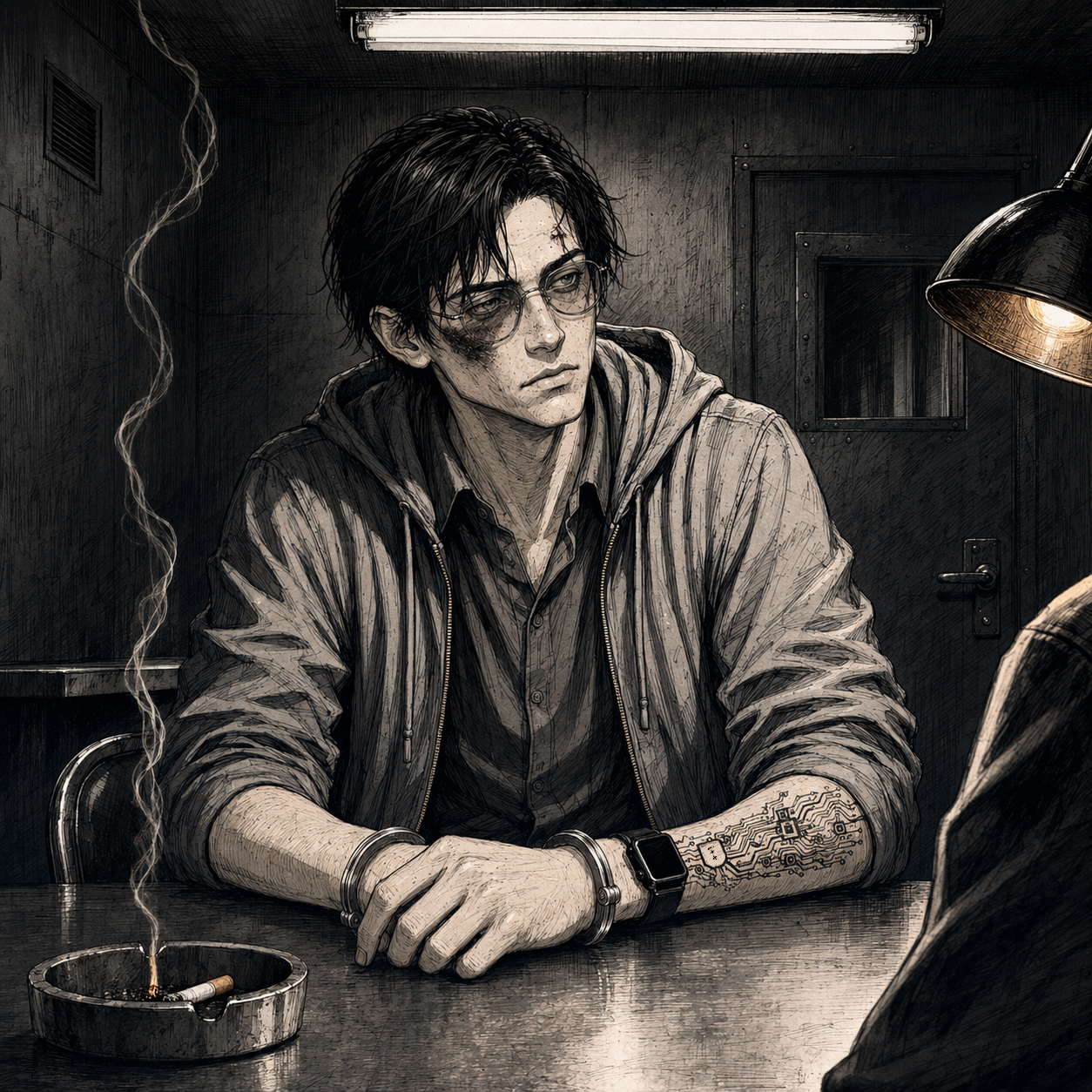
The smoke from his cigarette goes up through the dead air and curls around the fluorescent light like it’s trying to find a way out. It can’t. Nothing in this room goes anywhere.
The light is doing the bare minimum: a pale wash across the metal table, just enough to make everything look slightly worse than it already is. Or maybe exactly as bad. Hard to tell in here. The room has the quality of a place designed to make you stop trusting your own perceptions, which is either deliberate or a happy accident for whoever built it. I’ve already decided it’s deliberate.
The man across from me sets his cigarette in the ashtray like a man with nowhere else to be. He hasn’t rushed a single movement since they brought me in. That kind of stillness isn’t relaxation. It’s a posture, practiced and maintained, and what it says is that he has all the time in the world and would like me to feel the weight of that fact. I feel it. I don’t show that I feel it.
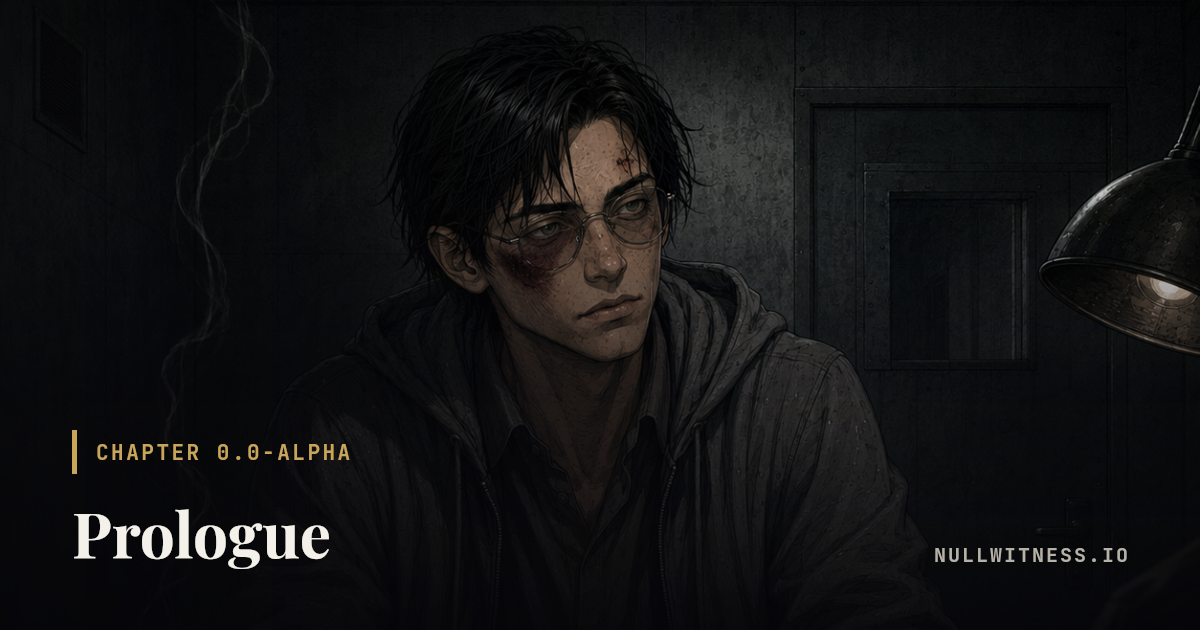
I adjust my wrists against the table edge, looking for some minor relief from the handcuffs, and find none. The metal has been on too long and too tight. My left arm catches the edge of the light as I move, the circuit tattoo visible beneath the cuff, interrupted by bruising. My smart watch is somehow still on. Small miracle, given everything that preceded this room.
My right cheek throbs with the specific deep ache of a bruise laid over bone. The split above my left eyebrow has stopped bleeding but not stopped hurting. The bruise under my left eye is four days older than both of those, yellow-green at the edges, a regrettable contribution by yet another person who objected to my existence in the past few weeks, healing on a schedule that doesn’t account for subsequent events. My hoodie is damp: from rain, from running, from whatever combination of the last several hours produced the version of me currently sitting here under a federal building’s worth of fluorescent misery.
The man across from me reaches over and adjusts the lamp. Just slightly. Just enough to make the light fall a little harder on my face. The gesture is so practiced it barely reads as deliberate. It is completely deliberate.
Federal facility · Before everything
He takes a long drag and exhales across the table before he speaks.
“I’m still waiting on that phone call,” I say. I lift my arms and set my handcuffed wrists on the table surface, buying myself a degree of comfort that amounts to very little.
He studies me, unhurried. Then he leans forward and stubs the cigarette out in the ashtray with the finality of a man closing a file.
“We’ll get to that in a minute,” he says.
“How about my lawyer then?”
He covers his mouth with one hand, elbow on the table, and takes his time considering this. “As far as we’re aware,” he says, “you don’t have one.”
The corner of my mouth moves, then thinks better of it. I look at the table. “But since you’re here,” he continues, “maybe we can talk a little while we wait for someone to find you one.”
“What’s there to talk about?”
He doesn’t answer immediately. He sits back. He laces his hands together on the table. He learned somewhere that whoever fills a silence first is the one losing, and he is in no danger of forgetting it. He lets several seconds pass. Then:
“Have you ever heard of Kevin Mitnick?”
I nod. Of course I have. Every person with any serious relationship to this craft and any respect for its history knows the Mitnick story. He knows I know. He’s not asking for information.
“In the nineties, Mitnick was the most wanted computer criminal in the United States. FBI spent years hunting him.” He has told versions of this before, in other rooms, to other people, and he believes in its utility every time. The delivery is measured to match. “He’d been hacking phone networks since he was a teenager. By the time they caught him he’d broken into dozens of companies: DEC, Motorola, Nokia, Fujitsu. Stole software, source code, whatever he could get his hands on. Not for money, particularly. Just because he could. Because the systems were there and the systems had edges and he wanted to find where the edges were.”
He pauses. Lets that sit between us.
“When they finally caught him, a federal prosecutor stood up in court and told the judge that Mitnick was so dangerous, so uniquely capable, that if he was given access to a telephone, any telephone, he could single-handedly initiate a nuclear strike.” A slight shift at the corner of his mouth, just enough to acknowledge the absurdity without quite smiling at it. “He could start a nuclear war by whistling into a pay phone. That was the argument. And the judge believed it, or decided to act like he did, and ordered Mitnick held in solitary for the duration of his pretrial detention. No phone. No computer. Limited contact with legal counsel.” He waits, watching it reach me. “Eight months.”
I say nothing. I hold still and listen and decide how much of myself to show.
“Now,” he says, “it was all complete nonsense, of course. Mitnick was good. Genuinely, extraordinarily good. But no person on earth was going to start a nuclear war from a pay phone, and everyone in that courtroom knew it. The prosecutor knew it. The judge almost certainly knew it.” He unfolds his hands and leans forward, and for the first time something moves in his eyes that isn’t professional patience. “And yet it happened. The appeals went nowhere. The public made noise, civil liberties organizations made noise, and none of it mattered. Not even slightly. They left him there.” He lets that land. “Why do you think that is?”
I raise an eyebrow and let it sit there.
“No?” He tilts his head. The patience returns, smooth and total, a door closing without a sound. “You were so opinionated when we brought you in.”
He opens one palm on the table between us, an invitation and at the same time a demonstration that he has nothing to prove, and waits.
Nothing comes.
Four seconds. Then his hand moves.
The lamp comes off the table in a single committed arc and connects with the side of my face with the force of a decision made and not lingered over. The bulb shatters. The chair goes out from under me. I hit the floor in the dark with the full weight of myself and my cuffed hands are useless and the sound that follows is a compound thing: glass across linoleum, the chair’s legs shrieking, my breath coming in jagged and sharp.
And then from directly above me, stripped of every layer of professional patience, carrying the worn authority of long practice in rooms like this and the conclusions it produces about what they require:
“Because terrorists don’t have rights!”
So.
I’m going to guess that wasn’t what you were expecting.
Don’t feel bad about it. I wasn’t expecting it either, and I was the one in the chair.
My name is Cade Voss. I’m twenty-four years old, and a little over a month ago I was the least remarkable person in any room I walked into. Student at a school you’ve already pulled the records on, in a city held together with municipal debt and optimism. I wrote code for money, slept too little, kept to myself. By every measurable standard, not someone worth the paperwork you’re currently sitting across from me with.
And yet.
I’m not going to convince you I’m innocent. I doubt I could. What I have is the order things happened in, and I’m only going to lay it out once.
The world we’re both sitting in didn’t come from nowhere: cameras on the corners, a network that can recite a stranger’s last seventy-two hours before you’ve said good morning. You know that better than most; you were on the job before the cameras went up. Maybe you think the Glass was worth what it cost. A lot of people do. I’ve seen 2030 from closer than most people my age, and it didn’t bring me around. That’s not the story.
The story is this: a little over a month ago I was grinding through bug bounties and about to make a decision that looked, from every angle I could see at the time, like exactly the kind of break I’d been waiting for.
It was not that.
It involved a company called Sigil Systems, which I’m fairly confident you already know something about, and a piece of software called NIGHTGLASS, which I suspect you know considerably more about than has been shared with anyone in this building.
And it involved people, a few of them, the kind you think you know and don’t. I’m going to tell you about them honestly and in order. The honest version is damning enough without editorializing.
So. A little over a month ago. Los Angeles. I was late for an interview.
Let’s start there.