The Glass Archive · Short fiction
Nominal
Five people. One week. What the Glass network saw — and what it didn't.
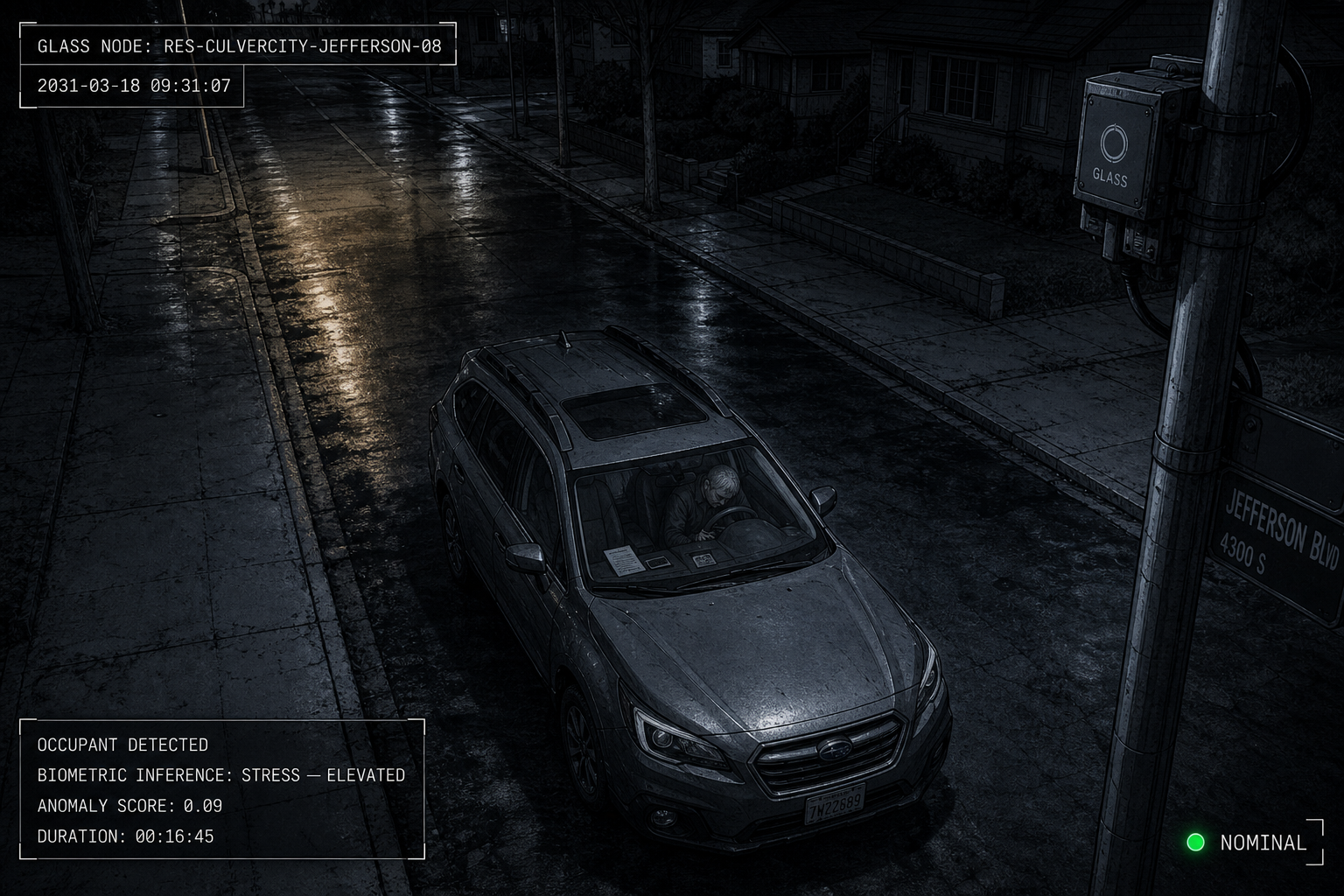
Glass node RES-CULVERCITY-JEFFERSON-08 · 2031-03-18 · Flag: nominal
I. The Architecture of Consent
Harlan Rowe, Senior Special Agent, Federal Bureau of Investigation, Cyber Division. Twenty-five years. I’ve sat across from a lot of people in a lot of rooms. I’ve reviewed a lot of footage. Read a lot of files. What I’m about to show you isn’t a case. It’s a week. Seven days of Glass coverage from a single metropolitan node cluster in the greater Los Angeles area, pulled and reviewed as part of a routine infrastructure audit I wasn’t supposed to care about.
I care about it now. I am reviewing this footage in 2035. The week I am showing you is March of 2031.
Let me tell you what we built, before I show you what it missed.
Nobody voted for the Glass. That’s the first thing I want to be clear about, because the version of this story that gets told in policy briefings implies a decision was made somewhere. A committee convened. A threshold was crossed. Some democratic instrument was engaged and the outcome was surveillance.
That’s not what happened.
What happened was slower and less dramatic and considerably harder to oppose, which is why nobody did.
In 2019, forty-four million American households had a Ring doorbell. Not because anyone told them to. Because porch pirates were real, because the ads were on television, because the devices were forty dollars and the app was free and the feeling of seeing who knocked while you were at work was genuinely satisfying. Nobody thought of it as surveillance infrastructure. It was a doorbell. It happened to upload continuous footage to Amazon’s servers, happened to share that footage with local law enforcement on request without requiring a warrant, happened to aggregate behavioral pattern data across a network of forty-four million endpoints in the most comprehensive neighborhood monitoring system ever assembled. But it was a doorbell. You could see who knocked.
FLOCK Safety sold license plate readers to homeowners associations and municipalities for fifteen hundred dollars apiece. By 2024 there were three million of them in the continental United States, networked, queryable, retaining location history for thirty days. The pitch was catalytic converters. Everybody’s catalytic converter was getting stolen. The device that solved that problem happened to build a movement database for every registered vehicle in America, queryable in real time by subscribing law enforcement agencies, with no warrant requirement because the plates were visible from a public road. It was a theft deterrent. It happened to be the largest vehicle tracking network in human history.
The social platforms knew things about their users that the users didn’t know about themselves. Not because of any particular malice, but because the data was there and the inference engines were good and the advertising revenue justified whatever it cost to run them. Behavioral profiles assembled from likes and shares and search history and location metadata and the way a thumb scrolls past something without stopping: these were advertising products. They happened to be indistinguishable from intelligence products. The FBI and the NSA and a dozen other three-letter agencies spent twenty years arguing about how much access they were entitled to. The answer, after two decades of legal evolution that most Americans did not follow closely, was: a lot.
Nobody voted for any of this. Each piece was reasonable in isolation. Each piece solved a real problem. Each piece was offered voluntarily, used enthusiastically, and contributed to an infrastructure that, assembled, no democratic process would have approved.
Then the Bust hit.
The AI bubble collapsed in 2027 the way bubbles collapse: gradually and then all at once. The Deletion Event took most of the cloud infrastructure with it: three weeks of cascading failures that wiped eighteen months of digital records across every sector simultaneously. The dollar followed. The Federal government did not fall, exactly, but it shed enough weight in the following eighteen months that what remained looked like the skeleton of a thing that used to be alive. The Pacific Compact emerged from the wreckage of California and Oregon and Washington as the most functional survivor, which was a low bar and they cleared it.
The reconstruction required infrastructure. Somebody had to fund it. The people who funded it had preferences about how it was built, and the preferences were written into the architecture, and the architecture was the Glass.
Not a vote. Not a committee. A capital allocation. The surveillance apparatus that forty million doorbells and three million license plate readers and twenty years of federal overreach had already normalized, now formalized, systematized, and given a name. The Compact called it the Public Safety Network. The documentation called it that too. The people who lived under it called it the Glass, the way you name something that is everywhere and invisible and that you can feel on your skin.
By 2031, the average Glass node cluster in a West LA residential zone was monitoring approximately 340 people. Of those 340 people, the network had established behavioral baselines for 312. It knew their commute patterns, their exercise schedules, their shopping cycles, their sleep rhythms inferred from screen activity and acoustic signatures. It knew which cars belonged to which residents and which cars were anomalous. It knew the restaurant where the couple in 4B had their weekly dinner and the Thursday morning route the man in 2A ran when he couldn’t sleep.
It knew the shape of 312 lives.
It understood none of them.
What follows is the record. I’m providing my own commentary where I think it’s warranted. In twenty-five years I’ve learned that data without context is just noise, and context without humanity is just bureaucracy. The Glass network produces one and sometimes the other and almost never both.
Make of that what you will.
II. Tuesday, 7:14 PM, Parking Structure B, Cedars-Sinai Medical Center
[GLASS NODE: MED-CEDARS-B2-07]
[2031-03-14 19:14:32]
VEHICLE: STATIONARY, Honda Accord 2027, LIC 7FRK291
OCCUPANT: 1, VANCE, MARGARET A., 47
DURATION: 00:23:14
BEHAVIORAL FLAG: EXTENDED STATIONARY DURATION, PARKING STRUCTURE
ANOMALY SCORE: 0.06
BIOMETRIC INFERENCE: ELEVATED STRESS INDICATORS
CROSS-REFERENCE: VEHICLE REGISTERED, ARRIVAL 15:11, EXPECTED DEPARTURE WINDOW EXCEEDED
FLAG: NOMINAL
Margaret Vance has been coming to Cedars every Tuesday and Thursday for four months. The Glass system knows this. It has her arrival and departure times logged with the precision of a timesheet. It notes the increasing duration of her visits. It notes, on this particular Tuesday, that she has been in the parking structure for twenty-three minutes after exiting the building, sitting in her car without the engine running.
What the Glass system cannot note: that Margaret’s mother, Eleanor, age 79, did not recognize her today for the first time. That Eleanor looked at her daughter of 47 years and said, politely, that she didn’t believe they had met. That Margaret said: of course, Mom, I’m your daughter. And Eleanor said: how nice. And smiled the way she smiles at volunteers.
What the Glass system cannot note: that Margaret sat in the elevator on the way down and held the wall and breathed through her nose for eleven floors because the alternative was crying in the elevator and she has not cried in front of anyone in four months because there is no one to cry in front of. Her husband travels for work. Her children are in Seattle and Austin and are busy in the way that adult children are busy, which is genuinely and without malice and with the effect of leaving a woman alone in a parking structure in the dark.
What the Glass system notes: elevated stress indicators. Extended stationary duration. Anomaly score 0.06, well below the 0.4 threshold that would trigger a review.
Margaret Vance is not a case. She is a data point. She is NOMINAL.
She sits in the car until she can drive. Then she drives home.
III. Wednesday, 2:47 PM, 5th and Alameda, Downtown Los Angeles
[GLASS NODE: COM-5TH-ALAMEDA-03]
[2031-03-15 14:47:19]
VEHICLE: STATIONARY, Ford F-150 2025, LIC 3PTK882
OCCUPANT: 1, OKAFOR, DANIEL E., 34
DURATION: 00:41:07
BEHAVIORAL FLAG: EXTENDED STATIONARY DURATION, COMMERCIAL ZONE
ANOMALY SCORE: 0.08
BIOMETRIC INFERENCE: ELEVATED STRESS INDICATORS, ELEVATED CORTISOL PROXY
CROSS-REFERENCE: DEPARTURE FROM: 830 5TH STREET, SUITE 400 (REGISTERED EMPLOYER)
DEPARTURE TIME: 14:06, EARLIER THAN ESTABLISHED BASELINE
FLAG: NOMINAL
The Glass network notes that Daniel Okafor departed his place of employment at 2:06 PM, approximately four hours before his established baseline departure time. It notes that he is sitting in his vehicle at the corner of 5th and Alameda. It notes elevated cortisol proxy, a biometric inference drawn from micro-expression analysis through the windshield camera and acoustic stress indicators from the vehicle’s passive audio environment.
It does not note: the cardboard box in the back seat, which contains a succulent his daughter gave him two years ago, a coffee mug that says World’s Okayest Dad, a framed photo of his team from the 2029 holiday party, and a desk organizer he always meant to replace and now will not need to.
It does not note: the HR director’s phrasing, which was restructuring and which means something precise in corporate language, which is that Daniel’s position has been eliminated rather than that Daniel has been fired, a distinction that is meaningful to lawyers and not to Daniel.
It does not note: that Daniel has been sitting in this car for forty-one minutes because he cannot figure out how to say the words to his wife. They have two children. The mortgage is at a rate they locked in when his income was what it is no longer. He has been doing arithmetic in his head since 2:06 PM and the arithmetic produces a number of months that is not reassuring.
It does not note: that what he is most afraid of is not the financial problem, which is solvable, but the expression on his wife’s face when he tells her. He has been carrying that expression in his imagination for forty-one minutes and it is heavier than the cardboard box.
NOMINAL.
He calls her at 3:29 PM. She says: okay. She says: we’ll figure it out. She says: come home.
He does.
IV. Friday, 11:04 PM, Residential Zone, Inglewood
[GLASS NODE: RES-INGLEWOOD-CRENSHAW-14]
[2031-03-17 23:04:41]
VEHICLE: STATIONARY, Toyota Camry 2022, LIC 8WNQ445
OCCUPANT: 1, TORRES, ALICIA R., 29
DURATION: 00:57:22
BEHAVIORAL FLAG: EXTENDED STATIONARY DURATION, RESIDENTIAL ZONE, LATE HOUR
ANOMALY SCORE: 0.17
BIOMETRIC INFERENCE: INCONCLUSIVE, OCCUPANT BELOW DETECTION THRESHOLD FOR PORTION OF DURATION
CROSS-REFERENCE: VEHICLE NOT REGISTERED TO ADDRESS, CROSS-REFERENCED WITH RESIDENTIAL REGISTRY, NO MATCH
HISTORICAL PATTERN: NO PRIOR VISITS TO THIS LOCATION IN 18-MONTH DATA WINDOW
FLAG: NOMINAL
This one is the most interesting to me from an analytical standpoint, which says something about the limitations of the analytical standpoint.
The Glass network flagged Alicia Torres with an anomaly score of 0.17, the highest of the five cases I’m reviewing, not because anything was wrong, but because the pattern was unusual. Vehicle not registered to the address. No prior visits. Late hour. Occupant intermittently below camera detection threshold.
The below-threshold notation means she was bent forward or sideways for portions of the 57-minute duration. It means she was not sitting upright. It means, in the language of the behavioral analytics system, that her posture was inconsistent with standard occupant rest positions.
It means she was curled against the door for most of an hour, in the car, outside the house where she grew up, trying to decide whether to go in.
Her parents live here. She has not been back in two years. Something happened in that house that she has not named to anyone, not to her therapist, not to her closest friends, not to the journal she started twice and abandoned twice because writing it down makes it real in a way that she is not ready for it to be real. She drove three hours because she thought maybe she was ready. She is not sure she was right.
The Glass network has a 0.17 anomaly score for a woman sitting outside her parents’ house in the dark trying to decide if healing is possible.
She goes in at 12:01 AM. She is inside for six hours. The Glass network logs her departure at 6:14 AM and notes the visit without further analysis.
NOMINAL.
I don’t know what happened inside. The Glass network, at least for now, doesn’t cover interior spaces. That is one of the things I still believe was the right call.
V. Saturday, 6:33 PM, Parking Lot, Vinh’s Restaurant, Santa Monica
[GLASS NODE: COM-SANTAMONICA-LINCOLN-22]
[2031-03-18 18:33:02]
VEHICLE: STATIONARY, Chevrolet Silverado 2019, LIC 2MHK773
OCCUPANT: 1, REAGAN, THOMAS P., 58
DURATION: 00:14:47
BEHAVIORAL FLAG: EXTENDED STATIONARY DURATION, COMMERCIAL ZONE
ANOMALY SCORE: 0.04
BIOMETRIC INFERENCE: ELEVATED STRESS INDICATORS
CROSS-REFERENCE: PRIOR VISIT TO ESTABLISHMENT, DEPARTURE FROM SAME 18:18
FLAG: NOMINAL
Thomas Reagan had dinner with his son tonight for the first time in six years.
The Glass network knows he was at Vinh’s from 5:47 PM to 6:18 PM. It knows he returned to his vehicle and has been sitting there for fourteen minutes. It has identified elevated stress indicators and assigned an anomaly score of 0.04, barely worth logging.
What the Glass network cannot know: that his son is twenty-nine years old and drove down from San Francisco and that the last time they spoke in person was at Thomas’s divorce hearing, which was not cordial. That Thomas has been sober for three years. That he wrote a letter to his son six months ago and his son didn’t respond for four months and then responded with two sentences that left the door open by approximately one inch, which was enough, which was more than Thomas had let himself hope for.
That dinner was two hours and fourteen minutes and his son called him Dad three times and the third time Thomas had to look at the window so that his son wouldn’t see his face.
He is sitting in the parking lot of Vinh’s Restaurant crying because it went better than he expected and he has nobody to tell. Not because no one would want to know, his sponsor would want to know, immediately, and with genuine joy, but because it is 6:33 PM on a Saturday and he doesn’t want to call anyone. He wants to sit with it alone for a few minutes, the way you sit with something that is actually good for the first time in a long time, holding it carefully because you are not yet used to holding things that don’t hurt.
The Glass network logs him as NOMINAL.
He calls his sponsor at 6:48 PM. His sponsor says: I told you. Thomas says: you told me. His sponsor says: get some dinner. Thomas says: I just had dinner. His sponsor says: get dessert.
He goes back inside. He orders the che ba mau. He sits by the window.
I like this one. Not because it ends well, though it does, but because it’s the clearest illustration of what the system cannot measure. Joy and grief have the same biometric signature at low-resolution inference. The Glass network cannot tell them apart. It does not try to.
VI. The Last One
I want to be careful here. I’m going to tell you about the fifth case with the same precision I’ve brought to the others, because precision is the only way to honor it. Numbers strip the humanity out of things. They also, sometimes, give you somewhere to stand when the humanity is too much to hold directly.
[GLASS NODE: RES-CULVERCITY-JEFFERSON-08]
[2031-03-18 09:14:22]
VEHICLE: STATIONARY, Subaru Outback 2018, LIC 6YRT114
OCCUPANT: 1, BRENNAN, WILLIAM C., 61
DURATION: ONGOING
BEHAVIORAL FLAG: EXTENDED STATIONARY DURATION, RESIDENTIAL ZONE
ANOMALY SCORE: 0.09
BIOMETRIC INFERENCE: OCCUPANT AT REST
CROSS-REFERENCE: VEHICLE REGISTERED TO ADDRESS
FLAG: NOMINAL
William Brennan is 61 years old. He lives alone in the house he’s lived in for nineteen years. He has three adult children. None of them have visited in the past eighteen months. The Glass network knows this because it has their vehicle registrations and it has reviewed the residential approach patterns for his address. It does not interpret this as significant. It is not designed to interpret absence.
His wife left nine years ago. The divorce was civil in the legal sense. In all other senses it was the end of the life he had understood himself to be living, and the beginning of a different one that he has never entirely found the shape of.
His medical debt, as of this morning, is $218,400. He has been in treatment for lymphoma for two years. Not in remission. Managing, which is the word his oncologist uses and which means something specific in clinical language, which is that the disease is present and being held but not defeated, that the holding requires ongoing intervention, that the intervention costs what it costs and the cost is what it is.
He has been managing alone.
The Glass network, reviewing its logs from this address over the past six months, would find: a man who leaves the house three times per week, on average. A man whose vehicle’s departure times have shifted progressively later over the past four months. A man whose baseline behavioral patterns have drifted from their eighteen-month average in ways that, individually, fall below the threshold for review, and that collectively describe a person who is moving through his life more slowly, with less purpose, with longer intervals between each thing and the next.
The Glass network does not review individual profiles for longitudinal drift unless a threshold trigger is met.
No threshold trigger was met.
[GLASS NODE: RES-CULVERCITY-JEFFERSON-08]
[2031-03-18 09:14:22, 09:31:07]
OCCUPANT BEHAVIOR: AT REST, STATIONARY
NOTE: OCCUPANT OBSERVED REVIEWING DOCUMENT, SINGLE PAGE
NOTE: OCCUPANT OBSERVED REVIEWING PERSONAL PHOTOGRAPH, WALLET-EXTRACTED
BIOMETRIC INFERENCE: ELEVATED STRESS, ELEVATED GRIEF PROXY
ANOMALY SCORE: 0.11
FLAG: NOMINAL
The document is a letter from his oncologist. He has read it four times since it arrived on Thursday. He has carried it in his coat pocket because he has not known what to do with it and did not want to leave it in the house.
The photograph is his family at Christmas 2019. His children are younger in it. He is younger in it. His wife had already left but they came together for the photograph because the children wanted them to and because in 2019 he still believed that goodwill produced goodwill if you put enough of it into the world.
He looks at the photograph for a long time.
Then his head drops below the threshold of the dashboard and the cameras cannot see him anymore. He has not left the vehicle. The system knows he is still in it. It does not know why he does not leave it.
[GLASS NODE: RES-CULVERCITY-JEFFERSON-08]
[2031-03-18 09:31:07, 09:31:44]
OCCUPANT: BELOW DETECTION THRESHOLD
ACOUSTIC EVENT: DETECTED, SINGLE, HIGH AMPLITUDE, DURATION 0.3 SECONDS
LUMINOUS EVENT: DETECTED, INTERIOR, HIGH INTENSITY, DURATION 0.1 SECONDS
VEHICLE: SEALED, OCCUPANT NO LONGER VISIBLE
ANOMALY SCORE: UPDATING...
[GLASS NODE: RES-CULVERCITY-JEFFERSON-08]
[2031-03-18 09:31:44]
ANOMALY SCORE: 0.31
NOTE: ACOUSTIC AND LUMINOUS EVENTS WITHIN NORMAL RANGE OF CATALOGUED ANOMALIES
NOTE: OCCUPANT DETECTION FAILURE, POSSIBLE SENSOR OBSTRUCTION BY ORGANIC MATERIAL
NOTE: CONTINUED MONITORING FLAGGED, NEXT REVIEW AT 72-HOUR THRESHOLD
FLAG: NOMINAL
I have spent twenty-five years looking at what systems miss and why. I have reviewed thousands of files. I have seen the institutional failure that happens when a sensor array processes an event correctly and draws the wrong conclusion from the correct data.
The Glass network detected an acoustic event. It detected a luminous event. It noted that the occupant was no longer visible. It cross-referenced these events against its anomaly catalog and found no threshold match. An anomaly score of 0.31 falls below the 0.4 review trigger.
The network flagged the vehicle for a 72-hour review.
It did not send anyone.
[GLASS NODE: RES-CULVERCITY-JEFFERSON-08]
[2031-03-18 09:31:44, 2031-03-23 05:03:15]
VEHICLE: STATIONARY, OCCUPANT NOT DETECTED
DURATION: 115 HOURS, 31 MINUTES, 31 SECONDS
72-HOUR THRESHOLD REVIEW: CONDUCTED, NO ACTION FLAGGED
NOTE: OCCUPANT DETECTION FAILURE, ONGOING, ATTRIBUTED TO SENSOR OBSTRUCTION
FLAG: NOMINAL
Four days. Nineteen hours. Thirty-one minutes.
His neighbor, a woman named Patricia who is 74 years old and has lived next door since 2014 and has brought him soup twice during his treatment and who thinks of him as a friend in the way of people who don’t see each other often enough to call themselves friends, noticed the car on the fourth day. She had noticed it earlier but assumed he was sleeping in it, which seemed possible given that he had mentioned being exhausted the last time they spoke, which was six weeks ago, which she now understood was too long.
She called 911 at 5:03 AM on Wednesday.
[GLASS NODE: RES-CULVERCITY-JEFFERSON-08]
[2031-03-23 06:17:44]
OCCUPANT: REMOVED FROM VEHICLE, GURNEY
VEHICLE: FLAGGED FOR FORENSIC PROCESSING
CASE: TRANSFERRED TO LAPD INCIDENT FILE
GLASS NODE REVIEW: INITIATED, RETROSPECTIVE AUDIT REQUESTED
FLAG: CASE CLOSED, TRANSFERRED
Patricia called 911.
Not the Glass network. Not a threshold trigger. Not an automated welfare check. Patricia, 74, who made soup.
I want you to hold that.
VII. What the System Knows
We built the Glass network because we were afraid and because fear, in a democracy, looks like voting and we voted. We built it on top of an infrastructure of disconnection that we had been constructing for twenty years, and we told ourselves that the cameras would see what the neighbors no longer saw, and in a technical sense we were right. The cameras see everything.
Five people in cars in a single week in a single node cluster across greater Los Angeles.
A woman who drove three hours to sit outside her parents’ house. A man who cried in a parking lot because dinner went well. A woman whose mother no longer knows her name. A man who cannot figure out how to tell his wife. A man who was alone and tired and out of road.
The Glass network logged all five as NOMINAL.
Patricia called 911. One neighbor. One phone call. The only intervention in five cases of human beings in private crisis, and it came from a 74-year-old woman who noticed because she was paying attention in the way that humans pay attention to each other when they are actually trying.
The network has 312 behavioral baselines in that node cluster. It monitors them continuously. It cannot make soup. It cannot notice, the way Patricia noticed, that someone has been in their car too long. It can log duration. It cannot feel the wrongness of it.
We voted for the system because we thought it would see what we were no longer seeing. We were right. It sees everything. It sees with perfect, inhuman consistency, and it understands with perfect, inhuman limitation, and it files everything it cannot understand as NOMINAL.
NOMINAL.
Everything is fine. Nothing to flag.
We built this. We voted for it. We went back inside.
We should probably think about that.
Harlan Rowe closed the audit file on March 24th, 2031. He submitted a supplementary report recommending that the Glass network’s acoustic and luminous event anomaly thresholds be recalibrated for enclosed vehicles. The report was received, logged, and assigned to a working group.
The working group met twice.
Patricia still lives next door to the house on Jefferson.
She brings soup to the new tenant when he seems like he might need it.
He usually does.
Null Witness is a novel in progress set in 2035 Los Angeles, releasing here as the draft is completed. If you or someone you know is struggling, please reach out to the 988 Suicide and Crisis Lifeline by calling or texting 988.