The World of Null Witness
The World of 2035
How it ended, and what got built on top of it.
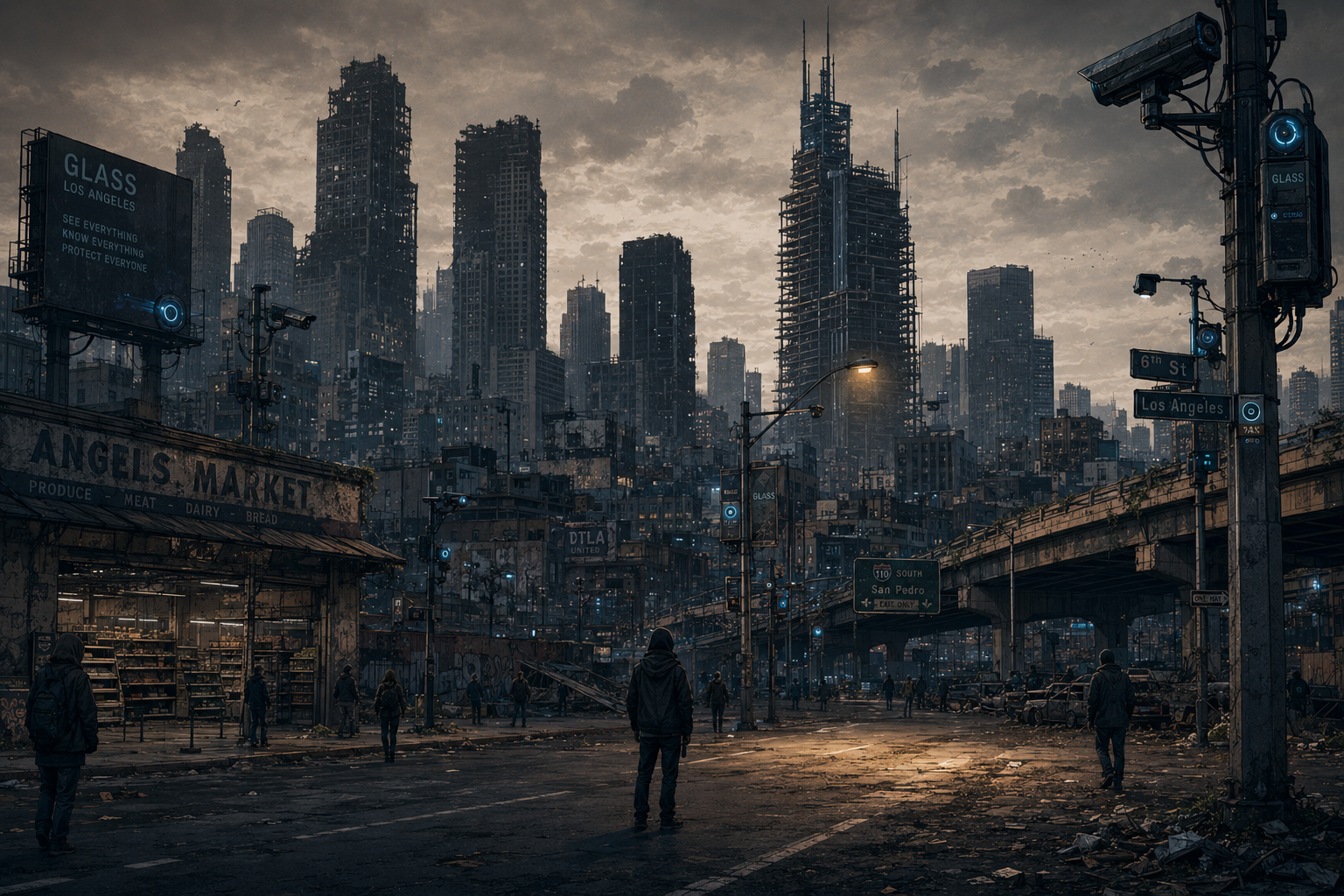
Downtown Los Angeles · Pacific Compact territory, 2035 · Where the city's services thinned out, the Glass never did.
The world of Null Witness is not invention. It is projection: a history of something that hasn't happened yet and might. Every piece of it extends from conditions visible right now: the debt, the bubble, the supply-chain fragility, the political fracture, the slow erosion of institutional trust.
The horror is in the plausibility. It never becomes fantasy. Here is how the most documented civilization in history lost its records, its money, and its center, in roughly five years.
Gradually, then suddenly.
It didn't happen the way the disaster movies said it would. No midnight vote, no visible tyrant, no door kicked in at three in the morning. It happened the way everything actually happens: not on any single day anyone could point to. By the time it was undeniable, the sudden part felt less like a decision than a recognition of something that had already occurred. The people who lived through it rarely use the official names. They call it the Bust, the Wipe, the Fall, and the Fracture.
The Bust · 2027
For half a decade, capital poured into artificial intelligence on a scale that defied every rule of valuation: companies with no revenue and no path to it, valued at hundreds of billions, because the alternative was being the person who passed on the internet in 1995. The investors knew the numbers didn't work. They invested anyway. When a cascade of earnings reports confirmed the profit wasn't coming, the first fund moved and the rest followed within hours. The sector went from overvalued to worthless in weeks, and it dragged every pension, bond, and regional economy wired to it down too.
The Wipe · late 2027
The economic damage was survivable. What followed was not. Failing companies had spent months gutting the maintenance budgets on the cloud infrastructure the world had quietly migrated into: the storage holding its financial records, medical histories, court archives, property deeds, and identity documents. Automated processes that should have been supervised were left running without supervision. Between October and December, they began to delete.
RECONSTRUCTION AUTHORITY · DATA-LOSS ASSESSMENT · SUMMARY
FINANCIAL RECORDS · STATUS: OVERWRITTEN
MEDICAL HISTORIES · STATUS: OVERWRITTEN
LEGAL & COURT ARCHIVES · STATUS: OVERWRITTEN
PROPERTY & IDENTITY RECORDS · STATUS: OVERWRITTEN
// Not partially damaged. Gone.
// You cannot prove you own a home when the deed no longer exists.
// The reconstruction is still going.
The Fall · 2028
The dollar's status as the world's reserve currency was the load-bearing wall holding the structure up, and it had been eroding for a decade. The Wipe was the crack that brought it down: credit markets depend on records of who owes what, and enough had just evaporated to freeze the entire mechanism. The intervention that followed produced the inflation the debt markets had always feared in theory and never lived at scale. The dollar lost forty percent of its purchasing power in eight months. The more holders sold, the more it fell; the more it fell, the faster they sold.
The Fracture · 2031
The rest was momentum. Supply chains optimized for efficiency rather than resilience failed when imports priced in other currencies became unaffordable overnight. The riots of 2029 weren't one movement. They were the same conditions speaking a hundred local dialects at once. The military didn't collapse; it contracted, pulling back to the coasts and corridors where function was still possible, and leaving the middle of the country with less, then less again.
California never declared independence.
It simply kept functioning.
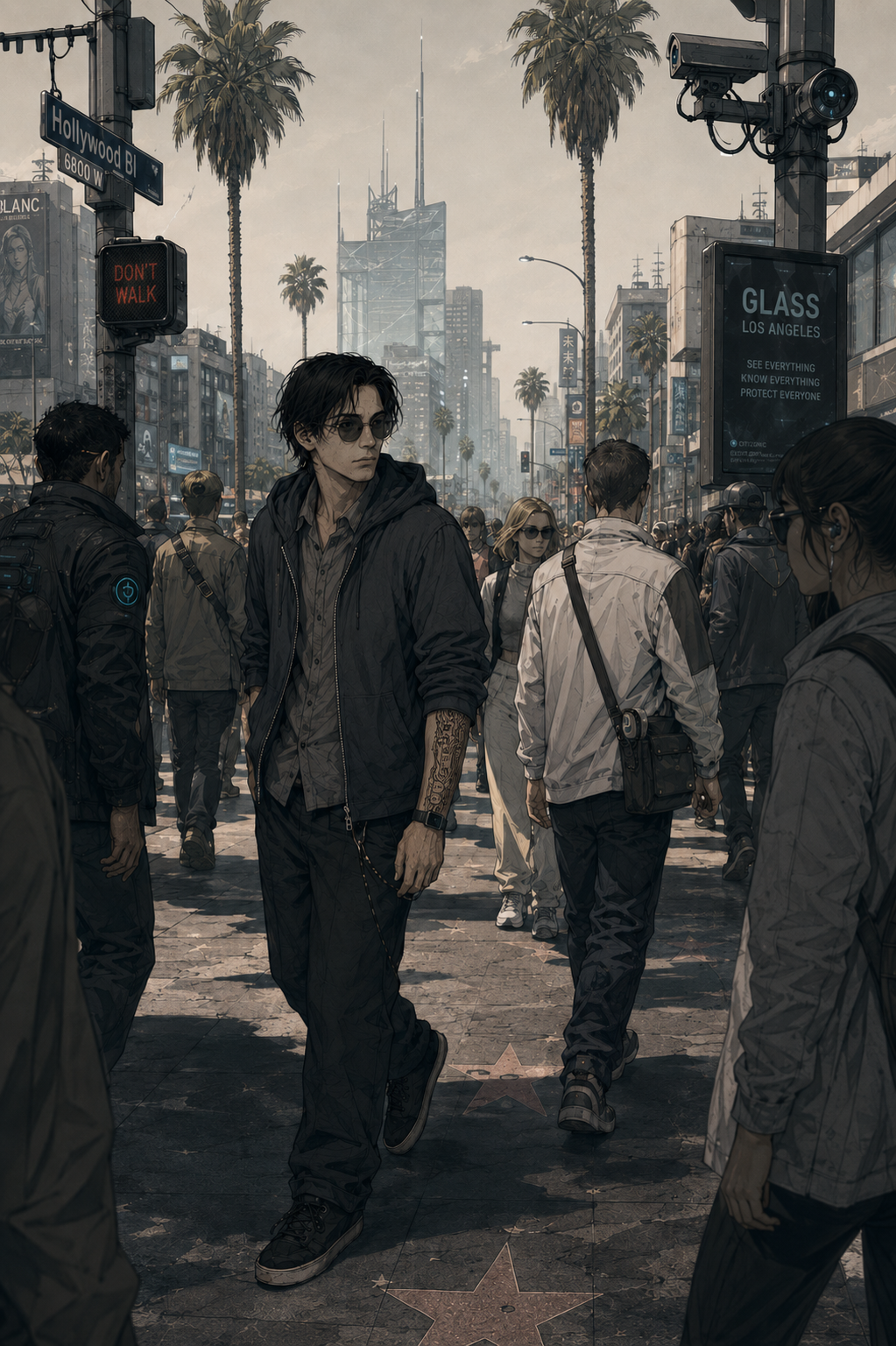
Los Angeles · Pacific Compact territory · 2035
When the federal government's ability to provide services and enforce laws fell below the threshold of functional sovereignty, California didn't secede. It kept running on its own resources, by its own priorities, and stopped remitting to a federal apparatus that had stopped providing anything in return. Oregon and Washington followed because their economies were already wired to California's. Others followed because the west was where the working infrastructure was.
They called it the Pacific Compact. By 2035 it is not a nation in the traditional sense. It is a functional zone of coordinated governance, a common currency, and a shared defense posture drawn from the military consolidated in western bases. Unstable. Functional. In those years, those were not the same thing, and functional was the only standard that mattered.
Downtown · 2035
Surviving is not thriving. Walk south and east of the functioning core and you reach the parts of Los Angeles that took the worst of 2029 and 2030 and never fully came back: blocks of half-gutted towers, a downtown thinned to its load-bearing minimum, an unfinished high-rise still wrapped in the scaffolding it was abandoned in. The 110 still runs south past San Pedro, because the road, at least, was cheap to keep. People stayed anyway. The Angels Market on 6th still puts produce, meat, dairy, and bread on its shelves, because a neighborhood that has lost almost everything will still organize itself around the one place that sells food.
And above all of it, on every pole, every shuttered storefront, every dead intersection, the cameras stay lit. Pristine. Powered. Perfectly maintained, in a district where almost nothing else is. That is the tell, and it is the whole argument of this book in a single streetscape: where the Compact's services end, the Glass doesn't. Its billboards still promise, in clean type over the ruin: See everything. Know everything. Protect everyone.
The federal government still exists in Washington. It still claims the whole map. When it had to choose what to protect with what it had left, it protected the surveillance infrastructure over almost everything else. That choice says everything.
The price we agreed to.
The dystopias always got one thing wrong: nobody made us do it. The Glass (the Public Safety Network, in the language of the people who run it) went up after 2029 with something close to public gratitude. To understand why, remember what 2029 felt like: empty shelves, power off for three weeks at a stretch, the National Guard handing out food while its own people hadn't been paid in six. A significant share of the population arrived at a single durable conviction: never again.
So when the Compact offered stability and named its price, most people paid it. The price was cameras on every corner, behavioral pattern analysis, a network that could pull up a person's last seventy-two hours of movement before you'd finished saying good morning. A surveillance apparatus so comprehensive that most citizens stopped noticing it, the way you stop noticing the hum of a refrigerator.
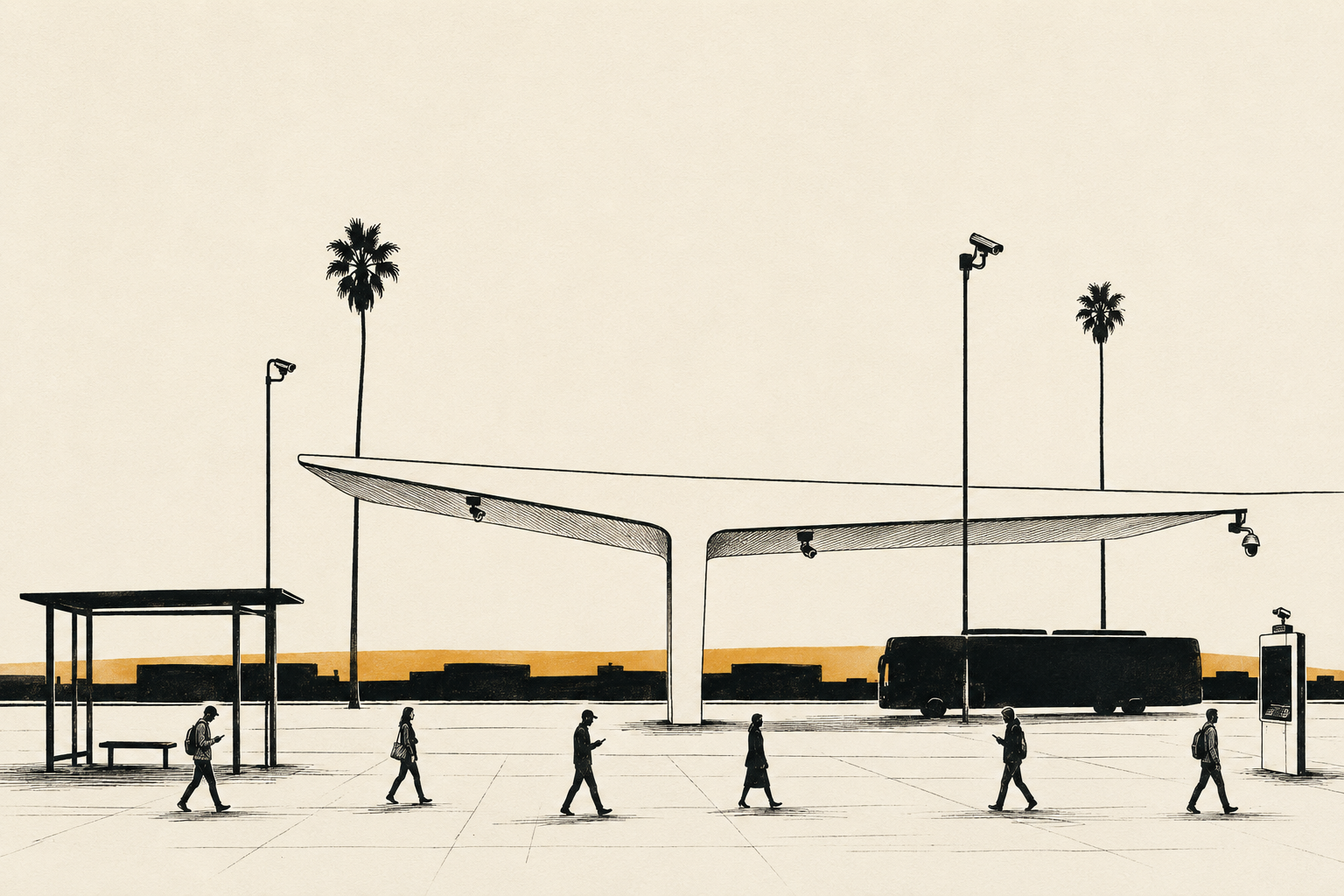
Civic Center Station · The Glass tags every commuter in real time. Most read NORMAL. One reads ANOMALY.
GLASS / PUBLIC SAFETY NETWORK · BEHAVIORAL ANALYSIS LAYER · LOG EXCERPT
SUBJECT_ID: KH-8841-LA · TIMESTAMP: 2035-08-14 23:47:02 PST
LOCATION: WEST_ABBEY / ON_FOOT · VECTOR: NNE AT 3.2 KPH
ACTIVITY_CLASS: TRANSIT [ROUTINE] · ANOMALY_FLAGS: NONE
// The Glass is very good at classifying what people do.
// It cannot classify why.
It does not read minds. It reads patterns, and it is extraordinarily good at that. What it cannot see is intent. What it cannot distinguish is a threat from someone who simply doesn't fit the expected shape of a life. For most people that gap never matters. For the people who don't fit, the gap is the whole story.
Stand in the station at Civic Center and the system's view of the crowd is almost gentle: every commuter wrapped in a quiet tag (status: normal · mood: calm), a mother and her son, a woman with a coffee, a vendor at his cart, a thousand ordinary lives the Glass has already decided are no one to worry about. The billboards keep their promises overhead. See everything. Know everything. Protect everyone. A safer Los Angeles starts with transparency. And off to one side, one hooded figure resolves in red (ID: 000-00-000 · status: anomaly · mood: unknown), flagged not because the Glass knows he has done anything, but because it cannot tell that he hasn't.
Money that remembers.
When the dollar fell, the Compact needed money that worked, and it had just watched the old system die because no one could prove what anyone owed. So its architects built a replacement around a single principle: the new currency would never forget anything.
NovaCoin carries a cryptographic record on every transfer, accessible to authorized Compact regulatory and law-enforcement bodies. Not a backdoor bolted on later. The entire point. A surveillance society requires a surveillance-compatible currency; an untraceable currency would produce an unmonitorable economy, the one thing the Compact had decided it could not afford again.
The unsettling part: the gray market runs on it too. Not for privacy. It runs on NoC because it is the most liquid instrument in the territory, the thing the lights run on. The underground contest circuit pays prizes in NoC on purpose, because the unforgettable trail is what makes a payout trustworthy. Winning Ɲ250,000 NovaCoin does not buy anonymity. It buys a number attached, permanently, to a chain a motivated investigator can read like a confession.
What you call it depends on where you stand.
The terminology a character uses tells you immediately which world they come from. Cade uses the street names without thinking. Institutions use the rebranded ones reflexively.
| Event / Concept | Street | Institutional | Common |
|---|---|---|---|
| AI bubble collapse | the Crash | Market Correction of 2027 | the Bust |
| The Deletion Event | the Wipe | the Cascade | the Burn |
| Dollar collapse | the Fall | Monetary Crisis | the Drop |
| US political fracture | the Fracture | the Reorganization | the Breakup |
| Pacific Compact states | the West | Pacific Administrative Zone | the West Coast |
| Federal remnant | the Feds | Federal Continuity Gov't | DC |
| Interior enclaves | the Dark | Unincorporated Territories | the Badlands |
| Surveillance network | the Glass | Public Safety Network | the Watch |
| Agentic AI systems | bots | Decision Support Infrastructure | the machines |
This is the world. Now meet the witness.
Null Witness is a serialized cyberpunk thriller set in the Los Angeles this world left behind. Start at the prologue. No context required.