The Glass Archive · Recovered broadcast
Peacekeepers
A recovered broadcast from the night the bridges closed on New York.
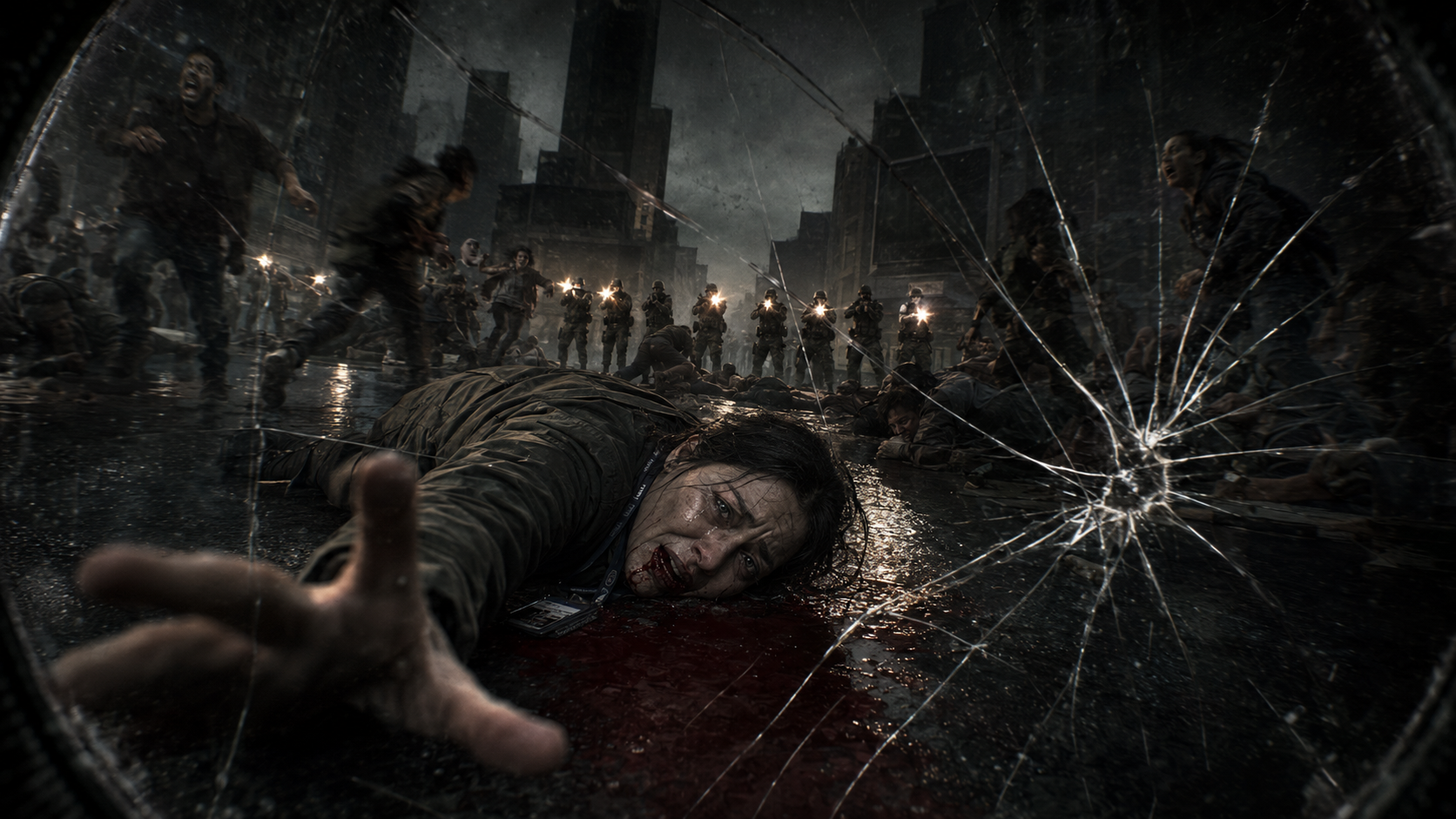
Recovered field-camera frame · Times Square, New York · 12 August 2031
The record that follows was reconstructed from a broadcast feed, one of the few from that year to survive intact, because too many people were watching it live for every copy to disappear with the servers.
The broadcast opened the way it always had. Good evening. Two anchors behind a curved desk, the set lit the way sets had been lit for eighty years, so that whatever got said would be said by people whose collars were straight.
The man was named Halloran. The woman beside him was Devi Rao. They had been doing this a long time, and it showed in the way they kept their voices level over material that would have broken a newer pair, though level was not the same as calm, and if you watched their hands you could see the difference.
“Good evening,” Halloran said, and the smile was the practiced one, the one that had opened ten thousand broadcasts. “Starting with the markets.”
The board came up behind him in the old red.
“The Dow retreated another four percent today, with no relief in sight for beleaguered investors. The Nasdaq and the S&P followed it down, off three and a half and four percent respectively.” He delivered it beautifully. He had been delivering it beautifully for thirty years, the same warm baritone that had carried audiences through crashes and recoveries and all the ordinary Tuesdays between them, and he brought exactly that voice to it now, as though a four percent slide were a weather system and not a headstone.
What the voice didn’t say, the numbers behind him did. The Dow (what the exchanges still called the Dow, running on backup power and a skeleton desk) had lost roughly eighty-four percent of itself since the spring of 2026. The Nasdaq and the S&P lay in the same grave beside it, near enough the same, and had lain there so long that the daily four percents were just the dirt settling. Five years into the slide, and still no floor anyone would call a floor. Halloran gave the day’s number in the tone you’d use for a box score, because the tone was the last thing the broadcast had that still worked, and everyone on both sides of the camera had quietly agreed to keep it running.
“Over to the currency desk,” Rao said, and she had the voice too, the same unhurried competence. “The dollar gave up more ground today, buying less against the yen than it did last quarter and less again against the yuan, as manufacturing and export activity remain, in the Commerce Department’s phrase, temporarily subdued.”
Temporarily. The dollar had been in this valley for two years. There was nothing temporary left in the country, but the desk read the department’s word for it the way the department had written it, because that was part of the ritual too: the small words, the manageable words, the ones that let a sentence be finished.
“And to the Midwest, where the blackout continues.” A beat. “Utilities across the grid interconnection say the outage is now in its eleventh day, with no restoration timeline. Residents are again advised to stay with family where possible.”
Neither anchor said the thing everyone watching already knew, which was that where they can had stopped meaning much.
Halloran touched his ear. Something was arriving in it that hadn’t been in the rundown, and his face did what a professional’s face does when the gallery starts talking fast.
“We’re going to go live,” he said, “to midtown, Times Square. Our Elena Marsh is down there. Elena?”
The picture that replaced the studio was worse than anything the studio had said.
The camera had come up on a Times Square nobody under thirty had ever seen full, and it was full, packed north to south past the point where the frame gave up counting, faces and shoulders and lifted arms in a mass that shifted like water finding its level. The great screens overhead were dark, all but one, which cycled the same white card over and over down into the crowd it was aimed at: REPORT TO YOUR DESIGNATED DISTRIBUTION POINT. Nobody was reporting anywhere. Under all of it ran the sound the microphone couldn’t hold: not a chant, not a scream, the low continuous roar a very large number of frightened people make when they are all making it at once.
And across the south end of the square, between the crowd and the storefronts, stood the line. Young. That was the thing the camera caught before Elena said a word: how young they were, the National Guard and the federal officers in mismatched gear, rifles held low across the body, a hundred of them maybe, set against a hundred thousand.
“Rob — get it wide, get the line —” Elena’s voice, off the mic, then on it. She turned to the camera already too loud, already pitched over the roar, nothing left of the studio’s practiced level. “Halloran, can you — okay. Okay. I’m on Seventh, we’re looking south, and I need you to see this, because I can barely —”
She stopped. Started again. She wasn’t narrating it. She was inside it.
“They won’t let anyone near the stores. There’s food in there — people keep telling me — here —” She pushed the mic toward a big man beside her in a coat too heavy for August, his face gone loose with something well past anger. “Tell them. Tell them what you told me.”
“There’s food right there.” He pointed, and the camera followed his arm to the dark glass of a grocery with a squad in front of it. “I can see it. I got a voucher —” he pulled paper from the coat, waved it, let it fall — “means nothing. Fifty of these for a can. Fifty. And the ration point on Forty-Second gave out at noon. So what am I —” His voice went. He put the heel of his hand to his eye and turned from the lens, because even now, even there, people don’t want to be seen doing that.
Elena had already moved. A thin woman, a child on her hip who was not crying, which was somehow the worst thing in the frame, a child that age not crying, just watching with the flat patience of the very hungry.
“Three days,” the woman said, before Elena even asked. She wasn’t loud. The mic barely took it. “He hasn’t eaten in three days. I give him mine and it isn’t —” She looked straight into the camera, the way people do when they’ve decided the lens is the last authority left that might listen. “They said stay in your homes and wait. Wait for what? There’s nothing coming. Everyone down here knows there’s nothing coming.”
“Here’s the thing,” Elena said, back to the camera, and for one sentence the reporter came up clean through the fear. “This is a city of eight million people that grows none of its own food. Almost everything anyone here has ever eaten came in on a truck. And the trucks stopped.” Then the fear took it back. “And they’ve put a line of kids with rifles between these people and the last of it, and I don’t — Halloran, I don’t see how this holds. I don’t think this holds.”
Halloran, thin down the line: “Elena, is there any way to know whether —”
And the sound changed.
It changed before anyone could see the cause of it: the roar spiking, a surge running through the mass like wind over a field, the crowd folding in toward some point too deep to see. And then, out of all of it, one shot. Flat and small and alone.
For half a second, nothing.
Then the line fired.
Not on an order. You could see there was no order, no raised hand, no signal, only the first crack handing a hundred terrified kids the permission each of them had been waiting for. And the whole southern rank lit at once. The camera was on it. It caught the muzzle flash run down the line like a struck match finding its length, and it caught what a standing crowd does when that arrives: the front of it came apart and dropped, not the way people fall, the way a floor gives out.
And then the whole square broke. It broke in every direction at once: a hundred thousand people discovering in the same instant that there was nowhere the fire wasn’t, a current pouring north up the avenue and jamming against the bodies still pouring in behind it, turning back on itself, folding, going down under itself. And in the middle of the frame, over and over, the small unbearable punctuation of it: one more figure dropping mid-stride and not getting up, and the crowd splitting around the place where they fell and running on, because there was nothing else a crowd could do.
The frame swung wild. Sky, pavement, a running man, sky.
“They’re shooting —” Elena’s voice shattered, no control left in it at all. “Halloran, they — the police, the soldiers, they opened fire, they’re firing into — oh my god. Oh my god, that’s — that’s a man, he’s — there’s a —” She wasn’t counting. She couldn’t. She named them one at a time as her eye fell on them, which was worse than any number could ever have been, because a number is a thing you can hold at arm’s length and a person is not. “That’s somebody — there’s a woman, she’s down, she’s not moving — there’s a kid, oh god, there’s a kid, they’re not — why are they not stopping, they’re not stopping —”
The picture stayed up. It stayed up because Robison, the cameraman, whose face was never once in the broadcast, did not run and did not lower it, held it on the square with both hands while people streamed past him the other way, and so the record kept being made.
Then Elena made a sound, and the frame lurched, and her hand flew to her arm.
“I’m hit —” Nothing of the reporter left in it, just a person, just fear climbing into the voice and taking it over. “I’m hit, I’m hit, Rob — oh god — my arm, it’s my arm —” She got a hand clamped over it, blood already coming bright between her fingers, her breath gone fast and shallow in the way that isn’t crying yet but is about to be. Whatever the work had put in her (the steadiness, the trained distance a reporter keeps between herself and the thing she reports) burned off in that one second and did not come back, and what was left was a young woman from a city desk who had never once in her life been meant for this, standing upright in the open while people died around her, still trying, somehow, to hold the microphone. “Are we — is it still on, are we still —”
They were still on. Robison had the camera up.
And the square, which should have emptied, did not empty. It answered.
What the broadcast carried next was the thing no one who saw it ever managed to describe afterward, because no words fit the size of it: the city fired back. From the ground where the front had gone down, and then from above (from the black windows of the towers up and down the avenue, one flash and another and then a scatter of them too many for the eye to hold), muzzle fire opened from every height at once. The federal line, which a breath ago had been the only guns in the square, learned in real time that it was not. The picture filled edge to edge with a crossfire that had no front and no center and nowhere in it a person could point to and call away from it.
Then it came almost all at once, the next of it: so fast that watching it back, later, you could never quite pull the pieces apart. Elena was hit the second time. A round struck the camera. And Robison lost his hold on it. All of it inside the same half-second: the frame jerked hard as the lens took the round and starred white clean across its face, and then it dropped, tumbled once, and came to rest on the wet pavement at an angle, still running.
That was the obscenity of it: that the lens was cracked straight across and the camera went on rolling anyway, and through the white bloom of the break the picture was still legible: a low, sideways, ruined slice of the world with everything in it still perfectly, unbearably visible.
And what it was pointed at was Elena.
She was down, close to the glass, her cheek against the pavement. She was bleeding from the mouth. She wasn’t trying to talk anymore. There was nothing left to say and no way left to say it. And she was crying, quietly, her eyes open and fixed on something out past the cracked lens, some point above the camera or beyond it that it would never turn to show. What was in her face by then was not terror. It was further along than terror. It was almost like attention, as though she had stopped being afraid of the thing and started, in the last of it, simply watching it arrive.
Then Robison came into the frame. Low, scrambling, both hands out. He reached her and got hold of the arm she’d been clutching and tried to move her, tried to drag her out of the open toward a doorway or the idea of one, because there was no safe place in that square and a man who has just watched his partner go down does the thing his hands already know to do.
He never finished.
The round took him through the neck. There was no drama in it, none of the choreography the movies had trained everyone to expect: one moment he was bent over her with both hands full of her sleeve, and the next he was simply gone, dropped sideways and out of the frame, and he did not come back into it.
The cracked camera went on running. It held, through its ruined white star, the shot it had been left holding: Elena Marsh on the pavement, close, her eyes still open and still fixed on that far-off point, the crying gone quiet, and then quieter, while the roar of the whole dying square came through flat and enormous over a picture that had stopped changing.
The feed ran on like that (steady, cracked, ruined, no one left alive in front of it to point it anywhere) until a control room a hundred miles north finally, mercifully, cut it to black.
The studio came back wrong.
Halloran had his hand over the lower half of his face, not a considered gesture, nothing an anchor would ever choose, just a man’s hand gone to his own mouth while the rest of him tried to catch up to what it had seen. Beside him Rao was staring at something off the lens, the teleprompter or the gallery or the middle of nothing, and when she made herself find the camera again her professionalism had a crack running through it that matched, exactly, the one they had all just been made to look through.
Because that was the part no rehearsal covers. These were two people whose entire craft was composure, thirty years between them and more, of holding the center of the frame level while the world did whatever the world was going to do, and they had just watched two of their own die on their own air, live, in real time, with no break to cut to and nowhere to put their eyes and no arrangement of good evening that reached it. There is a script for a great many things in that chair. There is none for this. You could watch both of them arrive at that fact together, and watch them understand in the same moment that the camera was still running and would go on running, and that they were going to have to keep talking through it, and that understanding, the trained reflex of it turning against them, was the most human thing the broadcast had shown all night.
“We’re —” Halloran started, and it was not his voice. He took the hand down from his mouth. He tried again, because trying again was the only tool left in the box. “We’re going to stay with our coverage.”
For a long moment that was the whole of what he had.
They stayed with it into the night. By the small hours the federal command had made its announcement, in the flat passive grammar those announcements are always written in: the greater New York area was under martial law, effective immediately, in the interest of restoring order. The bridges went first. The George Washington, the Verrazzano, the East River crossings, the tunnels, all of them closed, inbound and out, and a city of eight million that grew nothing and imported almost everything was sealed shut with whatever happened to be inside it.
It was near the end of that long broadcast, hours after the square, that Halloran read the first official numbers, and you could hear him not believe them even as he read.
“Authorities are confirming,” he said, “at least forty-two dead. Two hundred and seven wounded. And thirty-eight federal and Guard personnel killed or unaccounted for.” He set the paper down. “Those are the numbers as of this hour. They’re expected to change.”
They were the last numbers anyone would be able to stand behind. After that, counting stopped being possible, because counting requires that someone be able to walk the ground, and no one walked that ground for two weeks.
What the record holds, assembled long afterward, incompletely, the way everything after the Wipe was assembled incompletely, is that the siege of New York lasted fourteen days. That aid trucks staged on the far banks were not let across. That people who tried to leave on foot found the bridges had not been sealed as a figure of speech. And that when a count was finally attempted, the number set against those two weeks was forty-seven thousand, three hundred and eighty-four: some to the shooting the first night, more to the gunfire that never entirely stopped after it, and most, by a wide margin, to the oldest cause there is, the one that needs no rifle and no order and asks only that the trucks stop coming.
Forty-seven thousand people. In a country that had, four years earlier, thrown away the instructions for keeping them alive because keeping the instructions had cost fractionally more than deleting them.
PRIVATE QUARTERS — FEDERAL BILLET PHILADELPHIA, PA TUESDAY, 12 AUGUST 2031 / 23:52
Rowe watched it to the end with the sound low and the lights off and a glass he had not touched going warm at his elbow.
He watched the way he watched everything, which was for the seams. He had spent his life on a single proposition, that the alternative to order was precisely the thing on the screen, and he had just watched order produce it. He made himself hold both halves of that and set neither one down.
The men in the line were not villains. He knew what they were, because he had stood beside men exactly like them in Columbus the year before, when it came apart there: nineteen and twenty years old, handed a rifle and a barricade and a city that outnumbered them a thousand to one, told to hold a position that could not be held, toward an end no one had bothered to make survivable. Fear in a uniform is not a crime. It is a policy failure, and it arrives one trigger at a time, and the policy had been written years earlier by people who would never in their lives stand in a square and learn what their choices weighed. The crowd was not a mob. It was a city that grew nothing, ordered away from the only food there was.
And somewhere above all of it, dry and distant and still breathing, were the ones who had actually done this. Not the kids in the line. Not the woman with the child who wouldn’t cry. The others: the ones who had watched the debt swell and raised the ceiling anyway, the ones who had run the servers into the ground and walked away whole, the analysts who had tracked the rot since 2022 and said nothing because saying something was inconvenient, the whole comfortable altitude of people who had authored this world and would never once have to stand inside it.
That was the part Rowe let himself be angry about, alone, in the dark, because there was no one there to perform restraint for. Forty-seven thousand people in fourteen days. A city starved to death on a schedule, and every decision that set the schedule had been made by someone who had never in their life stood in a ration line, never watched a shelf they couldn’t reach, never once had to treat a need as anything but a certainty that would be met. That was the thing he kept coming back to, the rot under all the rest of it: they came from a class that had never had to learn the difference between a need and a want, because for them the difference had never existed. Both had always simply arrived, on time, in full, the way water arrives from a tap, so dependably that a person raised inside that reliability could mistake it for a law of nature, and not for what it was, which was a thing other people built and carried and could be made to die for the lack of. They had mistaken their comfort for competence. They had mistaken the quiet of a working world for the natural order of things, and they had spent that quiet down to the studs chasing a little more of what they already had past all reason to want, and when the bill came due it came due four hundred miles from any of them, in a square they would only ever see the way Rowe was seeing it, on a screen, from somewhere warm and safe and adequately fed.
The arrogance was nearly the worst of it. Not cruelty; cruelty at least requires that you picture the person you are harming. This was colder than cruelty. This was apathy with a portfolio: a few thousand people deciding, across ten thousand comfortable rooms, that the upkeep of the world was somebody else’s problem, and being right about that for a very long time, right up until the morning they were catastrophically wrong, and even then not being the ones who paid for it.
None of them had been in Times Square. None of them would be in the ground when the count was taken. They would read the number, if they read it at all, the way Halloran had read the Dow: as weather, as a figure in a column, as a thing that happens to the kind of people that things happen to.
Whose side. He turned it over the way he turned everything over, looking for the seam that would let the two pieces lie flat.
He believed in the law. The law had sealed the bridges. He believed in the people the law was supposed to be for. The people were behind the bridges, starving, and the law had put them there and called it containment. He could not make the two beliefs point the same direction, and he was too honest a man to pretend the fault lay in the question rather than in the thing the question was about.
He did not turn it off. He thought about the camera that had gone on filming through a cracked lens because both the people behind it were past reaching for it. He thought about the white card that had looped over the whole of it, REPORT TO YOUR DESIGNATED DISTRIBUTION POINT, patient and automated and addressed to no one left standing. He thought that a record was the only thing anyone had ever really had, and that this was a country that had taught itself to throw records away, and had gotten good at it, and was not going to stop with the ones it had kept on servers.
Then the coverage wore itself down toward the color bars, and the bars toward nothing, and the nothing was the most honest thing the network had broadcast all night.
Rowe sat with it a while longer. He was still, in that year, capable of believing that a man with his values needed to be inside the thing rather than outside it, and he would go on believing it for a long time, through everything the belief was later asked to carry. But he never did answer the question the broadcast left him with. Not that night, and not cleanly, ever. And a man who is honest about his work knows the difference between a question he has settled and one he has only learned to keep the lights off around.
He finished the glass. In the morning there would be the work, and the work would not care whose side anyone was on. It never did. That was most of what he trusted about it.