Act 0 · Null Witness
Chapter 0.5
Below Threshold
PACIFIC COMPACT PUBLIC SAFETY NETWORK
WESTERN DISTRICT PASSIVE SURVEILLANCE LOG
LOS ANGELES METRO SECTOR 7 — SANTA MONICA / PALISADES / ENTRADA

Collection period: 72-hour rolling window
Classification: ROUTINE AMBIENT
Active investigations flagged: 0
Subjects of interest: 0
Anomaly score: NOMINAL

This log is generated automatically.
No human review has been requested.
No human review is required.
[2035-05-14 21:51:09] MULTI-SUBJECT DETECTION
Entrada Building — Laundry Facility Entrance
CAM_17_UTILITY
SUBJECT_7741-F / CALLOWAY, CASSANDRA M. — present (detected 21:44:50)
SUBJECT_UNRESOLVED (male, consistent w/ residential pattern) — entering
Interaction flag: RESIDENTIAL_SOCIAL — non-notable
Interior coverage: WIFI_RADAR_PASSIVE
  Presence confirmation: 2 subjects, stationary
  Activity inference: LAUNDRY_BEHAVIORAL_PATTERN
  Communication content: NOT AVAILABLE
  Audio: NOT AVAILABLE
I don’t see the relevance of this. Nothing happens in a laundry room between neighbors worth retelling to a federal investigator.
But fine. As long as I can have one of those cigarettes first.
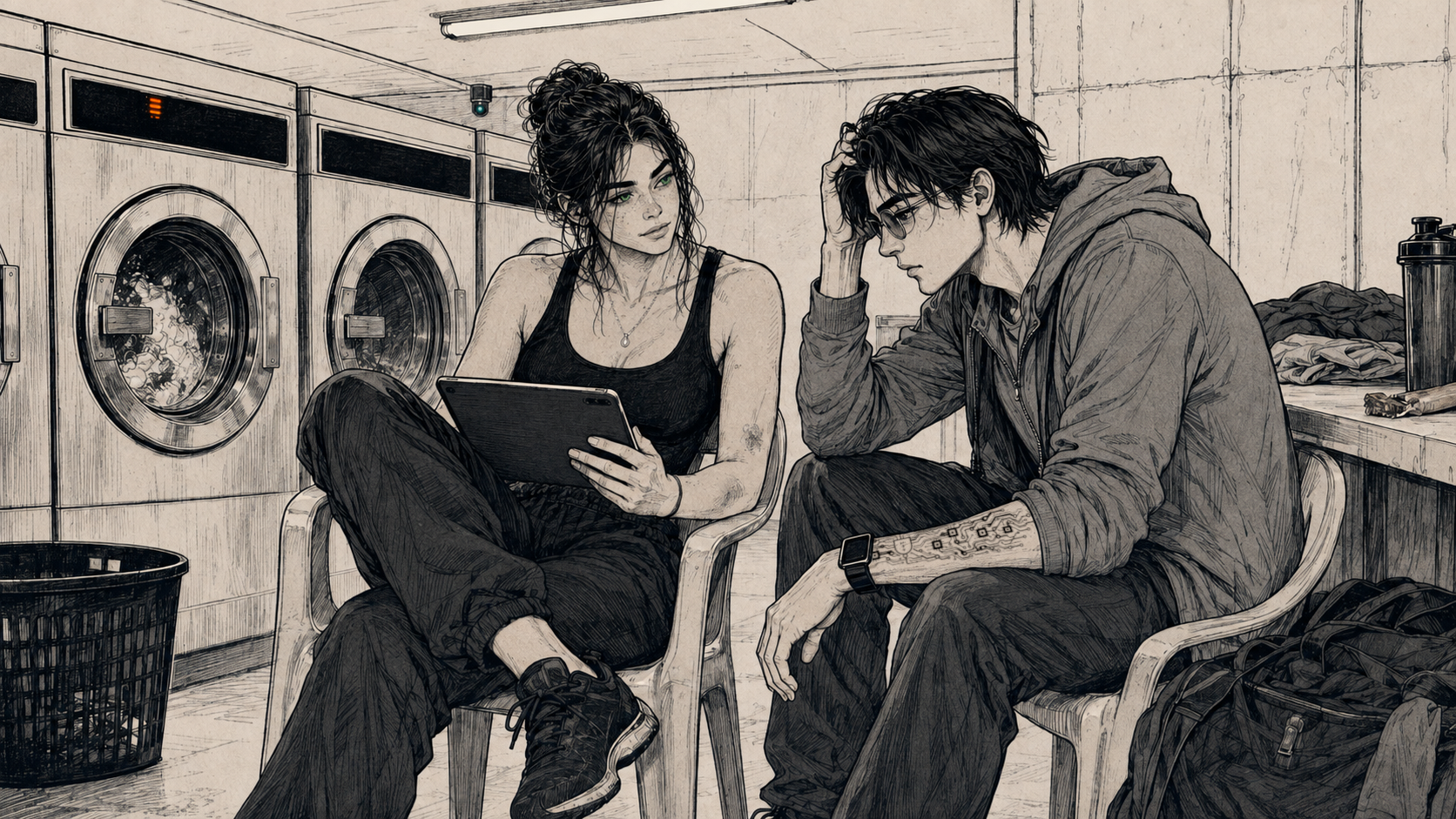
The laundry room was three washing machines, a folding counter, two dryers, and a fluorescent light that made everything in it look like evidence of something.
I came down because of the next day. Not because the laundry couldn’t wait another few days, it could, technically, with some creative interpretation of what counts as clean, but because there was an interview at two in the afternoon and I had exactly one shirt that didn’t require an explanation, and one shirt was not a margin I was comfortable operating on. So there I was at nine-fifty in the evening sorting darks from lights in a basement room while something that wasn’t quite hope ran in the background like a process I hadn’t fully examined yet.
She was already there.
I registered her before I registered anything else about the room, the gym bag by the door, the protein bar half-eaten on the counter, the tablet in her lap with an expression she wore when she was working on something that wouldn’t resolve easily. Her hair was damp. Not shower-damp, which settles a certain way; post-workout damp, the kind that dries from the outside in.
She looked up when the door opened. Something in her expression shifted, not a change exactly, more an adjustment, the small recalibration you make when the room has just become more interesting. I noticed it before I’d decided to notice it, the decision catching up after.
“Hey,” she said.
“Hey.” I checked the machines. Two running, one of them hers. I loaded mine into the one on the left and added detergent and started the cycle, and there was slightly more in the load than usual because I’d been avoiding this for a week and the consequences of avoidance have a way of compounding.
I considered the plastic chairs.
“Feel free to sit,” she said. “I’m not territorial about the laundry room.”
“I was going to,” I said, and sat. I typically wouldn’t.
She went back to the tablet. I took my phone out, not because I needed it, reflex, and then put it back. The machines ran. The fluorescent light did what it does.
I was in a head-space that night that I couldn’t entirely account for. Normally I’d be on my phone or working something through in my head, and the fact of another person in the room would be information I’d note and then route around. Instead I found myself paying attention as I do to things that interest me, which is different from polite social awareness in ways that occasionally get me in trouble.
“What are you reading?” I asked.
She looked up. She was half-closing a working window without closing the expression itself, there’s still an opening there, just narrowed. She was deciding how much to say. I recognized the calculation because it’s one I make too: the version you give to people who asked to be polite, versus the version you give to people who actually want the answer.
“Research paper. Uppsala University. CRISPR delivery in pancreatic tissue,” she said, short, the terseness of having been disappointed too many times by people performing interest in the work as a matter of courtesy rather than any real curiosity.
I turned this over. “That’s biomedical.”
“I’m biomedical.” She held the tablet up slightly, exhibiting it. “Third year.”
I waited. She glanced back at the tablet, then at me, reading something in the fact that I was still here, still looking, that hadn’t already moved toward something else. She gave me the condensed version. The one that ends conversations.
“They’re trying to get gene-editing machinery into pancreatic cells,” she said. “The challenge is the hostile environment those cells live in.”
“Hostile how?”
She paused.
Something changed in how she was sitting. She settled back slightly, given more room than she expected and deciding whether to use it. She’d said hostile in passing, as transition language, using a technical term to move to the next sentence rather than to invite a question. I asked anyway. Not about the CRISPR, not about the pancreatic cells, about the word she’d used to describe the obstacle. That was the part she was knitting her eyebrows together over.
“The pancreas secretes digestive enzymes,” she said, delivering the information differently now, the real explanation, not the summary, not the version that closes the conversation but opens it. “Among other things. Whatever carrier you use to deliver the editing machinery has to survive a chemical environment designed to break down biological material. It’s like trying to deliver a letter through a building whose lobby is full of people whose job is to shred things.” A pause. “These guys are using lipid nanoparticles. Little fat bubbles that protect the cargo and can be engineered to target specific cell types.”
“But?”
“But I think their dosing model is off. They’re seeing an immune response in the trial data and attributing it to the carrier, but the timeline doesn’t match. The response is delayed by about forty minutes compared to what you’d expect if the nanoparticle were the trigger.” She turned the tablet toward me, tracing the graph with her finger. “See this curve? The peak should be here. Instead, it’s here. Which means something else is triggering it and they’re looking at the wrong variable.”
I looked at the graph. Actually looked at it, read the axis labels, followed the curve rather than just acknowledging its existence.
“What’s the payload?” I asked.
“Sorry?”
“The gene-editing machinery inside the nanoparticle. What is it?”
“A modified Cas9 complex. Why?”
“Because if the carrier isn’t triggering the response and the timing tracks, the Cas9 might be getting out early. If the encapsulation is degrading faster than the model expects in the delivery environment…” I stopped. “Sorry. I don’t actually know what I’m talking about.”
“No.” She said it slowly, with a shift in her expression, eyes refocusing from the middle distance, the look of having her own thinking confirmed by a source she wasn’t expecting. The floor had shifted and she was taking a moment to find her footing on the new level. “No, that’s not wrong. If the encapsulation is degrading before the target, the Cas9 would be exposed earlier than the model accounts for. I had been looking at this for hours but…” Her eyes drifted up from the screen to me. I noticed how green they were. Emerald under the fluorescent light. “How do you know about Cas9?”
“I don’t. I just know the word. I looked CRISPR up once for something unrelated.” I shrugged slightly. “The logic is the same regardless of the domain, system, payload, delivery mechanism, unexpected response. Usually means the mechanism is doing something the model didn’t account for. Bad input, or input given before the system expected it in this case and didn’t handle it properly.” I stopped for a second. “We have a phrase for it: Garbage in. Garbage out.”
She was looking at me the way she looked at my terminal output on the campus path: something had shown up that didn’t fit the category she’d assigned it, and she was deciding whether to revise the category or just keep filing exceptions. I recognized the expression because I use it myself.
“What does Uppsala say?” I asked.
“I haven’t sent the email yet.” She glanced at the tablet. “I’m still making sure I’m not just being wrong loudly.”
“Is that a concern?”
“It’s always a concern.” She set the tablet on the folding counter. “If you’re wrong loudly, even if you try to forget it, this kind of community doesn’t let you.”
I sat with that. “That’s the risk you take doing work worth getting right.”
The machines ran for a while. At some point she asked what I actually do, not conversationally, not the passing question, but with the quality of attention she’d given the research paper. Like it was a question she’d been holding and had decided it was earned.
“What did you say you do again?”
“I didn’t.”
Her mouth moved up on one side. Her eyes closed a bit at me. “I’m asking.”
“Computer science,” I said. “At WAIT. Fourth year, roughly.”
“Roughly?”
“It means I’m enrolled and technically making progress.”
“That sounds like there’s a story there.” She said, and leaned in a bit.
My eyes moved to the dryer.
“It’s not a great one,” I said. That door was closed.
She just nodded and left it there. Respectfully. It was. Unusual.
“So what else do you do?” she asked.
I held the rest of it back a moment. “Security work on the side. Exploit research, bug bounties. The kind of work that’s difficult to put on a resume.”
“Difficult how?”
I considered how to answer this. The truest answer wasn’t the compact one. They weren’t always compatible, and I wouldn’t be willing to share it with most people, much less expect them to donate their time to hear it. I said it like this.
“Most of what I’ve built is good work,” I said. “Thirty-one documented CVEs in the last fourteen months.”
“CVE?”
“Common Vulnerabilties and Exposures.” I explained. “It’s the term cybersecurity uses to label flaws in software and assign numbers to them. The problem is that the documentation either doesn’t exist or exists in places that don’t map to the employment process that legitimate firms use. So I spend a lot of interviews explaining why my credentials can’t be verified and watching the hiring manager decide how much that matters.”
“How much does it matter?”
I let the air fall out of my chest that I had been holding in anticipation of her question.
“Enough that I’ve had nine interviews in the last year and none of them went anywhere.”
She absorbed this without filling the silence. I’d noticed she did this, didn’t rush to reassure, didn’t act out of socially-obligated sympathy. Just took in what was said and held it.
“There’s an interview tomorrow,” I said. “Actual meeting, not a phone screen. First one that’s felt real in a while.” I looked at the machine. I didn’t know why I was telling her this. “I’m trying not to put too much on it.”
“But you’re doing laundry,” she said.
“I’m doing laundry.”
She was starting to smile, and didn’t hide it. “You ran out of clothes…didn’t you.”
“I have one clean shirt,” I responded. I heard a subtle snort, a laugh that she failed to restrain, and a row of teeth appeared between her lips.
“That’s…” a pause. “optimistic.”
It was. It’s the kind where you allow yourself to need something without letting yourself want it too much, because the gap between needing and wanting is where the damage happens if the thing doesn’t come through. I’d been living in that gap for a while. Something about that night, the email, the name Mr. Ashfield in a subject line that addressed me as Mr. Voss like I’m a person with professional standing, had made the gap feel slightly smaller.
I didn’t say any of this.
“Something like that,” I said.
The gym bag by the door caught my eye. Her hair was damp, post-workout rather than post-shower.
“Just got back from somewhere?” I asked.
“Boxing class.” She said it plainly, a true and unremarkable thing. “A few nights a week. A friend from my program convinced me two years ago and I kept going after she stopped.” She rolled her shoulder once, working something loose the class had left in it. “Mostly MMA now. Boxing’s the part that stuck.”
I took this in without comment, which for me is a form of comment.
“You ever done anything like that?” she asked.
“Yeah.”
She waited.
“Muay Thai,” I said. I was watching the machine to have somewhere to put my eyes, redirecting attention toward something that didn’t have an opinion about me. “There was a gym near where I grew up as a kid.”
“Do you still?”
“Not really.”
The machines ran. We both had our phones out at some point and both put them away without having looked at them. This was the texture of two people who have decided, without discussing it, that they’re willing to be in this room for the duration of the laundry cycle and not be interested in the thing that constantly pulled their attention from something real.
Entrada laundry facility · Basement · 21:51 PST
She reached for the protein bar on the counter and the motion put her closer than she was, her arm crossing in front of me to where the bar had migrated. For a moment we were in the close proximity of a small room and I could see, among other things that I convinced my mind not to notice, the faded bruise on her forearm yellow-green at the edges, two weeks old at most.
“What happened to your arm?” I asked.
She glanced down. “Sparring. Caught a block wrong. My fault, I dropped my elbow.”
“You spar.” Not a question. An observation.
“Yeah, both the boxing and MMA. I’m terrible at the grappling though.” She peeled the wrapper. “You look surprised.”
“I’m not surprised,” I said. About sixty percent accurate.
“You had a face.”
“I don’t have a face.”
“You had the ‘recalibrating’ face. It’s fine. Everyone makes it.”
“It wasn’t surprise,” I said. “More like…” I considered, which was the honest version, “I was updating a model.”
She looked at me with an expression I spent a moment actually cataloguing, not quite amusement, something adjacent to it. She’d just gotten new information about what kind of person she was talking to and was deciding how to respond. There was nothing guarded about it. She seemed to find it genuinely interesting, which was a response I wasn’t ready for.
“A model,” she said. One eyebrow went up.
“It’s how I think about things. People included. I had one for you and it was wrong in a specific direction.”
“What direction?”
“I had you as careful about the world. Careful the way you get when you’ve learned to be. The boxing is…” I stopped, deciding whether to finish. “It’s the opposite of careful. It requires being somewhere intentionally dangerous doing dangerous things that could go badly. It was unexpected.”
The room went quiet. From somewhere in the building above us came the muffled percussion of someone walking across a floor.
“I spent a couple of years being very careful,” she said. “After my dad died. Everything had to be managed and controlled and I had to be the one doing it.” She was looking at the folding counter, not at me. “And then I moved here and I needed somewhere to put the part of me that was tired of being careful. So.” She glanced at the bruise. “Boxing.”
I didn’t say I’m sorry about your father because she didn’t tell me about her father to receive condolence. She moved too fast for that. It was not the point. It was a detail, a fact to know, not a wound to soothe. She told me because I asked a genuine question and she gave me a genuine answer, and the room was small enough and we’d been in it long enough that the usual distances had adjusted to something less than usual. I didn’t fill the silence, which was the right response, I think, and she seemed to know it.
“Does it help?” I asked.
“Yeah,” she said. “It really does.”
Her machine clicked as it completed its final spin. She started pulling laundry out and I helped without being asked because the dryers were on my side and I was closer. This put us both at the folding counter, her sorting, me transferring from the washer to the nearest dryer. Both our hands on the counter between tasks. Both of us reaching for the same thing at the same moment, and for two seconds our hands were approximately an inch apart and neither of us moved them.
She picked up the item. I moved to the dryer.
“What’s the story?” she said. “The college one. The not-great one.”
I watched the dryer door instead of her. The door clicked open.
“MIT,” I said, without knowing why I chose to answer. “Full scholarship. Second year.”
She waited. I continued as I was going to anyway, at my own pace, for reasons I could not explain because they were so different from my norm.
“Defense contractor research collaboration. Network architecture, stated scope.” I paused. Then the hard part. “About three months in I understood what it was actually going to be.”
“What was it going to be?”
“Surveillance infrastructure. Another generation of what they’re calling the Glass now, before anyone was calling it that.” I said it the way you’d say the ceiling is twelve feet, a fact, not a verdict. “I didn’t know going in. I just knew what I was looking at once I understood it.”
“What did you do?”
“Said something.” A small dry beat. “In a meeting. My professor and the contractor rep both in the room, which, in retrospect, was not the ideal venue.”
“How’d that go?”
“My concern was a misunderstanding of scope.” I said misunderstanding of scope without inflection, which admitted more than inflection would. “Scholarship review got moved up. I withdrew before it concluded. I knew the conclusion.”
She was quiet. Not looking for the right condolence, just holding what I’d said correctly. Not filling things in. Not apologizing. Just letting it be what it is.
“Was there a version where you said nothing?” she asked.
I actually considered this. Not the polite pause before the deflection, the real kind.
“No,” I said. “There really wasn’t.”
Nothing attached to it. No manifesto, no defense, no indication the answer requires any of those things. A fact about myself, stated, complete.
She nodded once, the kind of nod that means filed rather than agreed with. Not I understand, exactly. More like she’d added something to a document she’s been keeping and intends to come back to.
I moved the last thing from the washer to the dryer.
“Like I said.” I didn’t look at her. “Not a great story.”
She looked at me with an uncomfortable precision, her attention on me longer than I’m used to. I noticed she does the same thing I do: building a model, piece by piece, testing it against what arrives. The difference is that she does it with warmth rather than analysis, which produces a result that’s harder to defend against.
“WAIT was the compromise,” she said. Not a question.
“WAIT was the compromise,” I agreed.
Her laundry was in the dryer. She gathered the things that go on hangers, folded them over her arm. At the door she turned back, and the expression on her face was the loose thread I wouldn’t pull and that she wasn’t quite offering but wasn’t quite withholding.
“That model you’re updating,” she said.
“Yeah.”
“For what it’s worth, mine’s been off too.”
She left. The door closed. I stood in the fluorescent light for a moment, holding a folded t-shirt I don’t remember folding, and the dryer ran.
[2035-05-14 22:38:33] SUBJECT_7741-F / CALLOWAY, CASSANDRA M. — exits laundry facility
[2035-05-14 22:40:02] SUBJECT_UNRESOLVED — exits laundry facility
Note: Co-presence duration 47 minutes 13 seconds
Behavioral flag: STANDARD_RESIDENTIAL_INTERACTION
Anomaly score: 0.0
Flag: NOMINAL
The city wakes in layers.
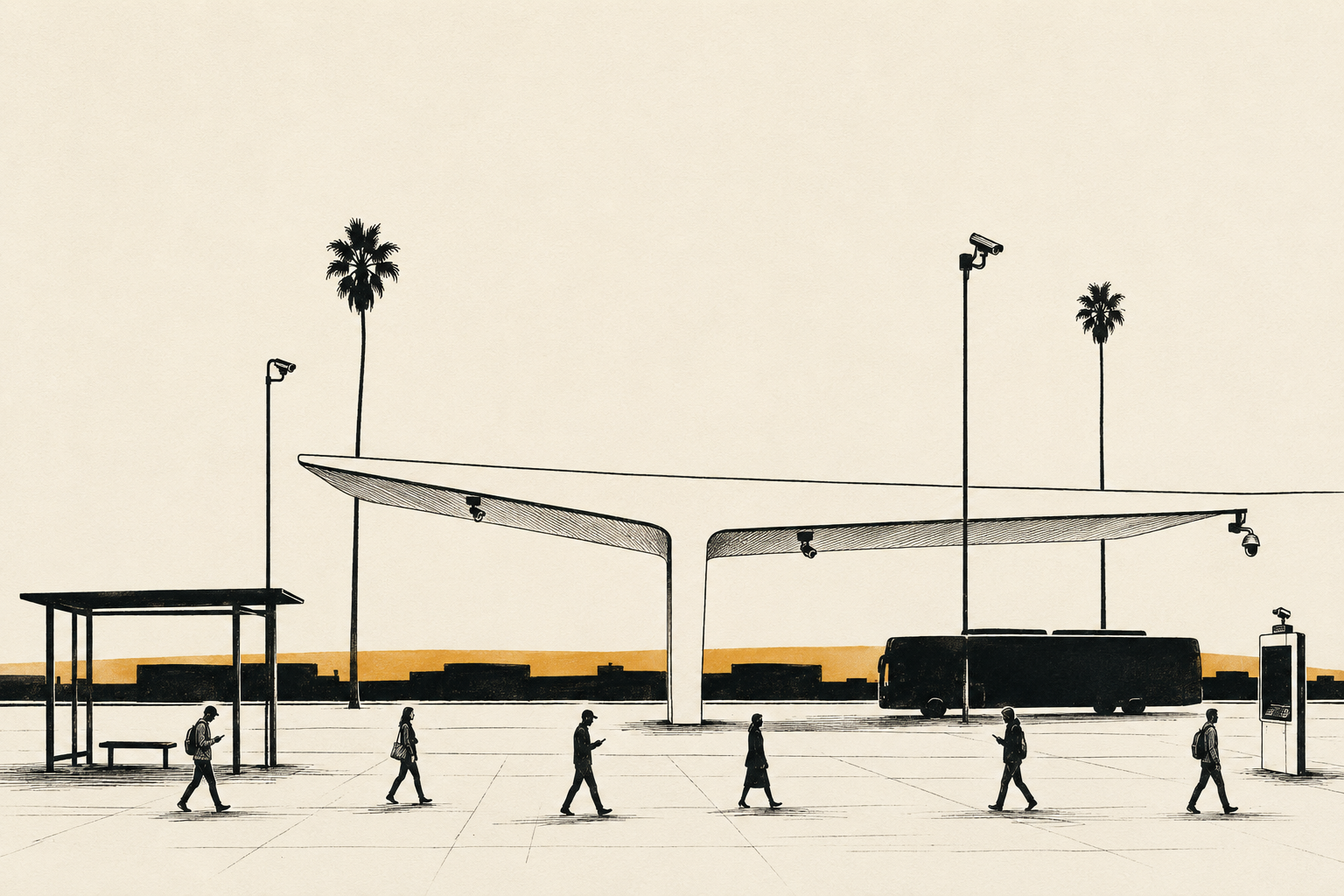
The first layer is the delivery infrastructure, supply vans, freight cycles, autonomous cargo units running pre-dawn routes through streets that are briefly, cleanly empty. The Public Safety Network notes their passage as it notes everything: a camera adjusts its field, a registration plate is read and matched against a logistics manifest, a confidence value assigned and logged. The units move. The cameras watch. Neither is aware of the other in any sense that has meaning.
The second layer is the workers, the people whose employment begins before the city’s social hour, the sanitation crews and early kitchen staff and overnight security guards ending their shifts with the gait of people who have been still too long. The Network reads their transit passes as they feed through the Santa Monica hub turnstiles. Reads their faces at the intersection biometric points, a brief wash of infrared, a fraction of a second, a confidence match filed in a database whose physical location no individual member of the public could identify.
They don’t feel the reading. Nobody does.
Metro Sector 7 · Passive collection · Pre-dawn
[2035-05-15 05:44:18] SUBJECT_UNRESOLVED
Entrada St / 4th St intersection — CAM_07_SW
Male, approx. 24-26, unresolved biometric match
Transit pass: NOT PRESENT
Behavioral pattern: TRANSIT_ALT_ROUTE
Moving: NORTHEAST at elevated pace
Confidence match to residential registry: 67% — BELOW THRESHOLD
Cumulative sector appearances, rolling 30 days: 16
Flag: NOMINAL
The young man moves through the pre-dawn streets at a pace faster than a walk and less regular than a run. He navigates rather than travels, choosing lines through the built environment that are not the lines it was designed for. The cameras on their poles watch him from above and at angles and occasionally lose him, which the system notes without interest because loss of tracking is not anomalous for subjects who are not flagged.
He vaults something. A wall. The camera at the next intersection picks him up eight seconds after the previous camera loses him, implying a route the cameras between them do not cover. The system notes this gap. Files it.
He stops at the retaining wall on the north edge of the Palisades park. Runs along the top of it for forty feet. Drops to the lower grade on the far side, clean, practiced, the weight absorbed through bent knees and momentum carried forward without pause.
Behavioral tag: PARKOUR_ASSOCIATED. Non-criminal. Non-suspicious. Filed.
He doesn’t look at the cameras.
The ones who still look at cameras are tourists and children and people with something to be nervous about. This young man’s avoidance is not a nervous man’s. He has thought about the cameras more carefully than most people and made a deliberate decision about how to move around them.
The system doesn’t think about this. The system files the confidence score, 67%, below threshold, and moves on.
[2035-05-15 06:31:02] SUBJECT_7741-F / CALLOWAY, CASSANDRA M.
Transit Hub — Santa Monica Blvd / Lincoln Blvd
Biometric match: CONFIRMED (99.2%)
Destination flag: GYM_AFFILIATED_VENUE (recurring, 3x weekly)
Behavioral pattern: ROUTINE
Flag: NOMINAL
She fed her transit pass through the reader without breaking stride and boarded the northbound local. The train’s internal cameras picked her up in a window seat. She was looking at her phone. Across from her, a man in work clothes was asleep against the window, his breath fogging the glass in a small regular oval. A normal train at a normal hour.
Cass’s phone buzzed. She read it. The involuntary beginning of a smile, not quite arriving, just its leading edge. She typed back quickly.
The train exited coverage at 06:35:44.
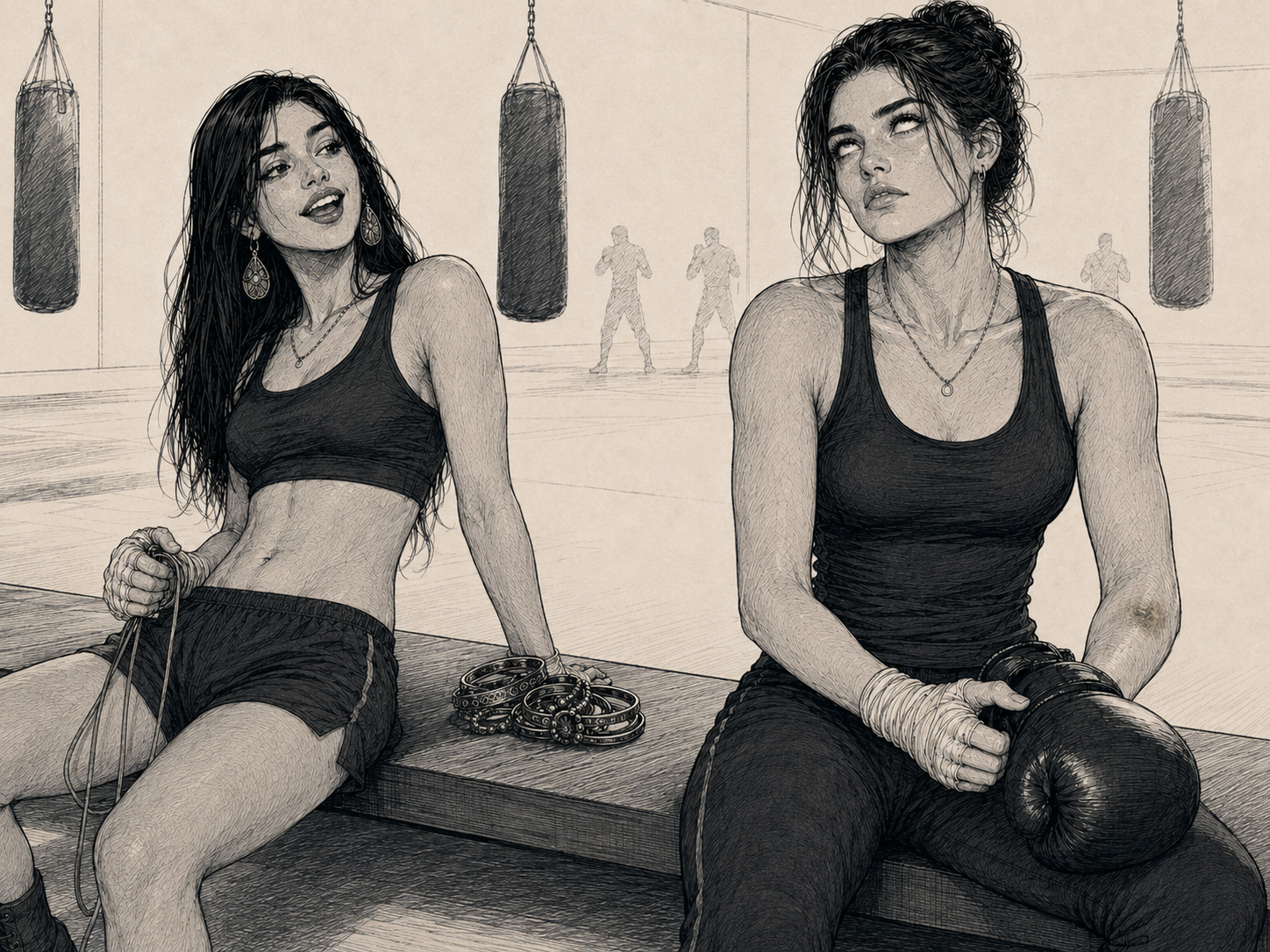
At the gym on Wilshire, Cass dropped her bag on the bench in front of her locker and started wrapping her hands with the automatic ease of long practice. The gym smelled of clean sweat and rubber matting and the metallic tang of a space where people hit things. The morning class was starting in the main room, she could hear the coach’s voice over the music, counting something.
Sam was already there when Cass came through the door, skipping rope in the corner with a focused expression that deteriorated immediately into something more social when she saw Cass. She caught the rope mid-swing and held it.
“Okay, first of all,” she said, before Cass had put her bag down, “you have the face.”
“I just walked in.”
“I know. You had it before you walked in. I could see it through the window.” Sam pointed at the strip of glass along the top of the gym door, which was approximately four inches tall and frosted. “Approximately.”
Cass sat on the bench and started pulling gloves from her bag. “I don’t have a face.”
“The face is—okay, it’s like this.” Sam adopted an expression of intense preoccupied absorption, eyes slightly unfocused, brow furrowed, the look of being physically present and mentally three rooms over. “That’s the face. You do it when something is interesting and you haven’t finished with it yet.”
“That’s just my face.”
“It’s your face when your brain is eating something. Normal-Cass has a different face. I have documented evidence.” Sam resumed skipping. “What was it this time? Please tell me it was something fun. I need you to have done something fun last night.”
“Research paper,” Cass said. “Uppsala. CRISPR delivery mechanisms in pancreatic tissue.”
Sam slowed the rope. “That’s not fun.”
“It’s interesting.”
“Cass. My love. The two things are not synonymous.” Sam caught the rope again and wrapped it over her wrist. “What was wrong with it?”
“Their dosing model is off. They’re seeing an immune response in the trial data and blaming the carrier, lipid nanoparticles, but the timing is wrong. The inflammatory marker peaks about forty minutes later than it should if the nanoparticle were actually causing it.” Cass pulled the first glove on and flexed her fingers. “Which means something else is triggering it and they’re looking at the wrong variable.”
“And you figured this out at midnight.”
“I figured it out around one-fifteen, actually. Although I had help getting pointed in the right direction.”
“AM? Help from who? You don’t have a lab partner who’s awake at one-fifteen. You barely have a lab partner who’s awake at one-fifteen in the afternoon.”
“It doesn’t matter.” Cass said this a half-beat too quickly, and Sam, whose entire sensory apparatus was calibrated to detect exactly this kind of half-beat, stopped skipping.
“Oh, it absolutely matters now,” Sam said. “Who?”
Cass exhaled. “I ran into my neighbor in the laundry room last night. We were talking. He asked the right question without knowing it was the right question.”
“Your neighbor.”
“Yes.”
“The building guy. The grocery guy.” Sam abandoned the rope entirely. “Last time, you said his name once and then changed the subject so fast I got whiplash. Cade. Third floor. Computer person. You described him as a nightowl with a zombie-aesthetic.”
“That’s the one.”
“And he just, what, casually solved your Swedish nanoparticle problem in the laundry room?”
“He didn’t solve it. He asked what the payload was and then said something about the carrier degrading early, which was the thing I wasn’t looking at.” Cass pulled the second glove on. “He doesn’t even know any biology. He said the logic was the same regardless of the domain. Which is annoying, because he was right.”
Sam was staring at her, handed a gift she did not expect and intending to enjoy it thoroughly. “So let me make sure I’ve got this straight. You met a man in a laundry room. He listened to you talk about your research. He asked a question so good it kept you up until one-fifteen solving it. And your takeaway is that it’s annoying.”
“It is annoying.” Cass groaned.
“That is the most romantic thing I’ve heard all year and you’re annoyed by it.”
“Romantic? There’s nothing romantic about biology studies in a laundry room.”
Sam narrowed her gaze and smirked. “I can think of at least three dirty movies that will disagree with you.” She made a gesture with her hands approximately waist-width apart and shook them rhythmically.
Cass rolled her eyes at the innuendo hard enough for them to roll out the door. “You’re so obnoxious. It’s not romantic. It’s irritating to be out-reasoned about your own field by someone who looked up CRISPR once for an unrelated reason.”
The Wilshire gym · Morning class
“Cass.”
“What?”
“You’re smiling.”
“I’m not.”
“You did the face again. Different face. New face.” Sam pointed at her with the jump rope handle. “I’m cataloging this one too.”
Cass turned to the heavy bag to hide what was, in fact, the face, and landed a combination on it. “Can we train? Please?”
“Sure,” she began, sounding innocent at first. “We can train. We’re not done though. We’re definitely coming back to this.” Sam planted herself at the next bag over, fond and relentless, settling in for a conversation she intended to keep having. “Also, how is his laundry?”
Cass almost laughed, the involuntary kind, the kind that arrives before you’ve decided to let it. She looked up and thought. “Optimistic,” she said.
[2035-05-15 08:31:14] SUBJECT_4402-M / MIHN, KI SOU
Business registration scan — KM Electronics and Repair, 1213 4th St
Biometric match: CONFIRMED (98.7%)
Business license: CURRENT
Tax registration: CURRENT
Anomaly score: 0.0
Flag: NOMINAL
The camera on the utility pole across the street from KM Electronics and Repair could see through the front window, the angle was not ideal but the glass was clear and the shop’s interior lighting was sufficient. A man at a workbench. A soldering iron. A circuit board clamped in a vice. The complete, unhurried concentration of real work.
The system watched this the same way it watched everything: because it had been positioned to watch this block and it did what it was designed to do.
Inside, Ki was on the phone.
“I know what you quoted me,” he said, to whoever was on the other end. “I also know what the component is worth, which is a number that exists in the world and is lower than the number you said. I’m not arguing with you. I’m telling you the number.” A pause. He turned the circuit board forty-five degrees in the vice and examined the joint from the new angle. “Right. Yeah. If that’s where we are, I’ll go somewhere else.” Another pause, shorter. “I know you don’t want that. I don’t want that. So let’s talk about the number.”
He put the phone between his shoulder and his ear and picked up the soldering iron. He had been doing two things at once for so long it no longer registered as multitasking. It was simply the pace of his mornings.
The negotiation went on for four more minutes. It ended in a number that was eleven percent below the original quote, which was approximately what Ki expected and slightly better than he had told himself to settle for. He put the phone down and went back to the board.
A customer came in at nine-twelve, a woman in her forties with a cracked screen on a Compact-issued work tablet. She set it on the counter knowing she needed help and prepared to be overcharged for it. Ki looked at it. Turned it over. Pressed the power button.
“Does it still work?”
“The screen cracks when I scroll, but yeah.”
He nodded. “Screen’s separating from the frame, the digitizer’s intact. New adhesive, maybe a brace on the corner. Two hours.”
“How much?”
He named a price that was fair and she looked at him with the suspicion you bring to a price lower than you expected, that something must be wrong. Nothing was wrong. He just charged what the work cost.
“Come back after noon,” he said.
She thanked him. She left. He put the tablet on the repair shelf with a label on it and went back to the circuit board. On the shelf above the workbench, visible through the back wall’s open doorway, there was something in a half-assembled state on a separate workbench, a device whose purpose was not immediately evident from the components visible around it. A custom enclosure, machined rather than printed. PCB traces in a configuration that didn’t match any commercial design standard. Ki glanced at it once, something he was thinking about in the background of everything else, and went back to his work.
[2035-05-15 09:50:02] SUBJECT_4402-M / MIHN, KI SOU
Business activity summary — KM Electronics and Repair, 1213 4th St
Operational activity: DEVICE_REPAIR (routine)
Customer interactions: 1
Anomaly detection: NONE
Environmental scan: NOMINAL
Flag: NOMINAL
[2035-05-15 10:44:33] SUBJECT_7741-F / CALLOWAY, CASSANDRA M.
WAIT Campus — Main Entrance / Biometric Gate
Biometric match: CONFIRMED (99.1%)
Companion: SUBJECT_8814-F / REYES, SAMANTHA A.
Behavioral pattern: ACADEMIC_ROUTINE
Flag: NOMINAL
They came out of the transit stop into the kind of LA morning that was neither cool nor warm but existed in a pleasant medium that would be gone by eleven. Sam was towel-drying her hair as she walked, which she did by draping the towel over her head and walking forward with the towel obscuring everything above her nose, which Cass had pointed out was a safety hazard on a city sidewalk on at least four separate occasions.
“I can see fine,” Sam said, from inside the towel.
“You can see the pavement.”
“That’s the important part.”
Cass steered her around a woman walking a very small dog. The dog looked up at Sam’s towel situation with open alarm. “You almost stepped on a dog and… now he’s judging you.”
Sam peeked out from under the towel then shrugged dismissively.
“The dog is a chihuahua. They judge everything. It’s not personal.” Sam emerged from the towel and surveyed the street, visibly satisfied to have navigated it despite reasonable odds. “Okay. Back to it. You said he’s strange like he chose it. Explain what that means.”
Cass thought about how to say this. “Some people are socially awkward because they can’t help it. It’s a deficit. They want the normal interaction and it doesn’t come naturally. He’s not like that. He’s withdrawn in a way that feels deliberate. Like he looked at the available options and made a considered decision about which ones were worth his time.”
“Arrogant?”
“No. More like… he has a different accounting system. For what counts as worth it. I’m guessing he’s the type that has been disappointed a few too many times.”
“And somehow you ended up on the worth-it side of the ledger.”
“We had one conversation about my research. I don’t think it means anything about me in particular.” She pauses. “He’d probably ask useful questions about anyone’s research if he was stuck in a room with them and nowhere else to go.”
Sam was looking at her with an expression she’d learned to identify as Sam constructing a counterargument she found self-evidently correct. “Okay but here’s the thing,” Sam said. “You just spent two sentences explaining why you’re not special to him. That he was stuck in a room when you know he chose to be in the room. That’s a very specific thing to spend time on.”
Cass opened her mouth. Closed it.
“I’m just observing,” Sam said virtuously.
“You’re doing significantly more than observing.”
“I’m a scientist. Observation is foundational. Inference is the natural follow-up.” She spotted the coffee cart outside the academic building and accelerated slightly. “Paulo!”
Paulo, who had been running a coffee cart outside this building since before either of them arrived on this campus, looked up from behind his equipment with the unhurried expression of a man who knew what he was about to be asked. He was somewhere in his fifties, compact and self-contained, a man who had arranged his life exactly as he wanted it and had no further adjustments to make.
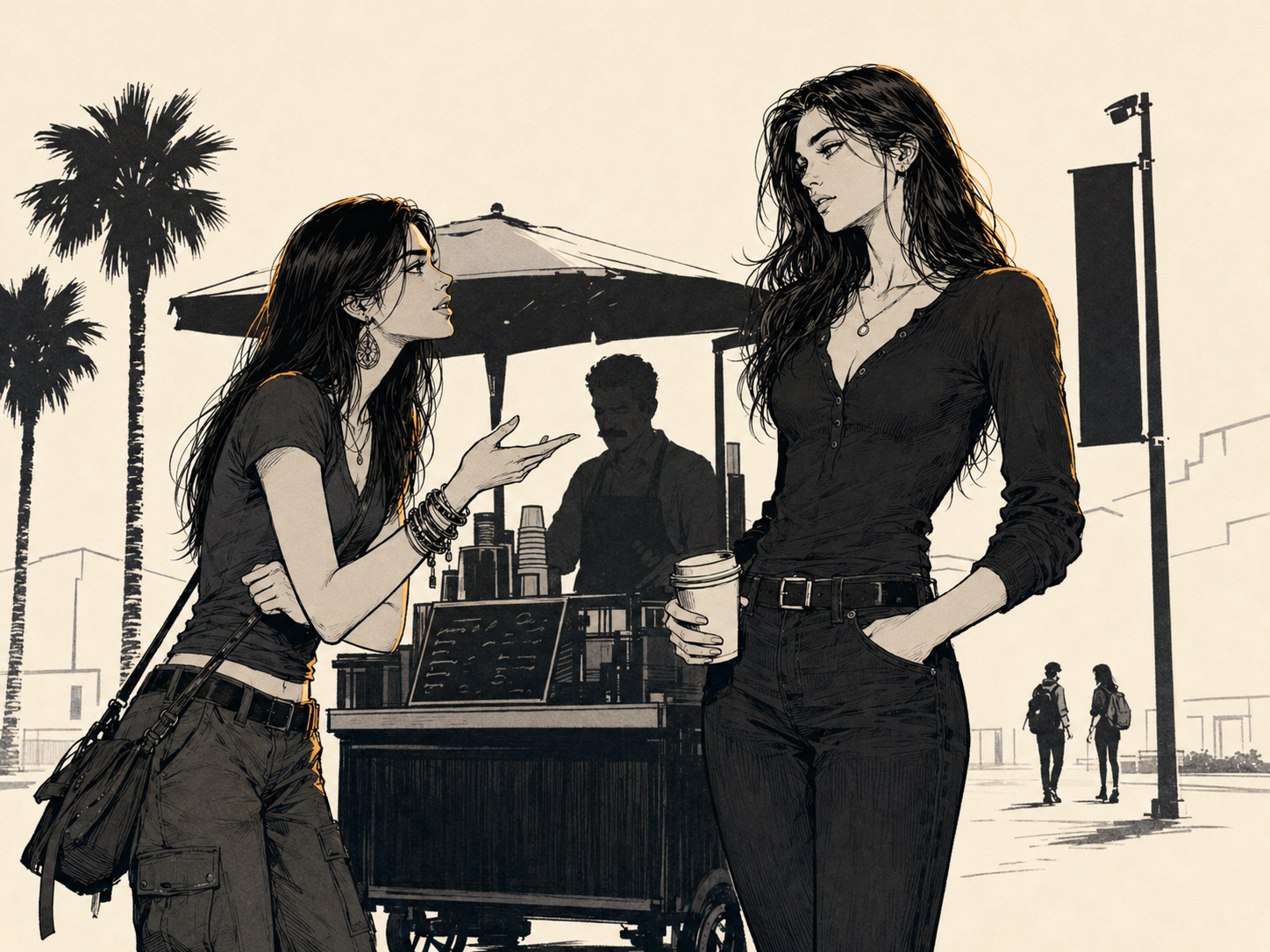
Paulo's cart · WAIT quad · Morning
“The usual?” he said to Cass.
“Please.”
He had already started it. He looked at Sam.
“I want to try something different,” Sam told him, with the gravity of someone announcing a significant life change.
Paulo regarded her. He had been making Sam’s order, unchanged, for seven months. He didn’t say this. He said: “What do you want?”
“I want whatever you’d get. If you were getting something.”
This landed differently than Sam expected. Paulo actually paused, a small pause, the kind that means someone is taking a question seriously rather than performing consideration. He named something. Sam agreed. He made it.
“He remembers everyone’s order,” Cass said, while they waited. “Hundreds of people. I’ve decided it’s either impressive efficiency or slightly alarming surveillance and I go back and forth on which.”
“It’s neither, it’s a memory palace,” Sam said. “He’s running some kind of system and this coffee cart is secretly his life’s work.” She leaned against the cart’s side with the familiarity Paulo tolerated from exactly two students on this campus, neither of whom were aware that they had been quietly granted a status the other four thousand students had not. “Paulo. Do you know a tall guy, kind of lanky, circuit tattoo on his arm, always has his head in his computer or phone?”
Cass closed her eyes briefly. Exhaled.
Paulo handed Cass her cup without looking up. “Looks like a zombie?”
“That’s the one.”
“He stops by here sometimes. Early. Before most people.” Paulo handed Sam her cup. “Usually looks like he didn’t sleep.”
“Does he talk to you?”
“No. He nods.” Paulo said this without judgment, in his matter-of-fact analysis, nodders and talkers were equally valid. “Good tipper.”
“A man of quality,” Sam said.
“Sam,” Cass said.
“I’m building a profile.”
“You’re interrogating a coffee cart vendor.”
“I’m gathering publicly available information from a willing source.” Sam took a sip of the new drink. Her eyebrows went up. “Oh, that’s very good. Why did I get the same thing for six months?”
“Because change is frightening,” Cass said.
“Said by the woman who orders the same thing every single time.”
“I know what I like.”
“You know what’s predictable. Those aren’t the same thing.” Sam took another sip, gestured with the cup. “Anyway. Paulo just independently confirmed that our subject is an interesting person.”
“Paulo confirmed he doesn’t sleep and tips well.”
“Which are both data points about character.” Sam held the building door. “I maintain that the universe is trying to tell you something.”
“The universe is not—”
“Post-session debrief. After your next laundry encounter. I want everything.”
“There won’t be—”
“Everything,” Sam said, and went in.
[2035-05-15 12:22:09] SUBJECT_UNRESOLVED
Consistent with prior entries — Entrada District
Moving toward: commercial district, Pico Blvd corridor
Behavioral pattern: UNCLASSIFIED ERRAND
Biometric match: 69% — BELOW THRESHOLD
Flag: NOMINAL
He ate standing at the counter of the noodle bowl place, which was his habit. The woman behind the counter, whose name was Linda and who had been running this place since 2031 with her brother-in-law and who did not particularly want to know the names of her regulars but had come to know their faces, their orders, and their approximate emotional states on arrival, set his bowl down and said nothing, because nothing was required. He had been coming here for eleven months. He always ordered the same thing. He always ate at the counter.
Today he looked like something was running in the background.
“You okay?” she asked. Not out of concern exactly, more reflex; she had watched enough people stand at her counter to know the difference between ordinary quiet and the occupied kind.
“Fine,” he said. “Thanks.”
She nodded and went back to the prep counter. He finished eating. He paid. He left.
Linda watched him go. She would remember this in a few weeks, when the people came asking about him, and she would tell them exactly what she told them: that he came in, he ate, he paid, he left. That she didn’t know his name. That he was always polite. That something was going on with him today, but then again, something is always going on with somebody.
She didn’t know this yet. Today she just watched him leave and went back to the prep counter.
[2035-05-15 21:17:44] NIGHT SURVEY — SECTOR 7 RESIDENTIAL
Automated thermal scan — building occupancy confirmation

UNIT 2B — SUBJECT_7741-F / CALLOWAY, CASSANDRA M.
Thermal signature: PRESENT
Activity: SEDENTARY (study behavioral pattern)

UNIT 3B — UNRESOLVED (consistent with prior male subject)
Thermal signature: PRESENT
Activity: ACTIVE_SEDENTARY (terminal work behavioral pattern)
Note: Subject not biometrically resolved in 30-day window
Note: Consistent avoidance of biometric confirmation points
Note: No criminal association. No active flag.
Anomaly score: 0.1 — NOMINAL
The building on Entrada Street was quiet at twenty-one hours. The Network watched it from outside the way it watched everything, without preference, without judgment, without anything resembling the qualities that would make watching mean something.
On the second floor, in 2B, a woman was reading. The tablet on the table beside her had a new annotation in red ink added sometime around twenty hours ago, several lines long, more certain in its phrasing than the ones that preceded it. She had already sent the email to Uppsala, polite in its framing, unambiguous in its argument, and was now reading the next paper in the chain, the one the first paper cited, following the thread backward as she did when something had caught her and wouldn’t let go. She scrolled back up to the latest response, received that morning. This would be the third time she read it. Something changed in her expression. There was weight in the reading. Her head fell back against the couch cushion and her gaze rested on the ceiling. She inhaled deeply. Held it.
Then she laughed.
On the third floor, in the unit directly above hers, a man was working. On one of his monitors there was a reconnaissance terminal and on another there was a notes document with several new entries, one of which was a single word, NIGHTGLASS, with a question mark after it. He worked through the terminal output with the patient, methodical attention of someone for whom this kind of work was the most honest version of themselves. Occasionally he stopped and looked at the notes document. Occasionally he looked at the floor, which was also the ceiling of the apartment below him.
The system could not see any of this. The system knew only that two people were present in adjacent units, their thermal signatures consistent with their established behavioral patterns, their anomaly scores nominal, their flags clear.
What was happening in the rooms was outside the Network’s field.
This was, for now, where the Network ended.
END COLLECTION PERIOD EXCERPT

Total subjects processed, 24-hour window: 44,291
Active investigations: 0
Subjects of interest: 0
Anomaly score, sector average: 0.03 — NOMINAL

This log has been automatically filed.
No human review has been requested.
No human review is required.
No human review will occur.
The system is always running.
It was running before any of them arrived in this city. It will be running after they leave it. It was built in the years after the Burn and the riots that followed. The people who built it told the public that this was what safety looked like now, that the price of not going through all of that again was visibility, transparency, the permanent condition of being known. The public, exhausted and reduced, having seen what the alternative produced, mostly agreed that this was probably right.
It is running now.
The man on the third floor, the one the system has failed to biometrically resolve in thirty days of observation, the one who moves in the shadow of the cameras with the fluency of someone who has thought carefully about where the shadows are, will, in approximately three weeks, become a subject of interest. His anomaly score will not be 0.1. His flag will not be NOMINAL. The system will be directed to compile its accumulated record of his appearances, his behavioral patterns, the sixteen times it watched him move through this sector without being able to say with certainty who he is.
The record will be extensive. The record will be, in its way, intimate.
It will contain none of the things that mattered.
Not the laundry room. Not the folding counter. Not the inch or the loose thread at the door or the email that was not yet sent when the night began and was sent by the time it ended. Not the way a person looks when they are told something about someone else that updates a model they were building without knowing they were building it, and they decide not to show that it matters, and it matters anyway.
The system will not have any of this.
The system will have forty-four thousand two hundred and ninety-one transit records and seventeen thermal signatures and sixty-three camera sightings of a young man who consistently failed to meet the confidence threshold for identity resolution.
It will not have him.
It will think that it does.
This is the thing about the system that the people who built it understood and the people who use it have mostly forgotten: it sees everything and it knows nothing. It collects the shape of a life and mistakes the shape for the life. It builds a file on a person and mistakes the file for the person. It watches without ceasing and understands without exception absolutely nothing about what it watches.
For now, the building on Entrada Street is quiet.
Two people are in their respective rooms, one floor apart, thinking about things the system cannot see.
The system watches the building from outside.
The system will always watch.
This is what was asked of it.
This is all it can do.