Act 0 · Null Witness
Chapter 0.13
Unresolved
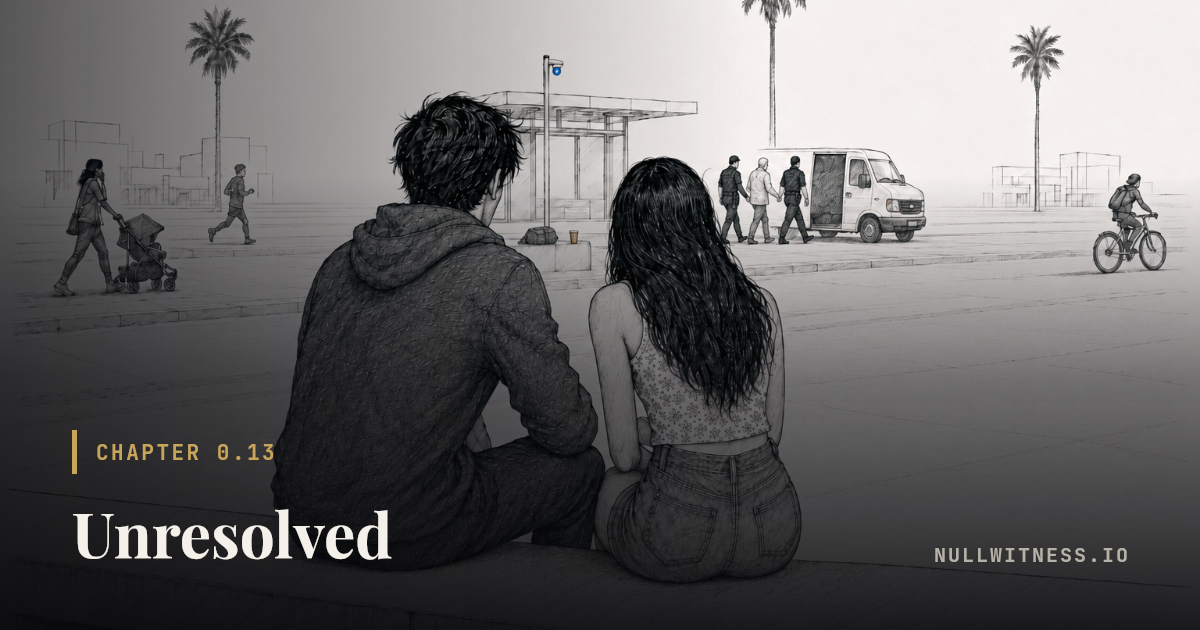
23 May 2035, Wednesday, late morning
We walked back toward campus at the pace of a morning that had taken more than it should have, not slowly, exactly, but without any hurry to arrive anywhere either. 4th Street was doing its late-morning version of itself: the sandwich shop two doors down from Ki’s already had a lunch line starting, the Playhouse marquee advertising something none of us were going to see, delivery trucks working the loading zones, unbothered, the drivers long past caring how long it took. We turned south, then east when the street told us to, the walk toward Pico settling into the rhythm a walk settles into when nobody’s decided how fast it needs to be. Cass had the tablet against her chest with both arms, the way you hold something you’ve already lost once.
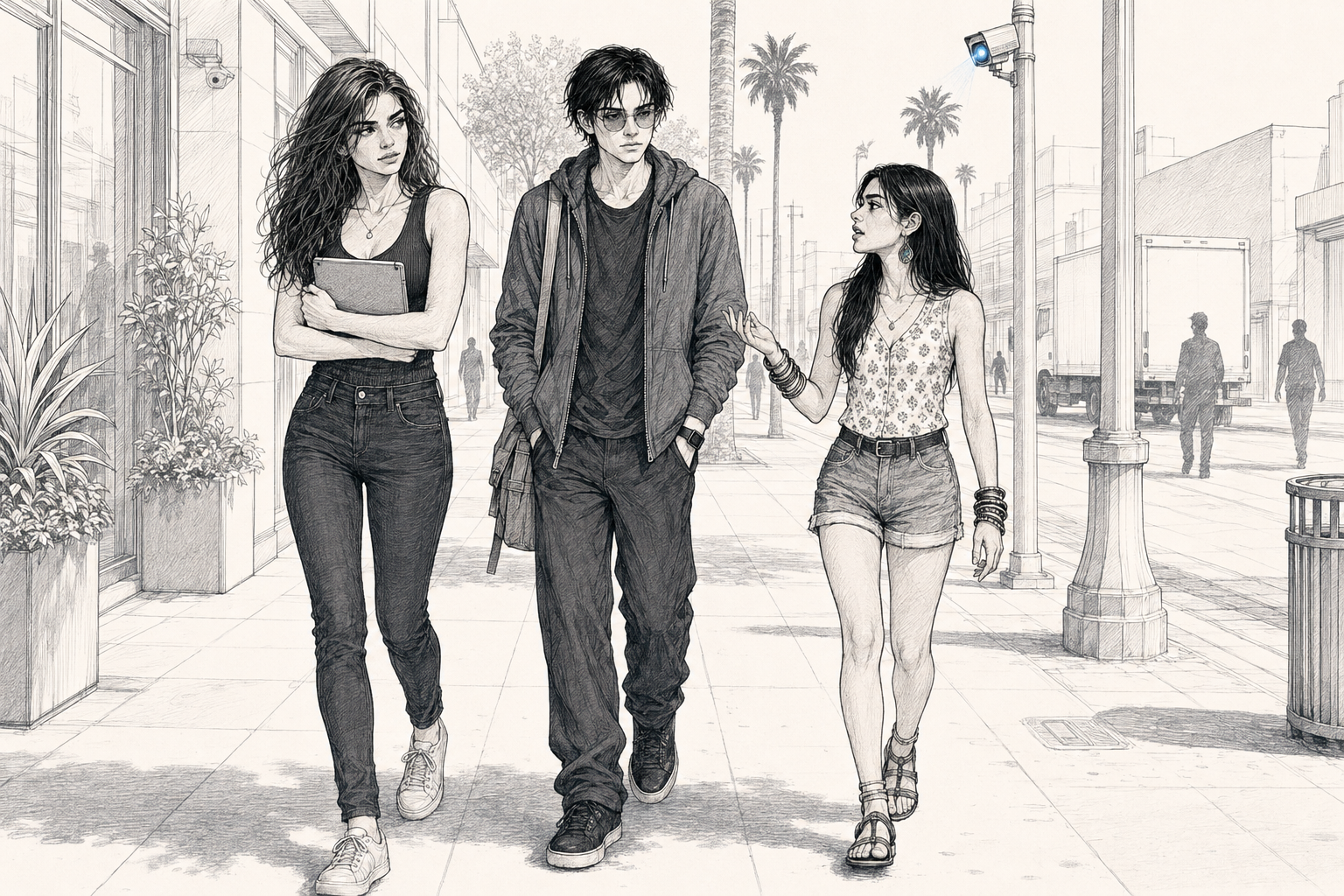
4th Street · the walk back
“I still have to finish the discussion section,” she said, mostly to herself. “And the citations aren’t formatted. And Delaney wants it by eleven-fifty-nine like the extra four minutes past midnight would somehow be the thing that ruined my credibility.”
“What’s it actually on?” Sam said. “The paper.”
“Degradation kinetics. Whether a compound stays stable long enough to be useful outside a lab freezer, basically. If it breaks down too fast in normal storage conditions, it doesn’t matter how well it works in the trial. Nobody in an actual clinic has a lab freezer.” Cass shifted the tablet to one arm. “The Uppsala data mostly supports the framing. Delaney thinks the framing undersells the failure cases.”
“Does it,” I said.
“A little,” Cass admitted. “I know exactly which two paragraphs he means. I’ve known since Tuesday. I just haven’t fixed them yet because fixing them means admitting he’s right, and I wanted one more day of being annoyed about it first.”
“That’s allowed,” Sam said. “You get a day.”
“I got a day. Today’s the day the day ends.”
We crossed at the light. Cass didn’t say anything else about the paper. I didn’t ask her to.
“So what’s your deal?” Sam said to me, filling the space Cass’s silence had left. Then, before I could decide how much of an answer that deserved: “Actually, don’t. I already know you’ll give me four words and call it complete. Ask me instead.”
“Okay,” I said. “What.”
“Wrong question. You’re supposed to ask what to ask.”
“What should I ask.”
“Better.” She looked satisfied. She had gotten exactly the outcome she’d engineered. “Ask me why marine biology.”
“Why marine biology.”
“My dad’s a marine biologist. Actual one, tenure and everything, does reef surveys off the Coronado Islands twice a year and comes back sunburned in exactly the same three places every time.” She said it like a fact she enjoyed having, not one she was performing. “My mom teaches high school chemistry, which means dinner conversation growing up was two people who both thought explaining things correctly mattered more than being interesting about it. I did not have a choice, structurally. I was raised by a pH scale and a guy who could identify a fish by its silhouette from forty feet.”
“That sounds deliberate.”
“It wasn’t deliberate. It was just what the house was.” She shrugged, easy about it. “I got the full ride here, which my dad still brings up more than I do. I think he tells people at conferences. I have no proof. I just have a feeling.” She tipped her head. “My brother didn’t go in for any of it, not the ocean, not the science, not the being-right-at-dinner. Went his own way early. My dad’s never quite forgiven the ocean for losing that one.”
“He’s proud of you,” Cass said. “He called while we were getting coffee a few weeks ago just to tell you your scores had come back. Put you on speaker before you’d even said hello.”
“That’s because it was good news and everyone in the vicinity deserved to hear it.” Sam didn’t even pretend embarrassment. “He’s insufferable about it. Those aren’t mutually exclusive.” Sam glanced at me. “Your turn. Where are you from?”
“Ohio.”
“Exciting,” Sam said, mostly out of politeness.
“I can promise that is the least true thing you can say about it.”
“Worse than boring?”
“More like consistently ancient and dull, and nearly inescapable.”
“What do you study, then?”
“Comp sci.” I offered nothing else after it, and didn’t feel the absence as a gap the way she apparently did.
“Did you always want to work with computers?”
“Not really.”
Sam looked at me for a second, then at Cass, then back at me, doing the math on how many words she’d spent to get how little back. “Wow.” She didn’t bother hiding the sarcasm. “Could you maybe try a little harder to let the rest of us get a word in?”
“Sam,” Cass said.
“What! I’m complimenting his economy.”
“You’re being you at him.”
“I’m always being me at him. He usually survives it better than this.” Sam looked back at me, waiting.
“It just was what was interesting to me,” I said, “and the interest happened to make me decent with them. So it’s what I do.”
“See, that wasn’t so hard.” Sam said it like she’d won something, which, in a sense, she had. “What do you do when you’re not doing that?”
“Run, mostly.”
“Like, for exercise, or run run?”
“Does it matter?”
“It might.”
“Exercise, then.” This was underselling it by a margin I didn’t feel like closing.
“Okay. What else?”
“That’s the offering for today.”
“That’s a small offering.”
“It’s what’s on the menu.”
Sam considered this quickly, and with the satisfaction of someone adding a data point to a file she intended to keep open indefinitely. “Fine. I’ll take it in installments.” She said it lightly, the kind of light that meant she’d remember exactly what she’d been given and exactly what she hadn’t, and fully intended to come back for the rest of it eventually.
We reached the library steps before anyone had decided the conversation was over.
Cass split off there. She had a paper due, and she had decided, mid-stride, that the day owed her one uninterrupted hour more than it owed anyone else.
“I’ll see you tonight,” she said, already half-turned toward the doors.
“Tonight,” I agreed.
She looked at me for one more second, the look she gave things she was filing, and went in.
That left Sam.
We walked without a destination, which is a different kind of walking than walking somewhere. The quad ran east toward the biomedical building, its glass catching the late morning at an angle that made it look, for a few steps, like something more interesting than a biomedical building.
“Do you know what Delgado did to me this week?” Sam said, out of nowhere. She had been holding the story a while and had just found the opening for it. “I hand in a notebook. Handwritten, like the syllabus says. He hands it back with a note that says my handwriting ‘introduces ambiguity into the data record.’ Ambiguity. I wrote the number seven. There is exactly one way to misread a seven and it requires you to already be looking for a reason to be annoyed.”
“What’d you do.”
“I wrote back ‘noted’ and changed nothing. I am not learning calligraphy for a man who grades on a curve he’s never once explained the workings of.”
I laughed, which surprised both of us a little, and the conversation moved on without either of us commenting on it. The campus did what campuses do in late May, students on the grass, the unhurried quality of a Wednesday that hadn’t decided yet whether it was going to matter.
We ended up at the bench because the walk ran out of anywhere else to go. Neither of us suggested it. Paulo’s cart was three trees over, doing its late-morning business. Sam sat first. I sat because she had.
“You’re being weird,” she said, at minute four of sitting there.
“I’m always weird.”
“Not your normal weird.” She looked at me sideways. “Quieter.”
I didn’t say anything to that. There wasn’t a version of “I’m fine” that wouldn’t have sounded like exactly what it was.
She let it sit for a while. Behind us somebody ordered something complicated. Then, like it had just occurred to her, though I doubted it had:
“You haven’t touched your phone.”
“I don’t need to.”
“That wasn’t the observation.” She said it lightly, no weight on it yet, just setting it down. “The observation was that you haven’t touched it. Not why.”
“I have a call in a few hours. Client feedback.”
“Okay.” She waited. “Still not the thing I asked.”
I looked at the quad instead of at her. “Checking wouldn’t change anything. It happens when it happens.”
“Sure.” A beat. “That’s not why, though. That’s just true.”
I didn’t answer that.
“You know what your problem is?”
“Several. Pick one.”
“You always give people the flat version instead of the nice version.” She shrugged, like she’d caught herself believing it more than she’d expected to. “Even when the nice version’s also true.”
“Why would I do that.”
“Because you don’t trust the nice thing unless you’ve already survived without it.” She knocked her shoulder against mine, the closest Sam got to comfort that wasn’t a hug. “That’s a little messed up. I respect it.”
“You’re diagnosing me.”
“I’m observing you. There’s a difference.” She said it plainly, no apology in it. “You’re going to be fine. Whatever they say.”
“Probably,” I said.
“You have a terrible relationship with that word.”
“It’s accurate more often than the alternatives.”
“See.” She didn’t say anything else about it. She let it be the last word on the subject, which was somehow worse than if she’d kept going.
For a moment the morning held the picture of two people who had run out of anything that needed saying and were comfortable in the space that left. Paulo’s cart hissed somewhere behind us, steam and espresso, which made the whole quad smell faintly like it was trying to be a café. A skateboard clattered across the quad’s far edge and someone laughed about it. Sam had her eyes closed, face tipped up at the sun, unselfconscious, having decided, for exactly as long as this lasted, not to be doing anything else. It was, by any ordinary measure, a good morning.
That was when the street changed temperature.
It started as nothing, the kind of nothing you register without registering it, two vehicles pulling in at the transit kiosk across from the quad’s western edge, no sirens, no urgency in the movement, nothing that would have made either of us look twice on any other morning. I noticed it peripherally, cataloguing before I’d decided the catalogue mattered. Two officers got out. Unhurried. The doors closed with the quiet of doors that closed like that dozens of times a day and had stopped needing to announce themselves.
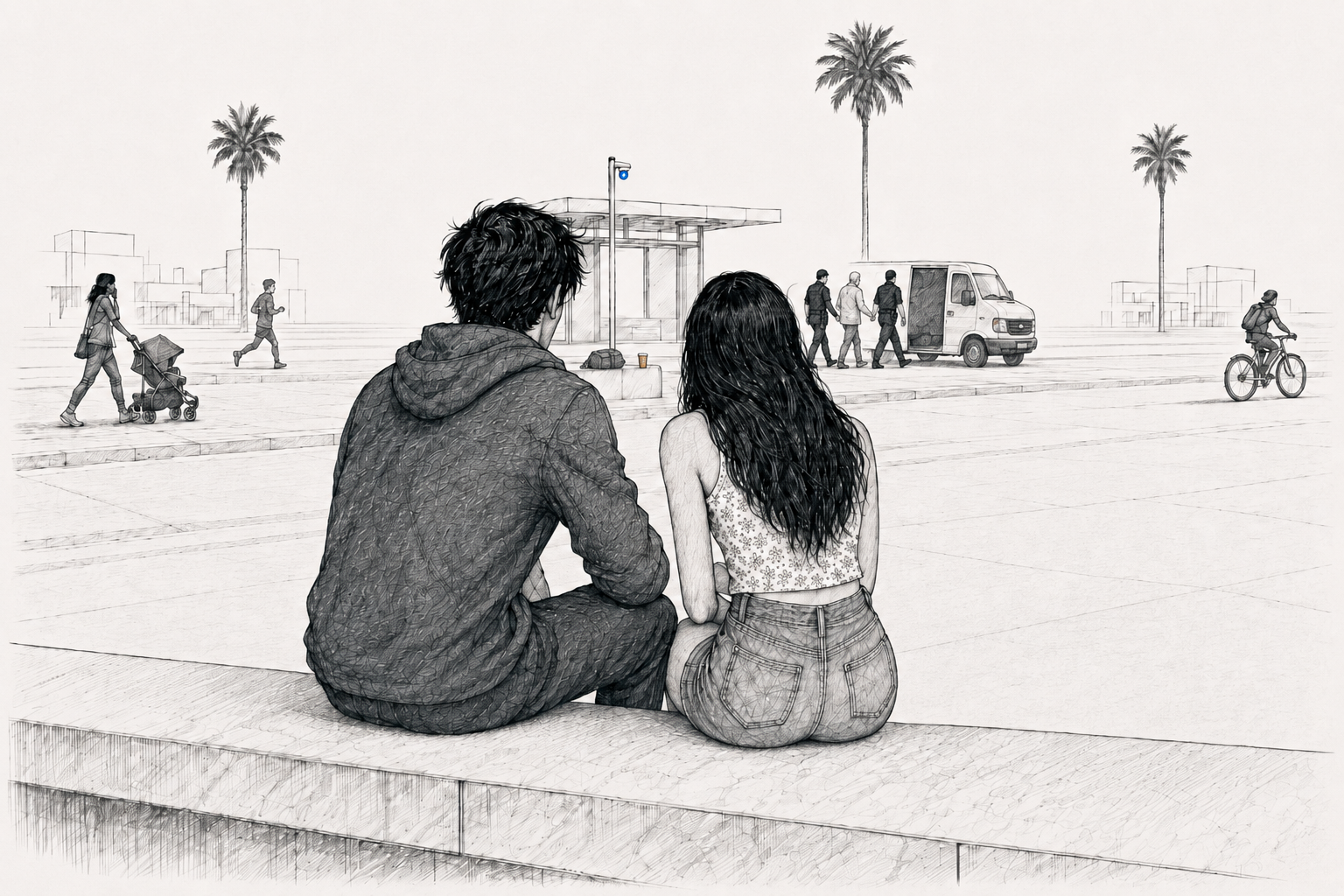
The quad's western edge · ninety seconds, and nobody looks up
Sam noticed it a half-second after I did, and her whole posture changed, not dramatic, just a small forward lean as she recalibrated what kind of morning this now was.
“Is that—”
It was a man. Older, maybe sixty, a canvas bag over one shoulder with something soft-edged inside it, a paper cup from the coffee stand near the kiosk still in his other hand, half full. He had been sitting on the low wall by the transit stop, from what I could reconstruct, for some period of time before this, long enough that his posture had the settledness of having stopped expecting to need to move soon. The two officers approached without hurrying. One of them was talking. The man was nodding, the coffee cup still in his hand, not resisting anything. He had understood that resistance was not among his available options and had decided, correctly, not to spend energy discovering that the hard way.
Nobody around them was reacting. That was the part I kept returning to as it unfolded across maybe ninety seconds that felt considerably longer. A woman with a stroller adjusted her route by four feet and kept walking, phone already back at her ear before she’d finished the correction. Two students glanced up from twenty feet away and looked back down within a second and a half, unbothered, already elsewhere. A jogger came through the middle of it, threading the gap between the vehicle and the wall without slowing. He had made this exact adjustment enough times that it had stopped registering as an adjustment at all. It read like weather, something the street had learned to route around rather than something the street found remarkable.
The officers walked the man toward the vehicle. He wasn’t handcuffed. Nothing about the scene would have photographed as violence. That was, I understood watching it, the entire design of it, nothing here would ever generate the kind of image that made people angry. It would only ever generate paperwork, and paperwork didn’t trend.
The vehicle pulled away. The street resumed being a street, already forgetting, the way streets are built to.
The bag was still on the wall. The coffee cup beside it, half full, going cold in the sun. A man walked past it without breaking stride, then a pair of students, then someone on a bike who swerved around the wall out of pure muscle memory without appearing to register there was anything on it worth swerving for. Nobody stopped. Nobody would. In an hour, someone from the transit authority or the shop across the street would clear it and it would be like none of it had happened at all.
“They didn’t even take his coffee,” Sam said.
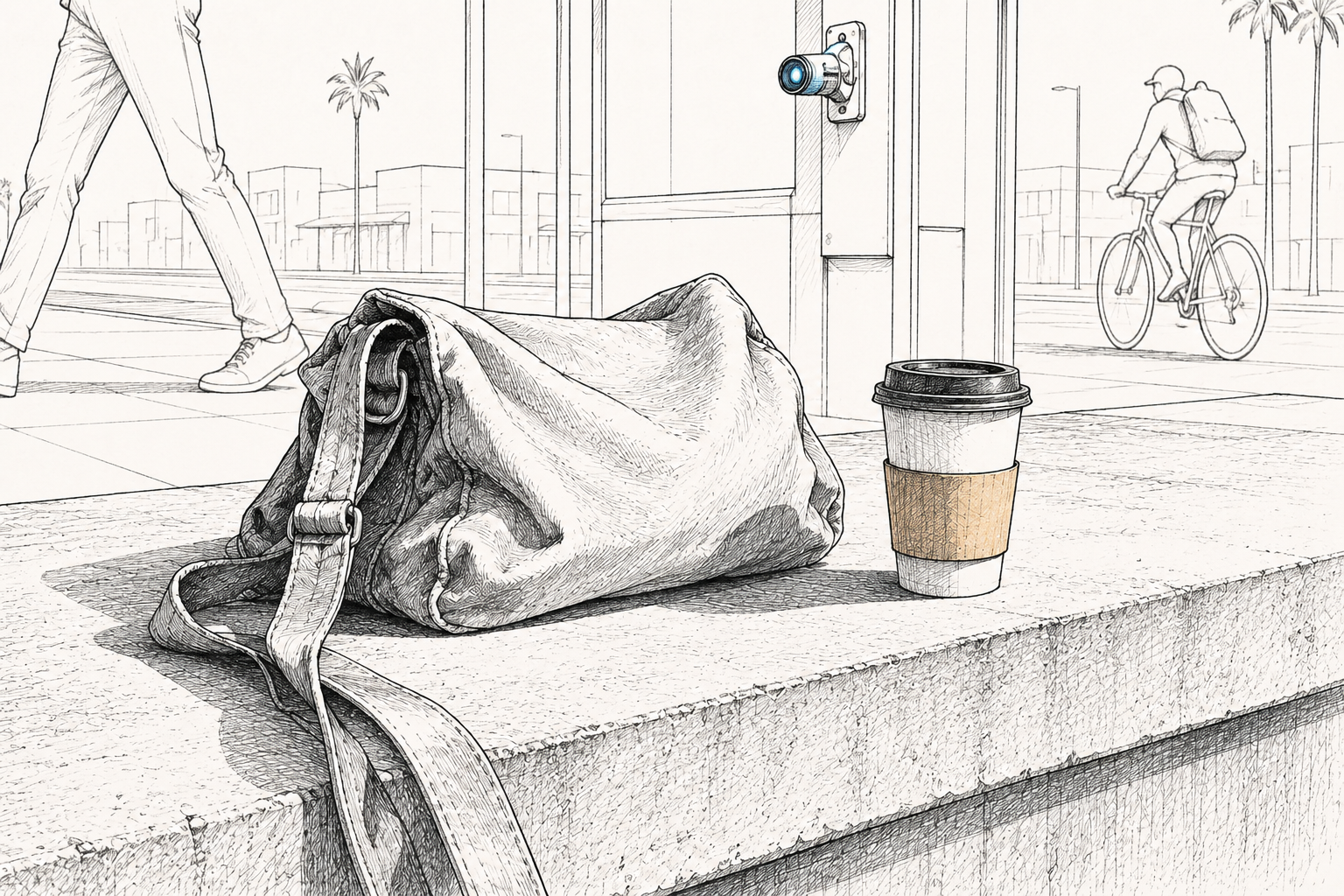
The transit stop · going cold in the sun
It wasn’t the thing to say about any of it, and it was also, somehow, exactly the thing that had gotten through to her, the small human wrongness of a cup going cold next to a bag nobody was coming back for today, sitting there in plain sight while the street walked past it and continued not seeing it, the same way the street hadn’t seen the man himself twenty seconds ago.
She was quiet again after that, for longer this time. When she spoke again, her voice had lost every bit of its usual range.
“I hate that.”
“I know.”
“Not—” She stopped, started again, flatter than I’d ever heard her. “Not just for him. I hate watching it and not being able to do anything about it. I hate what it does to me for the rest of the day.”
“What does it do.”
“Makes me paranoid.” She said it like a fact, not a confession, no hedge anywhere in it. “I start running my own week backward. Where’d I stand too long. Who’d I talk to that doesn’t officially exist. It’s stupid. I know it’s stupid while I’m doing it and I do it anyway.”
“It’s not stupid.”
She read me like that answer had taken something to give, which it had, though I hadn’t decided to give it, it had just arrived ahead of the version I would have built if I’d had time to build one.
For a while she didn’t say anything. The line at Paulo’s cart moved and reformed behind us, and she let the noise of it fill the space I wasn’t filling.
“You know I had a brother teach me the running-it-backward thing,” she said. “Except he didn’t teach it. I just watched him do it enough that it got into me.”
“Watching him do what.”
“Watching him get careful.” She wasn’t looking at the transit stop now, or at me, somewhere past both of us. “Mateo. He’s six years older, and when everything was coming apart he was the kind of angry that walks toward the thing instead of away from it. The late marches, the ones still going after all the sensible people had gone home. He’d come back from them lit up. He was so sure it mattered.” Something moved in her voice and she pushed through it. “It was against the federal stuff, back when there was still a federal to be against. Then the Compact came, and it turned out it didn’t matter which side you’d been shouting for. There was just a record with his name on it. The new people inherited the record, and a record doesn’t care what you meant by it.”
She stopped. I didn’t fill it this time either.
“I was nineteen. We were just walking, a regular sidewalk, the middle of an afternoon, and a van came up over the curb and two of them had a bag over his head and him inside it before I’d finished turning to see what the noise was.” Her hands had found each other in her lap. “And they didn’t say anything to me. Didn’t look at me. They left me standing there like I was part of the sidewalk. Like there was nothing to see. Like I wasn’t even a witness to it.” A breath. “That’s the part that still gets me. Not the van. Being left standing there.”
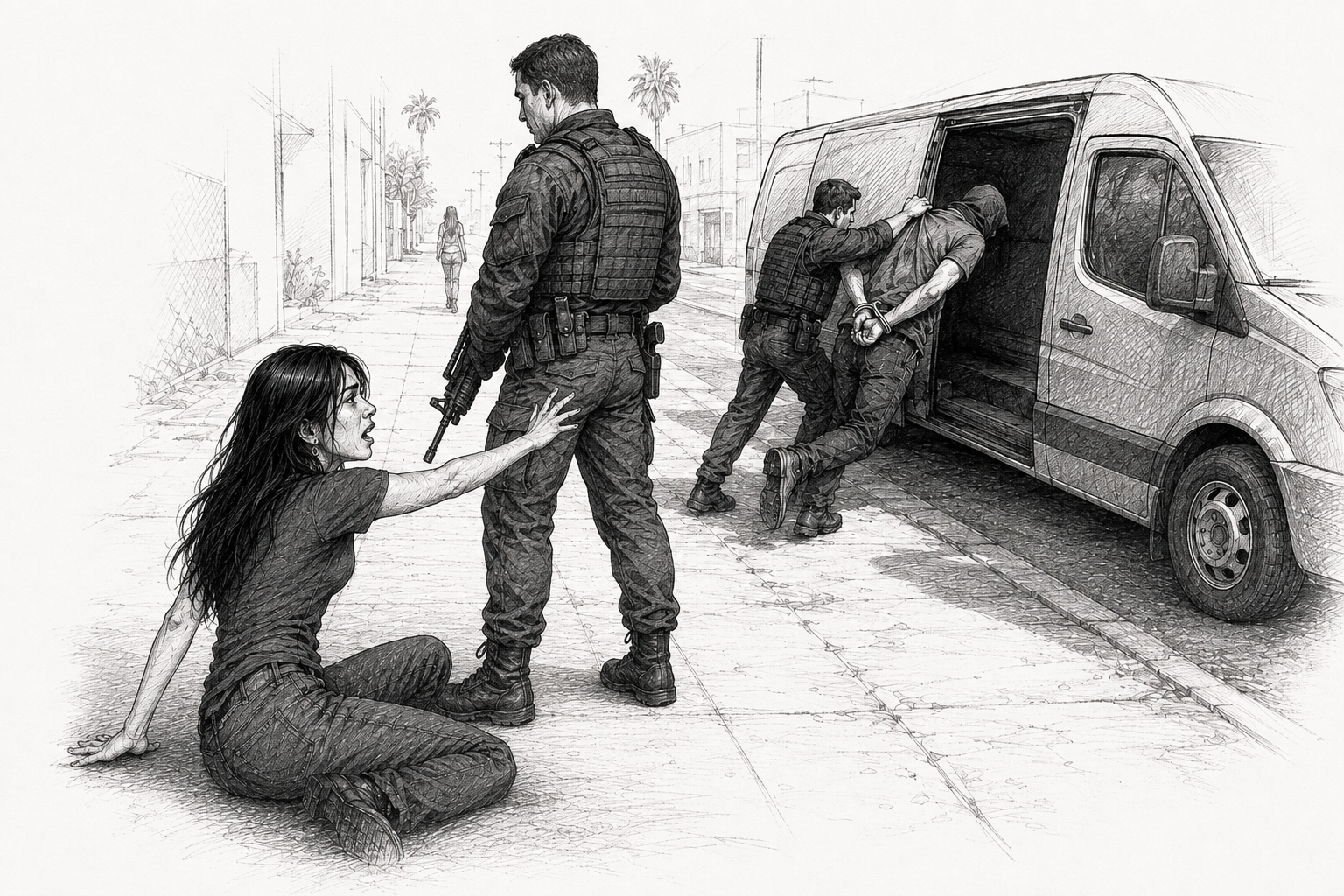
San Diego, 2031 · like I was part of the sidewalk
“How long.”
“Five days.” She was quiet a moment. “And I got him back. Same face. But he came back careful, and he stayed careful. Stopped standing anywhere too long. Stopped saying what he actually thought unless he knew the room cold. He got so good at being someone nobody would bother to open a file on.” Her mouth twitched, not quite a smile. “And the worst of it is that most of that was for us. He’d sat down and done the math on what being near him could take from the people he loved, and he didn’t like the number, so he made himself small.” She looked at me then. “He’s fine now. Good job. Says all the right things to all the right people. He’s so fine I could scream.”
Then she was finished, I watched her close it, the way you watch someone shut a door they’ve decided not to open again today.
She was looking back across at the low wall. “Do you think he’s okay?” Sam said. “Wherever they took him.”
“I don’t know.”
“Guess.”
“Probably fine, technically. A form gets filled out, somebody asks him three questions he’s answered before, they let him go in a few hours with a warning that means nothing because nobody’s tracking whether he complies with it.” I looked at the wall where the cup still sat. “That’s the most likely version. It’s also not really the point.”
“What’s the point?”
“That it happened at all. That it’s going to happen again to somebody else this week, somewhere else in the city, and neither of us will be there to notice it, and it won’t matter whether we do.”
“That’s bleak.”
“It’s just accurate.”
“Those aren’t mutually exclusive either, apparently.” Sam almost smiled at her own callback, then didn’t quite finish it. She was quiet after that, working through it fast, but not so fast it looked easy.
“You don’t have to agree with me,” she said. “You could’ve said something about odds. You’re the type.”
“I could have.”
“Why didn’t you?”
I didn’t have the analytical version ready, and for once I didn’t reach for one anyway. “I run my week back too. I wonder how much of what I’ve done is seen, how much of it doesn’t fit the norm. I don’t fit the norm to begin with, so I’ve tried to just stay unnoticeable. Something as mundane as staying in one place a little too long makes ‘wrong place, wrong time’ a lot more likely than it should be.”
She didn’t fill the pause. She let it sit there, easy, no pressure in it, which was somehow the thing that pulled the rest out of me, ahead of any decision to give it.
“It started with being good at something and wanting people to know it. The catch is that it was the kind of thing you don’t brag about if you plan to keep doing it without collecting felonies. I bragged.” A short breath. “And it didn’t come down on me, not really. It came down on people whose only mistake was standing near me while I decided I was worth watching. Being noticed almost cost me, and them, an entirely different version of my life than the one I ended up with.” I watched the quad. “Ever since, I’ve been uncomfortable being noticed. So I avoid it.”
Sam went quiet in a different way than before, not shut down, more like she was recalculating something.
“That’s twice now,” she said.
“Twice what.”
“Twice you’ve said something straight instead of turning it into a theory first.” She said it lightly, but she was watching me when she said it, the attention of a person filing it somewhere permanent. “First time was the tablet. This morning. You paid Ki before Cass even had her hand in her bag, and when she noticed, you turned it into a whole logistics thing, you’d already been meaning to settle up, it was easier this way, some story I stopped listening to because it wasn’t the real reason and we both knew it.” She shrugged. “That’s one. This is two. I’m keeping count.”
“Don’t.”
“Too late. Already counting.”
I didn’t have anything to do with that, so for a moment I just sat with it, the discomfort of being tracked by someone who meant well, which was not a category of attention I had built any defenses against, because I had spent most of my life assuming the only kind of tracking worth guarding against was the kind that wanted something from you. Sam didn’t want anything. That was, somehow, worse. I didn’t have a rule for it. Every other version of being watched I’d ever encountered came with an angle attached, and I could work an angle, I was good at working an angle. This came with nothing to work against. Just a person who had apparently decided, at some point I hadn’t been present for, that I was worth the attention.
“You don’t have to make it a whole thing,” I said.
“I’m not making it a thing. I’m just not going to pretend I didn’t notice.” She said it plainly, the plainness she saved for things that were true. “You can keep doing the theory version with everyone else. I’m just telling you I know when you’re doing it.”
“Why does it matter to you.”
Sam looked at me for a second before she answered, like she was deciding how much of the real answer to spend on the question. “Because Cass doesn’t keep count the way I do. She just believes whatever version you give her, because she trusts you, which is a much bigger thing than most people treat it as.” She looked out at the wall where the bag still was. “Somebody in this should probably be paying attention to the difference between the versions. Might as well be me.”
I didn’t say anything to that either, and this time it wasn’t because I didn’t have anything. It was because I did, and it wasn’t finished yet, and I didn’t know how to hand her half of a thing.
“I’ll check on Cass tonight,” she added, apropos of nothing I’d said, though probably not apropos of nothing in her own head. “She hates this stuff more than she lets on. Make sure she actually eats something before that paper’s due, not just the granola bar she thinks counts as a meal.”
“You do that a lot. Check on her.”
“Somebody has to. She’s terrible at telling people when she needs it.” Sam shrugged, easy again, most of the flatness gone out of her voice now, though not all of it. “You’ll figure that out eventually. If you haven’t already.”
I thought about the version of me Cass got most days, competent, useful, careful in a way that read as considerate rather than what it actually was. I thought about the version Sam had just spent the better part of an hour collecting evidence on. I didn’t know yet what I was going to do about the gap between them, or whether Cass would ever get handed the second version on purpose, rather than by accident, the way Sam just had.
I looked at my watch instead. Less time than there had been an hour ago, considerably less than four hours now.
“I should get going,” I said. “The call.”
She looked at me, a longer look than the sentence required, re-filing something she’d thought she already had the outline of. “Yeah,” she said. “Go. Good luck.” A beat. “Text me after. Actually—” she caught herself, the ghost of a smile arriving late to a scene that hadn’t earned it yet, “don’t. Check your phone when you check your phone. I respect the discipline.”
I stood. She stayed on the bench a moment longer, looking at the empty transit stop like it might explain itself if she watched it long enough.
I walked toward the engineering building with four hours become considerably less than four hours, and did not look at my phone. The route took me past the low wall again. Someone had already cleared the cup, not the bag, not the man, just the cup, the one piece of it small enough to remove without anyone having to fill out a form about where it went. I noted this without deciding what to do with the noting.
By the time I reached the building I had assembled the version of myself the call needed, steady, a little apologetic without apologizing for anything specific, the performance of competence under scrutiny that I had gotten reasonably good at over several years of needing it on short notice. It usually came easily. I tried to put the morning where I put most things, and found, for the first time in longer than I could immediately place, that it didn’t go into the drawer as easily as it usually did.
It still doesn’t go into the drawer. You should know that before we go any further.
You would call what I watched at that kiosk a system working. You would be right, and that is the whole of my objection.
Berlin swept itself clean for six weeks in 1936. Took down the ugly signage, scrubbed the streets, let the world come and photograph it. The visitors went home and reported that the reports had been exaggerated. Nothing underneath it slowed for a single day. The machine had only learned what a camera was, and it never forgot.
All the while the world enjoyed its Olympics, men were being starved and beaten and worked into the ground five hundred kilometers away at Dachau. Not the ovens, not yet. That came after, once the world had looked directly at the thing and decided it could live with what it saw. And a nation cheered in the stands, some of them ignorant and some of them knowing exactly, while it happened.
Nobody at that stop drew a weapon. Nobody raised a voice. It will never produce an image that makes anyone angry, and that is not luck, that is the brief. You have built a thing whose first achievement is that it cannot be photographed doing what it does.
But you? You are worse. You had the history. You had it in the books and the footage and the count, and the camps in Arizona and Texas and New Mexico were open by 2008, and every one of us had time to see where a thing like that goes. You had time. You embraced it. All of you ignored the one outcome that was never in doubt, which is that it is always easier to blame the immigrants and the undesirables for why life is hard than to look up at the men who put the hardship on the doorstep. A finger points. A boot kicks in the door.
So you want to know why people like me happen. It isn’t ideology. I don’t have one worth the name. It’s arithmetic. You have assured me, in every document and at every level, that you are permanently in control, and I believe you, and that is the problem. Something permanently in control has no structural reason not to incinerate me the day my existence stops being convenient, and it will not need to hate me to manage it. It will need a form, an afternoon, and a clerk thinking about lunch. Nobody intelligent signs that. Nobody ever has. Every one of them who looked straight at a machine like this one spent everything they had trying to take it apart, and most of them lost, and they did it anyway, because the alternative was sitting very still and waiting to find out how convenient they were.
You’re writing that down. Good. Get it right.