Act 0 · Null Witness
Chapter 0.12
The Repair
23 May 2035, Wednesday, morning
I slept that night.
I mean I chose to sleep. Those are different things and I want to be precise about which one it was.
The damp mattress was still on the floor where the flood had left it, the dehumidifier had done its work through the night and the mattress was dry to the touch, but it still held something in its density that wasn’t water anymore, just the record of water having been there. I lay down on it anyway. I did not open the laptop. I did not check the competition interface or the binary notes or the things-that-don’t-fit document. I turned the monitors off and in the close dark of the loft with the dehumidifier cycling through its hum, I lay there and let the ceiling be a ceiling.
I am noting this because it was not my default. The body will eventually force the issue on its own terms, threshold reached, system override, four hours of non-negotiable maintenance whether I have opinions about it or not. That’s not what this was. This was a decision made before the threshold, with enough functioning cognition remaining to constitute an actual choice. I chose to stop. I closed the open processes. I slept.
I noticed, as I was drifting, that I had expected to feel resistance and didn’t. I had expected the restlessness of a mind with a problem it could be working and has been told to stop working. What I felt instead was something that took me a moment to identify, because it was sufficiently unfamiliar that my first pass at naming it came back empty.
It was rest. That’s what it was.
I should probably take that information and do something with it.
It was later than I expected when I woke up. By a significant margin. The light on the west-facing side of the loft had the angle of a morning that had been going on for a while without me, the sun having already cleared the marine layer and made its decision about the day. My phone said a number I looked at twice.
I lay there for a moment taking inventory. Three things. Still running. But at a lower priority than they had been, which I also noted.
Then the building door slammed.
Not the ordinary sound of a door that has been released, the percussion of a door thrown shut by someone moving too fast to manage it carefully, the impact of it traveling up through the stairwell with the directness of sounds that aren’t trying to be quiet. I was already calculating: that was the front door, that was a significant hurry, that was…
Footsteps on the stairs. Fast, two at a time, rising to two, stopping just below me, a pause of a few seconds, then reversing back down at the same tempo. Something retrieved. Somebody up there was furious at themselves for forgetting it. Then the front door again. Entrada Street swallowing whoever it was.
I had a reasonable hypothesis about whoever it was.
I got up. I made coffee with the French press I had bought to replace the one destroyed in the flood. I stood at the counter and drank it and thought about the three things. Having slept better than expected, I found them slightly smaller in the morning light than they’d been the night before. Not solved, not gone, just containable. A different relationship to the same facts.
Then I got ready to leave.
The morning I’m describing has an internal weather pattern that I will try to convey accurately.
There were three things running in my head simultaneously when I left the apartment that morning, and they were running in the parallel fashion of problems that resist being addressed one at a time because each one implicates the others. I have described this feeling elsewhere as the experience of loading three unsolvable programs and watching them consume each other’s available memory in an infinite loop. The experience is accurate. The description is insufficient.
The first thing was the binary. I had taken a copy of Sigil’s proprietary compiled application off a server I had access to, using a method specifically designed to avoid detection, and the NDA I had signed covered proprietary materials accessed during the engagement. Pryce knew. Lena Holt was calling this afternoon. The legal exposure was real and I had run the numbers on it enough times to know the range of outcomes, from they decide the report’s value outweighs the problem to they pursue this under the civil provisions of the NDA and I hand back every coin I made and then some.
The second thing was the deployment module. The function in the binary I’d described as MDM-adjacent in the report and which Pryce had described as remote diagnostics in his response. The signing key hardcoded into the binary. The device registry growing dynamically with every connection the main service processed. The production numbers in the architecture documentation, which I had worked out and arrived at a number. I had written the number in my notes and given it a header: do not look at this too directly. I had read that header this morning before leaving the loft and had spent a moment with what it meant that I’d phrased it that way. Not unknown and not unexplained. Those were the honest words for not having formed a conclusion. Do not look at this too directly was something else. It was either a measured professional judgment, don’t let pattern-matching produce a conspiracy from an architectural anomaly, or it was something worse: I had accepted payment, and that gave me a reason to stop short of what I was almost certainly seeing. I had not determined which one it was. I was aware that not determining it was also a kind of answer.
The third thing was the possibility that things one and two were exactly what they had been explained to be and I was doing the kind of motivated reasoning that produces paranoia in people who expect to find problems because finding problems is how they make their living.
The problem with being good at finding hidden things is that you can’t always turn it off. The pattern-matching that makes you useful also makes you see patterns in noise. I have been wrong before. I have been sitting in this exact uncertainty before, this feels wrong on one side and what you feel is not the same as what is on the other, and the resolution has gone both ways often enough that I cannot trust my instinct absolutely.
I was running all three of these simultaneously when I walked out my door, which is why I wasn’t paying attention to anything.
Cass was coming up the stairs and she already looked like someone who had been losing a fight with her morning since before it officially started.
I noticed it before I noticed any single detail: she had been managing something difficult for longer than she had the energy for it. Her bag on one shoulder, a jacket shoved under that same arm, a stack of printed notes tucked against her ribs, keys in her hand, and the tablet under the other arm, and she was doing the thing where you’re three logistics decisions past optimal and you’ve committed to solving it in motion because stopping to reorganize means acknowledging how badly the morning has already gone. Her hair wasn’t up as it usually was. She had woken up late and had not closed the gap between where she needed to be and where she was.
She was one step from the landing when the tablet slipped.
She couldn’t get her hand there in time. It caught the edge of the top step, bounced once, and hit the landing floor on its corner with the crack that has its own frequency, the register of a screen failing, distinct from all other breaking sounds, as certain kinds of damage are distinct from other damage.
The papers went with it. The printed notes scattered across the landing.
She stood there.
I stood there.
The screen had gone from intact to a radiating fracture pattern corner to corner in the time it takes to blink. The tablet lay face-down on the landing floor with the stillness of a thing that had just become a problem.
“That’s my seminar paper,” she said. Her voice came out flat, and the flatness wasn’t emptiness. It was the sound of holding something together by its last thread. “That’s my seminar paper. It’s due tonight, it’s twenty percent of my grade, it’s my entire semester, and this has been the…” She stopped.
The eyes went first. Then she exhaled, trying to keep in something that was already getting out regardless, and her jaw tightened and she pressed her lips together and looked at the ceiling for one second. She had been managing difficulty competently all morning, the missed bus, the argument in the hallway, forty minutes of Professor Delaney being condescending about her thesis framing, the breakfast she didn’t have time for, and had now run directly into the one thing she doesn’t manage well, which is failure.
Tears were starting down her face. Not a flood, the quiet kind that arrive not from a sob but from accumulated pressure that has been building since before seven AM and has finally found the only available exit. She didn’t acknowledge them. She was still looking at the ceiling.
I crouched down. Picked up the tablet. Picked up the papers and the scattered notes and stacked them into something that approximated organized. Stood up.
She was still looking at the ceiling.
I reached up and poked her once on the top of the head. Not hard. I had assessed the situation and decided the correct response was not solemnity.
She looked at me.
One of the tears had reached her chin and she didn’t know it. I noted it as I noted anything that wasn’t my business, and filed it anyway.
“Hey,” I said. “Cut it out.”
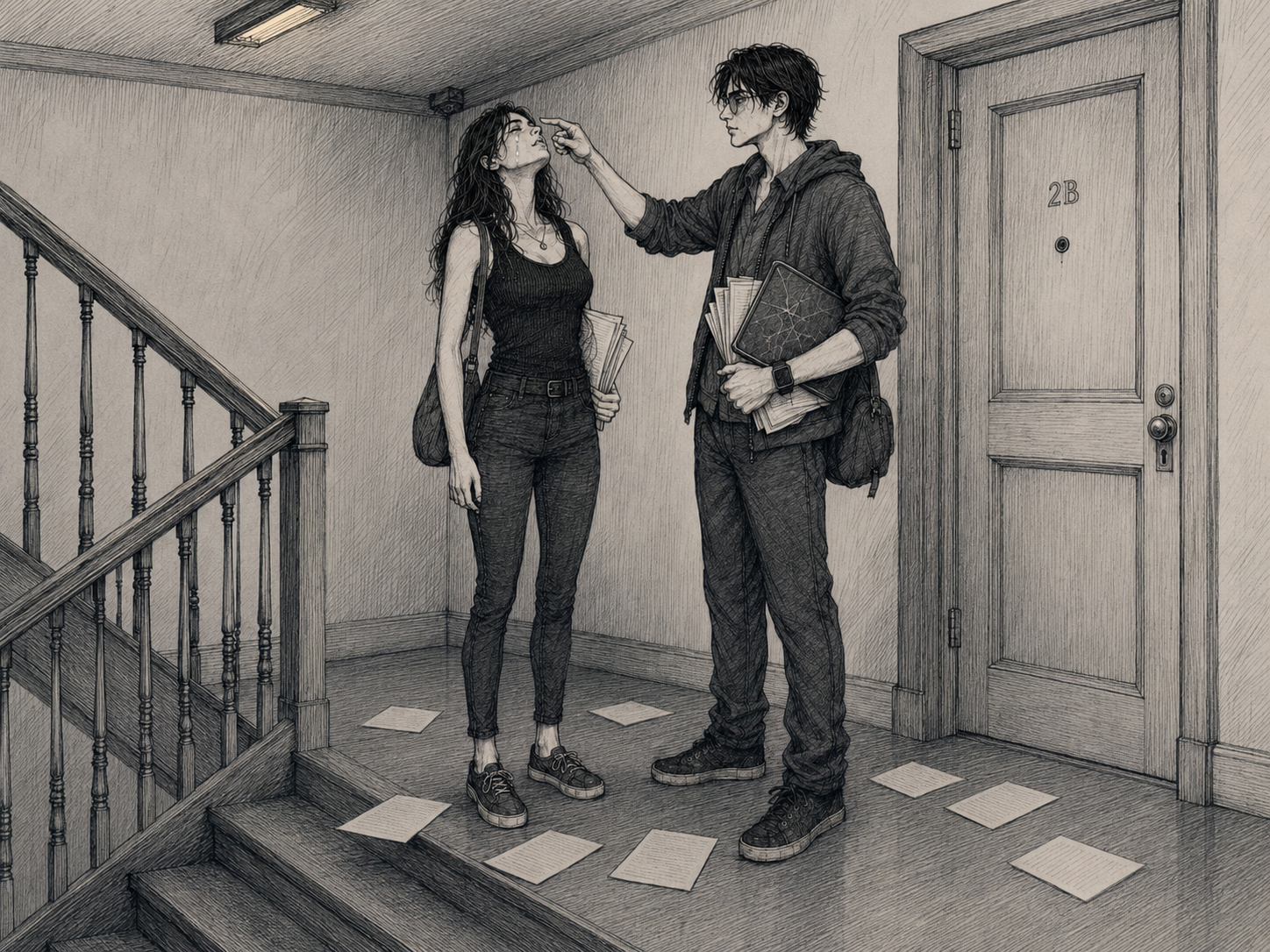
The second-floor landing · the morning, so far
Not cruel. It carried the particular warmth of telling someone, without making a speech about it, that the situation is survivable. Her expression did something complicated, the pull of wanting to fall apart and having just been gently told not to, and feeling, despite herself, that the telling came from somewhere real.
“Come on,” I said. “We’ll fix it.”
She looked at the tablet in my arms, then at the papers I’d gathered.
“Do you know a repair guy?” Her voice had mostly reassembled itself.
I shifted the tablet under my arm. “I know the repair guy.”
She was eating a bagel with cream cheese when we got to the block where Ki’s shop sits, the two of us maybe four hundred feet from the door, the Santa Monica morning doing its pale-warm May thing around us, the marine layer already most of the way burned off.
I don’t know exactly when she noticed she hadn’t paid for it. Probably the same way I’d noticed the coffee I hadn’t paid for the afternoon before, that moment when you realize you’re holding something and can’t account for its arrival, and the accounting tells you something about the person who put it in your hands.
She was mid-bite when I saw her expression do the math.
She kept eating.
The crisis had gone from flashpoint to managed somewhere between the landing and the bagel, and we were walking toward the solution slowly, having decided it was close enough to walk to.
Ki’s shop had its usual morning smell, the faint petroleum undertone from the floor, the warm electronics presence, and underneath those the clean smell of components handled carefully for years. The display window had been rearranged again, the visible merchandise tilted toward foot traffic from Arizona Avenue. Ki himself was at the bench with his magnifying headset pushed up onto his forehead and a disassembled cellular module in front of him, both hands occupied with instruments of varying precision.
He looked up when we came in. Registered me. Registered who I was with. His expression did the brief recalibration it did when there was something new to assess, and then he put it away and gave the situation his practical attention.
I gestured as people do when frequency has quietly crossed over into familiarity.
“This is the guy,” I said.
“The guy, hm?”
“Yeah, my repair guy. Who else?”
I read a flat expression in his eyes that rolled away as he waved his hand for us to come up to the bench.
“The sign out front says KM Electronics and Repair,” Cass said, following me across the floor.
“The sign is for the street. Repairs pay the lease.” Ki cleared a space and laid the mat down. “The build work goes out under a different name.”
“Which is?”
“M.I.H.N Custom Systems.”
She looked at him. “That’s your name.”
“With periods in it.” He squared the mat to the edge of the bench. “People pay more when there are periods.”
“What happened?” he said. He could see what happened; he wanted the rest of the context.
“It fell,” Cass said.
Ki held his hand out for the tablet. I passed it across. He turned it over, pressed the power button, the device lit up, screen cracked but responsive, and ran his thumbnail along the fracture pattern the way he ran his hands over everything, gathering information from contact. He pressed once at the corner where the impact had been. The glass shifted fractionally. He nodded.
“Digitizer’s okay,” he said. “The glass is the casualty. I have the assembly in stock.” He set it on the bench beside him and pulled up something on his workstation. “Forty minutes.”
Cass exhaled. I watched her register the relief of a problem with a solution and a timeline.
“Paper due this evening,” I said, by way of explanation.
Ki looked at Cass. “I’ll have it done in thirty-five,” he said, which was Ki’s version of accommodation, not adjusted enthusiasm, just a slightly revised estimate. He got to work.
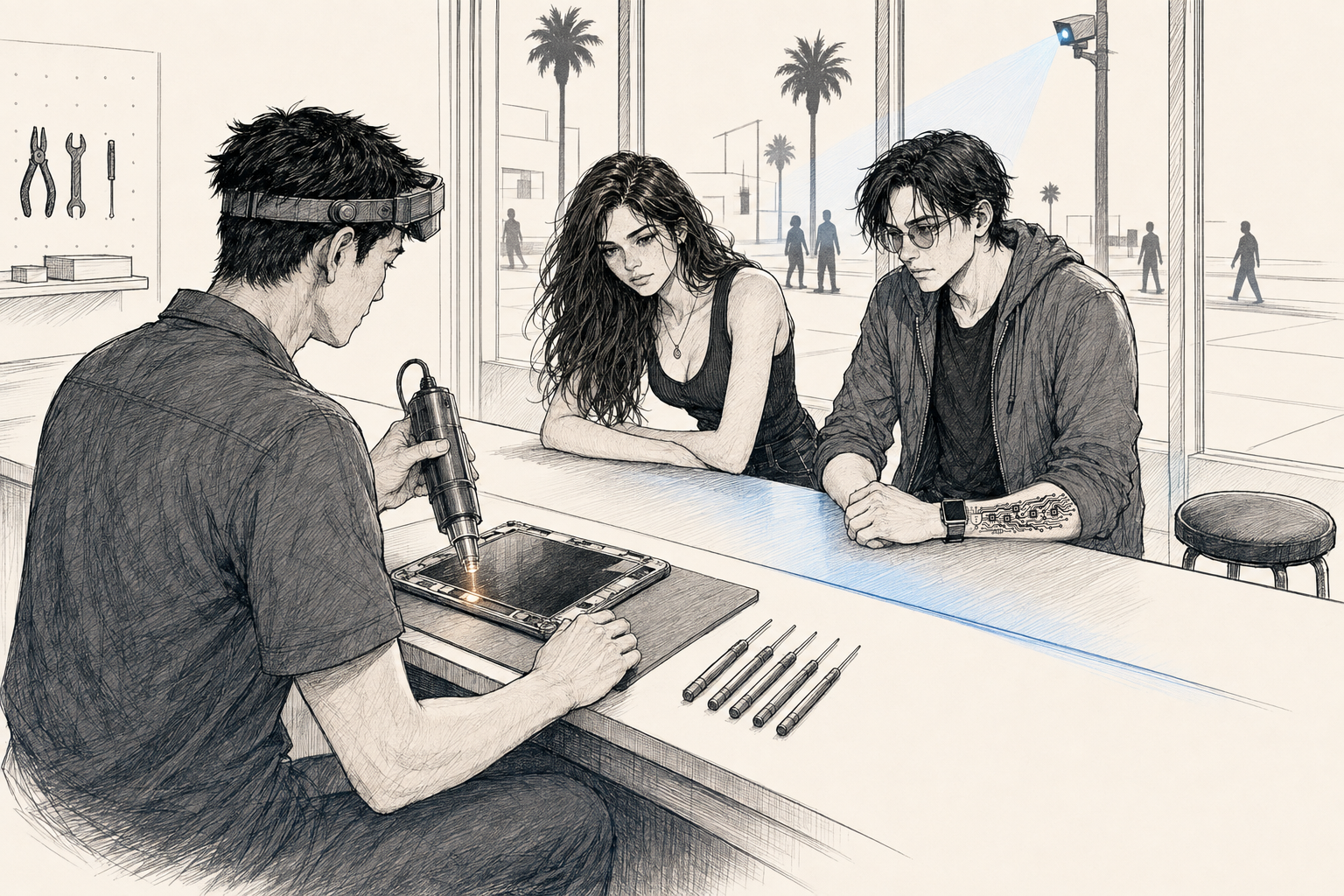
M.I.H.N Custom Systems · forty minutes, call it thirty-five
I pulled two stools up to the counter. Cass sat. I sat. The sleeve of her jacket was close enough to my arm that I registered its position without meaning to. Ki behind the bench with his tools and the tablet, and the shop around us doing what it always did, the small ambient sounds of a space organized around work, the occasional foot traffic from 4th Street through the glass.
The conversation started as conversations start in that shop: slowly, without announcement, around the edges of what was actually on anyone’s mind.
Ki asked how the engagement was wrapping up. Not invasively, he was asking as someone asks about a project they know is ongoing, checking in rather than interrogating. I told him the report was in, the client response had come back, there was a call this afternoon.
“How’d it go?” he said. The heat gun was on, warming the adhesive around the screen assembly.
“The work went well,” I said. “The part where I stepped outside what I was authorized to do may go a different way.”
Ki’s hands kept moving. He didn’t stop to process this. “How far outside?”
“Far enough that the call this afternoon is going to address it.” I looked at the counter. “I exfiltrated a copy of their compiled application binary off the test server. The NDA I signed covers proprietary materials. Pryce knew about it before the report was delivered.”
Cass was looking at me. Not with alarm. It was the attention she brought to new information, weighing whether it changed her model of the situation.
“Why’d you do it?” Ki said.
“Because the scope they gave me didn’t include the full application. I had library code to review and black-box access to the running service. That’s like being asked to assess a building’s structural integrity by examining the plumbing specifications. I needed the binary to understand what I was actually testing.”
“And what were you testing?”
This was where it got complicated.
“A network security monitoring platform,” I said. “That’s the documentation. What the binary actually contains is more interesting.” I paused. “Probably.”
Ki set down the heat gun. He was giving me the full-stop attention now, hands still, tools on the bench, his eyes on me. He had been listening carefully for a while and had arrived at a question worth asking. “What does probably mean?”
“It means I found something in the binary that doesn’t match the documentation, and the client has a plausible explanation for it, and I can’t decide whether the explanation is accurate or whether I’m telling myself it’s accurate because the alternative is uncomfortable.”
Cass said: “What did you find?”
I told them the outline of it. Not the specifics, not the deployment function, not the hardcoded signing key, not the production numbers and what they implied. The outline: a module whose behavior was inconsistent with a passive monitoring system, a client explanation that was technically plausible, and a wrongness I couldn’t put down.
Ki was quiet for a moment. Then he did something I’d seen him do before, which was pivot slightly, away from the direct engagement and into something sideways of it.
“The person I’ve mentioned,” he said. “The one who did contract work for a firm like that.” He was holding the tablet now, applying even pressure to seat the new assembly. “He said the scope felt like a frame around a window. Clean sight lines, everything visible inside the frame.” He pressed the tablet flat against the bench surface to let the adhesive bond. “He said the firm wasn’t restricting what he found, necessarily. Just what he was looking at when he found it.”
The tablet made a soft sound as it settled.
“Everything outside the frame was still there,” Ki said. He picked up the tablet and examined the new screen from several angles. “He didn’t take another job from them.”
Nobody filled the silence right away.
“How similar,” I asked, “was this firm.”
Ki looked at me. “Similar enough that I mentioned it.”
Which was the most he was going to say about it, and we both knew it, and I filed it next to the other things I was keeping.
Cass had been holding the question she was going to ask for most of that conversation. I could tell because of how she’d been listening, not passive reception but active construction, like she was building something from the pieces and waiting for the right place to put it down.
“What are you actually worried about?” she said. “Not the legal part. You’re describing that like it’s the manageable part.”
I looked at her.
She looked back. Her arms were loose on the counter, her right hand slightly open, palm up. She wasn’t pressing, she was just there, in the way Cass was just there when she asked things, with the full unhurried weight of someone who asked because she wanted the actual answer and not its social proxy.
“I don’t know yet,” I said. Which was true. The concern about the deployment module was still too unformed to say out loud without sounding like someone who had convinced themselves of something. The quality of the wrongness I’d felt since finding that function in the binary, the hardcoded key, the device registry, the production scale, was real. Whether it was evidence of something or an artifact of my own pattern-matching I genuinely could not tell.
She held it for a moment. Then she nodded once, the nod that meant filed. Not pushed aside, absorbed, catalogued, returned to later. She was making a model and this was a new piece and she was incorporating it.
She didn’t say anything else about it.
Ki, behind the bench, was doing the final quality check on the screen assembly, running a fingernail along the edge to confirm the seal. He did not appear to have been listening. He had, in fact, been listening to every word.
The door opened.
Sam came in already in motion, the canvas bag swinging, her eyes moving around the shop before her feet had fully committed to being inside it. She clocked Ki’s setup in about one second, found it credible, and then got approximately three more steps in before she registered us on the stools and stopped.
She looked at the room. She looked at Ki. She looked at Cass, who was sitting there with the evidence of recent crying mostly but not fully resolved. She looked at me, which took less time. Then her expression settled into a warm, particular attention. She had walked into something real, and she was not going anywhere.
“Hey,” she said to me. “Hey,” she said to Cass, the second one carrying more content than the first. “Hi,” she said to Ki, with the additional warmth of meeting a new person in a context she’d already decided she trusted.
Ki looked at her with the brief assessment he gave everyone, and something in the assessment concluded quickly and positively. “What do you need?” he said.
“USB-C to barrel jack adapter, 20 watt, if you have it. And whatever cable fits a fourth-gen communications tablet, the slim port.” She said it without hesitation, having bought components in places like this enough times to know exactly what she wanted.
Ki turned to his shelves. “Second drawer from the left, bottom row. The tablet cable is on the pegboard behind you, blue label.”
Sam went and found both in approximately twenty seconds. She brought them to the counter, set them down, looked at Ki’s workstation, looked at the tool layout on the bench, looked at the tablet currently having its repaired screen reassembled.
“Nice soldering station,” she said, nodding at the equipment behind him.
“It works,” Ki said.
“It works a lot better than it needs to if you’re just doing screen replacements.”
The corner of Ki’s mouth moved. “I do other things.”
“I know. I’ve been buying components here for two years.” She paused. “I didn’t know Cade knew you.”
“Apparently he knows the repair person,” Ki said, with the dry economy of someone quoting a thing he’d been told and found appropriate.
Sam looked at me. Then at Cass. Her expression was doing the calculation. “Okay,” she said. “So what are we stressed about?”
“Nothing,” I said.
She tilted her head. “You’re both on stools in a repair shop at nine in the morning and Cade looks like someone who has been running calculations to stop a rocket from crashing into the surface of the sun.” She set the components on the counter and crossed her arms with the ease of someone settling in. “Which of you is going to tell me?”
“It’s handled,” I said.
“It’s almost handled,” Cass said, which was more accurate.
Sam looked between us. Looked at Ki, who was very deliberately attending to the tablet in his hands. Then she looked back at me. She had identified the actual situation and had a response prepared.
“Let me make sure I have this right,” she said. “You’re stressed about… a job. That you completed. That went well. That paid you. And now you’re sitting in a repair shop at nine in the morning being stressed about it.”
“The job had a complication,” I said.
“Which you handled.”
“Which I mostly handled.”
“Right.” She picked up the USB adapter and turned it over in her fingers. “So you’re stressed about a complication that you mostly handled in a job that went well.” She paused. “That’s the problem.” Her disbelief was palpable enough to touch.
“There’s a call this afternoon,” Cass said. Not helpfully, helpfully, in the sense that she was giving Sam accurate information. Not helpfully in the sense that it gave Sam more to work with.
“A call,” Sam said.
“It should be fine,” I said.
Sam looked at me for a long moment. Then she nodded, small and certain, a conclusion arrived at and made peace with. “I’ll wait,” she said, and hopped onto the third stool like she had been coming to this shop for years and always sat there.
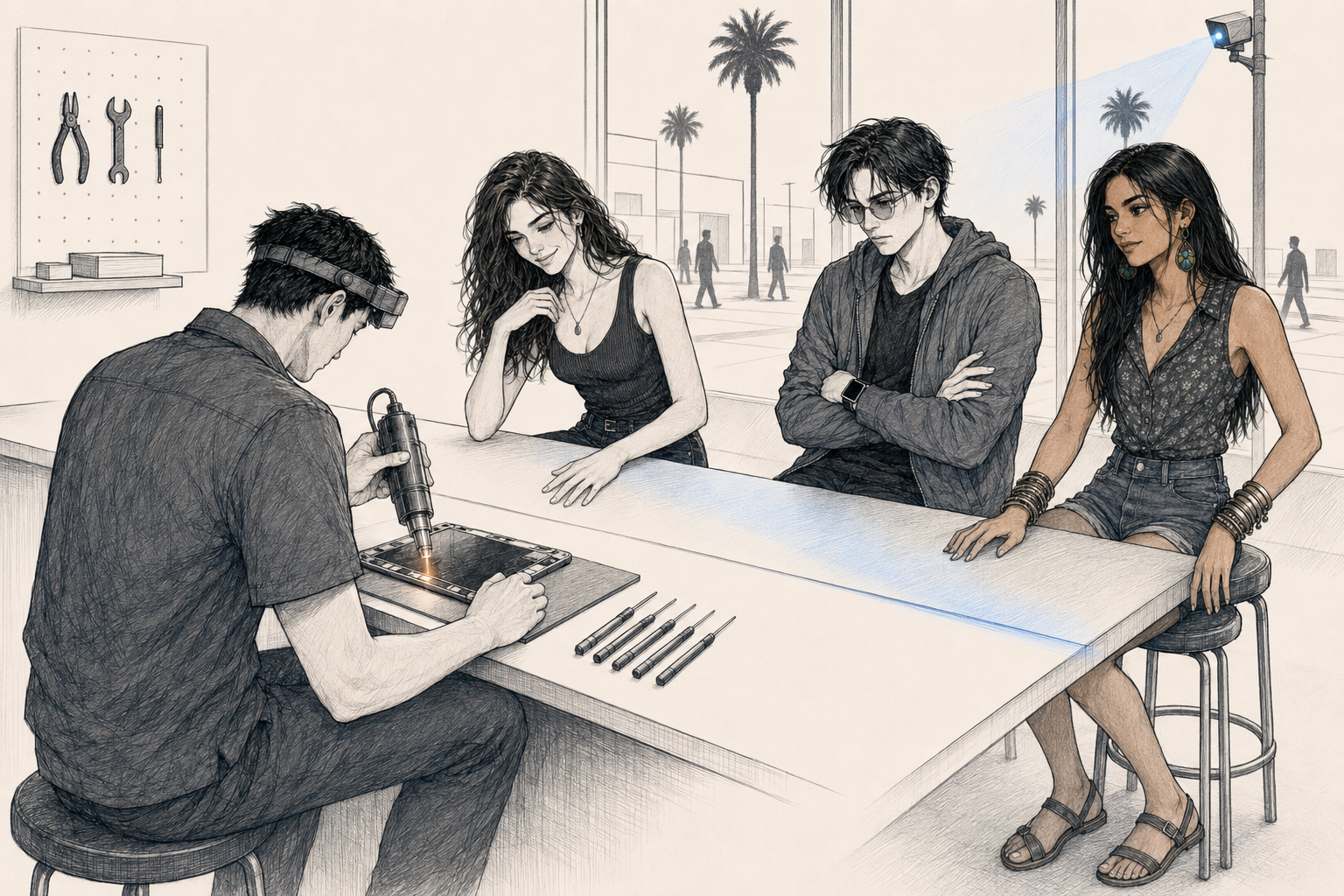
M.I.H.N Custom Systems · the third stool
Ki handed her the tablet cable without being asked. She paid him for both components, he made change, and then he turned back to the final assembly work while Sam made herself comfortable on the stool and I made peace with the fact that Sam was apparently here now.
She lasted about thirty seconds in comfortable silence before turning to Cass with the easy curiosity of having been patient long enough.
“Is that yours?” She nodded at the tablet in Ki’s hands.
“Dropped it on the stairs,” Cass said. “This morning.”
“On the morning when—”
“On that morning. Yes.”
Sam absorbed this. “The seminar paper’s on it?”
“It was.”
“And it’s the Delaney class?”
Cass looked at her. “How do you always—”
“Because,” Sam said, “the only time you look like you’ve lost a fight with gravity before nine AM is when Delaney has said something condescending before nine AM. It’s a consistent pattern. Was it the thesis framing comment?”
“It was the thesis framing comment.”
“He does that one when he hasn’t had enough coffee. I’ve mapped it.” Sam picked up the USB adapter from her bag, turned it over once, set it back down. “I will say this for you: you did not, apparently, commit any crimes in that office. That is a form of personal growth I genuinely respect.” She paused. “I once told Professor Nakamura that his understanding of my methodology was, and I quote, ‘a generous interpretation of the data.’ Which he technically had to agree with because it was accurate. There was a strongly-worded email. I had to acknowledge receipt.” She tilted her head. “There was also a notation in my lab log. ‘Student error: hubris.’”
Cass looked at her. “That is not the same situation.”
“No,” Sam agreed. “But the face you’re making right now is different from the one you were making when I walked in.” She turned back to the counter with the satisfied expression of a task completed. “I’ll count it.”
Cass looked at the counter for a second. Then, despite everything the morning had done to her, she laughed, not a big laugh, the small one that’s harder to produce because it’s real.
Ki, behind the bench, did not look up. But the corner of his mouth moved.
The thirty-five minutes became thirty-eight. Ki handed the tablet back to Cass, screen intact, device responsive, stylus test confirming the digitizer had survived. She looked at the restored screen, a problem solved in exactly the form she’d needed it in. She held the solution close to her chest and exhaled. The detail I was hoping for. An equivalent exchange.
“Thank you,” she said to Ki. Her thanks direct, measured, meaning exactly what it said. Ki acknowledged it without deflecting it and without making a production of it.
Cass reached for her wallet.
I had already put the payment across the counter shortly after we sat down.
She looked at her wallet. Then at the counter. Then at me. I was looking at the tablet, which I picked up from the counter and handed back to her.
“You had a paper due,” I said.
She took the tablet. Held it for a moment. The expression on her face was doing something I hadn’t seen before, her mouth had gone soft in a way it hadn’t been all morning, and the line of her jaw had released whatever she’d been holding in it, and I identified it in my peripheral awareness and looked at it directly for approximately one second before I returned my attention to the counter, where Ki had set the components Sam had bought in a small bag and was already turning back to his bench.
“Come back if the adhesive has any issues,” he said to no one in particular, which was how Ki ended appointments, functional rather than ceremonial.
I held the door. Cass went through first. Sam fell in beside me on the sidewalk, components bag in hand.
“It’s going to be fine,” Sam said, offering the kind of help that is not specifically about the situation that requires it.
“Probably,” I said.
She looked at me sideways. “That’s a terrible answer.”
“It’s the one I have.”
She made a sound that might have been agreement or might have been the beginning of something she decided not to finish, and then the three of us walked back toward campus in the texture of a Santa Monica morning that had made its decision about what kind of day it was going to be, and was proceeding accordingly.
I had the call with Lena Holt in four hours.
I did not look at my phone.