Act 0 · Null Witness
Chapter 0.8
Burn Rate
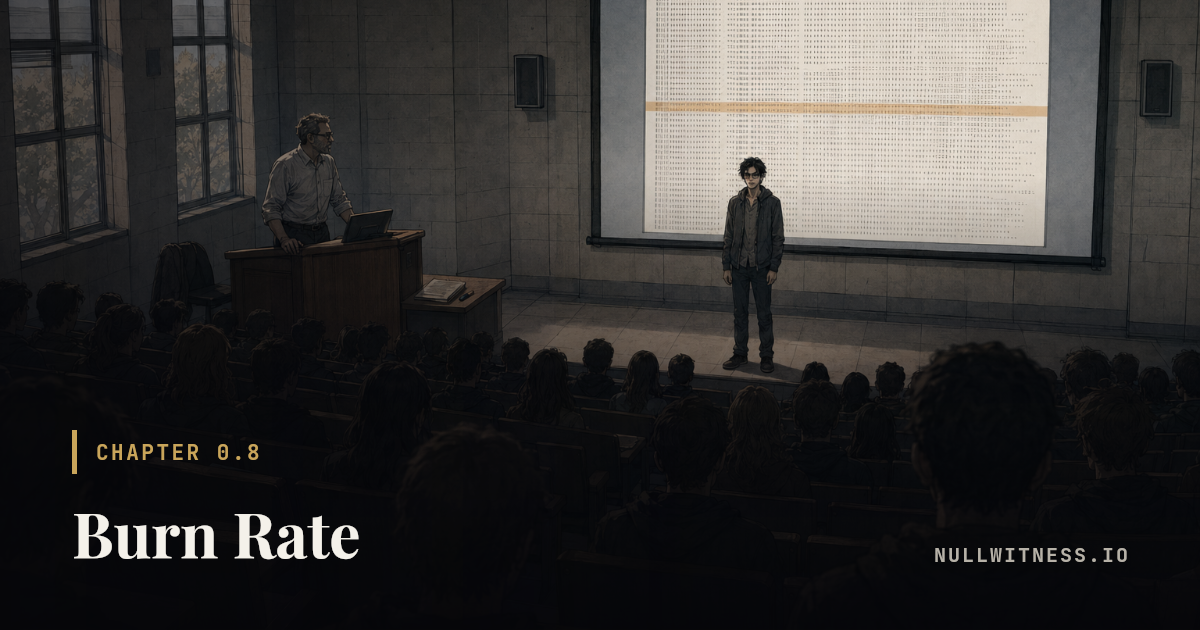
16–22 May 2035, the same week, from the other chair
Now that I’ve given you the week you care about, I’ll give you the version of it I cared about. Same seven days, the other monitor, the life that went on around me while I sat inside Meridian’s network telling myself the work was the point.
The work was not the only thing on the screen. There was also a number, and that number was going the wrong way.
Here is the part nobody puts in the story about the freelancer who lives by his wits: the wits do not pay on a schedule. The Nestfield bounty had cleared a week or so back and most of it was already spent, on rent I’d covered early because covering it early was the one financial discipline I had, on the drives from Ki, on the electricity a rack of servers turns into heat whether or not you are being paid that month.
Meridian had my report. Meridian owed me forty thousand. And Meridian had told me, in Pryce’s own words, that payment was processing. Processing is a word that means the money exists somewhere and is not yet mine, which is exactly as useful as money that does not exist at all when the auto-draft for the following month’s rent is nine days out and the wallet on my phone had a balance I had started checking more often than I checked the leaderboard.
I am not going to pretend I was noble about it. I was not thinking about surveillance, capitalism, or the fate of the republic. I was thinking about twenty-one hundred for the loft and another three-fifty for power and a number under both of those that was not large enough to cover them twice, and I was thinking it at two in the morning with the good work of the day already done and nothing left to do but watch the figure sit there and refuse to grow.
The engagement paid. The engagement was going to pay. The competition, the thing I was actually pouring myself into after midnight, paid nothing at all unless I won it, and I was not winning it, and I was starting to understand that the not-winning was not an accident.
I should say, before I get to the part where it went wrong, that the challenges themselves never did.
That was the cruelty of the week. The puzzles were the one place the floor held. Whatever else was coming apart, I could still sit down in front of a scrambled graph or a malformed protocol and take it apart with my hands, cleanly, the way you can still tie your shoes on the worst day of your life. There was a cluster of players well behind the main field, persistent, methodical, the kind who weren’t going to win but would be markedly better in six months than they were now. BYTE_STORM had been stuck on a path traversal node for three days, posting dead ends with the frustration of being close and unable to see where close is. They had the technique. They were missing the question, so I gave it back to them:
[DARKC/T2-07] KernelHavoc » @BYTE_STORM what does the application do with the path after
                            normalization
Half an hour later:
[DARKC/T2-07] BYTE_STORM » oh. oh that's evil. got it, thank you.
That is the part I have always found satisfying. Not the solution. The moment someone’s question turns into the right one.
I could do that all night. I did do that all night. And none of it moved the number on my phone, and none of it moved the only position on the board that mattered, which belonged to a competitor who was not moving either.
Vanta hadn’t moved in five days.
That was the part that kept landing wrong. Vanta had swept Tier One in two days, torn through Tier Two and the first Tier Three challenges, a pace that was either extraordinary skill or knowledge of the challenge structure nobody was supposed to have, and then nothing. The position sat at the top while the rest of the field inched up underneath it, and the longer it sat there the more it bothered me, in the low background way a sound bothers you before you consciously hear it.
The field read it as a wall. Vanta hit the ceiling of Tier Three, the story went, same as everyone eventually would. I didn’t buy it, and the reason I didn’t buy it is the reason I’m good at this, which is that I know what people look like when they’re stuck, because I have been stuck ten thousand times and it has a rhythm.
You don’t run a maze you’ve never seen without hitting a wall. Not once. Not ever. Real solving is a trail of wrong turns, and you read a person’s record backward the way you read tracks in snow: here is where they doubled back, here is where they sat for six hours and tried nothing, here is the dead end they hit three times before they believed it. Vanta’s early record had none of that. Every node cleared on the first submission, in minutes, in the optimal order, the clean straight line of somebody who already had the map and was pretending to draw it as they went.
And the stall was wrong in the same direction. A wall doesn’t look like silence. A wall looks like flailing, like a hundred desperate submissions and a forum post at four in the morning asking a question you’d be embarrassed to ask in daylight. Vanta wasn’t flailing. Vanta was parked. Four posts in ten days, brief, technically precise, no questions of their own, no frustration, no celebrating. A presence technically active and experientially absent, a room with the lights on and nobody home.
I catalogued it and told myself I was cataloguing it because that is what I do, and not because it had started to feel less like a race and more like standing in a room you thought was empty and hearing, somewhere behind you, someone breathing.
The field had other voices. A few days after I joined the CTF, a new alias appeared, Corvus, with no history in the leaderboard cache I’d kept since the competition opened. Not a competitor who’d fallen behind. An entry that hadn’t existed days earlier, already at Tier Two, already working nodes I’d cleared. The posts were short and built out of contempt, contempt used like an instrument. Congratulations on completing content designed for intermediate participants. The bar is not high. And then one addressed to me, three hours before I found it:
[DARKC/T2-11] Corvus » @KernelHavoc moving careful for someone with your
                        reputation. Either the nodes are harder than you're letting
                        on or you've got something else on your plate.
A needle looking for the soft place. He wanted to know whether my pace was my ceiling or a choice, wanted me to explain myself, hand over data he didn’t have. On a better-rested week I would have found it funny. That week it landed on the exact nerve the sparse number in my account and the sleeplessness had already stripped, and I sat with a reply in the box longer than I should have before I closed the door on it, politely:
[DARKC/T2-11] KernelHavoc » Good problems take the time they take.
He didn’t respond, which told me more than a response would have. He was just another sharp voice in a dark room, one more person who’d decided I was worth needling, and I filed him under the small irritations and turned back to the only one that wouldn’t leave me alone: the ghost at the top of the board, and the growing certainty that the game I was breaking myself against had been decided before I ever entered it.
Being careful, I wrote in the notes document, to convince myself of it, is rarely wasted effort.
The morning it came apart, I was late to Dietrich’s lecture. Again. Call it twelve minutes, which by then was less a failure than a habit, and I came in through the doors at the back of the big hall with the weekly assignment in my hand, fifteen pages and a flash drive clipped to the cover page, three weeks of a course I could have taught reduced to a stapled offering I intended to set on the front desk as I’d set the last four, quietly, while he talked, a transaction that asked nothing of either of us.
He stopped talking.
He had never stopped before. He’d said you’re late, Mr. Voss to the middle distance and kept going, because the lecture was the point and I was a rounding error in it. This time he set the projector remote down on the podium and watched me come down the side aisle, and a hundred and eighty people watched him watch me, and I understood in the specific way you understand a thing half a second before you have any evidence for it that the morning had a design nobody had shown me.
“Mr. Voss.” He wasn’t angry. That was the first wrong thing. “Leave the assignment. Come up here.”
I set it on the desk. I did not go up.
“Come up here.” He gestured at the floor beside the podium, in the wash of the projector, where a student goes to present and not to hide. “In front of the screen. You’re going to help me teach.”
You do not, in that situation, walk out. Walking out is an answer, and I didn’t yet know the question. I went up. I stood where he pointed, in the light, with the whole tiered hall in front of me and the bright rectangle of the screen at my shoulder, and Dietrich moved to the podium with an ease I had never once seen in him, the ease of a man who has been looking forward to something.
“We’re going to shift gears,” he told the room. “Set the problem sets aside. We’re going to talk about the practical use of cryptography in modern transport protocols. Specifically about trust. About what happens between two machines that have decided, for the sake of getting anything done, to believe each other.”
He clicked to a clean slide. He was a different person up there than he’d been for eleven weeks. The disappointment had burned off him. What was under it was a man who knew his subject to the floor.
“Most of what your devices do all day depends on implicit trust,” he said. “Machine A asks a question into the air, whoever owns this address, where are you, and machine B answers, and machine A believes the answer, because the protocol was written in a gentler decade and nobody put a lock on the mailbox. That protocol is called Address Resolution Protocol: ARP. It is old, it is necessary, and it is completely trustless. Anyone on the network can answer for anyone else.”
I felt the first cold thread of it then and told myself it was coincidence. ARP is the first thing anyone teaches when they teach this, the natural example, the one I would have reached for myself. I kept my face where I’d left it and I waited, because there was nothing else to do, and because some animal part of me had already stopped believing in the coincidence and was simply waiting for the rest of me to catch up.
“When you can answer for anyone,” Dietrich said, “you can stand in the middle. You tell the first machine you’re the second one. You tell the second machine you’re the first. Everything they say to each other now passes through you, and neither of them has any way to know it. We call the person in the middle a great many things. This morning, think of him as the a mail carrier who reads the mail before he delivers it.”
He had my own words. He couldn’t have. He did.
“And there is one more piece,” he said, “because these days the mail is supposed to be sealed. Encryption is supposed to make the carrier in the middle irrelevant and ignorant to the contents, he sees only ciphertext. But encryption only protects you if your machine insists on it, and there is a technique, an old and inelegant one, that leans on a machine’s willingness to accept a plain envelope when it should demand a sealed one. It quietly downgrades the connection. The little lock in the corner of the browser goes gray. Almost nobody looks at the little lock.” He let that sit. “The technique is called SSL stripping.”
The nickel dropped. It dropped all the way to the bottom and I heard it land.
He clicked again, and the slide filled with something that was not a diagram. It was a log. Real capture, real timestamps, and down the left margin a column of MAC addresses, and I did not have to read them to know that one of them was mine, because I recognized the outline of the story the log was telling. An address answering for the router. The same address answering for the faculty machine. A spoofed certificate. A downgrade. A set of credentials moving across the wire in the clear, at a time of day and on a date I could have recited from memory if my memory had been working, which it was not, because most of my blood had left my head.
“The attacker who does all of this,” Dietrich said, and now he was looking at the room and not at me, which was worse, “collects the credentials. Then he does the one thing the whole exercise was for. He logs in to the target machine as the person he impersonated.” He clicked. A single line, highlighted. “And here you might notice something. The login request has to originate somewhere. It comes from the attacker’s own network card. Which announces, as network cards do, the machine it lives in. In this case a laptop, with a hostname, and the hostname contains the student’s ID number.” He said all of it without raising his voice, which is the part I have never forgotten.
The hall was very quiet.
I have been caught before, in small ways. I know the feeling of a thing closing over you. This was not that. This was a different silence, total, the kind two hundred people make when they have just understood, a beat ahead of me saying it, that the demonstration is a person, and that the person is standing in the light at the front of the room.
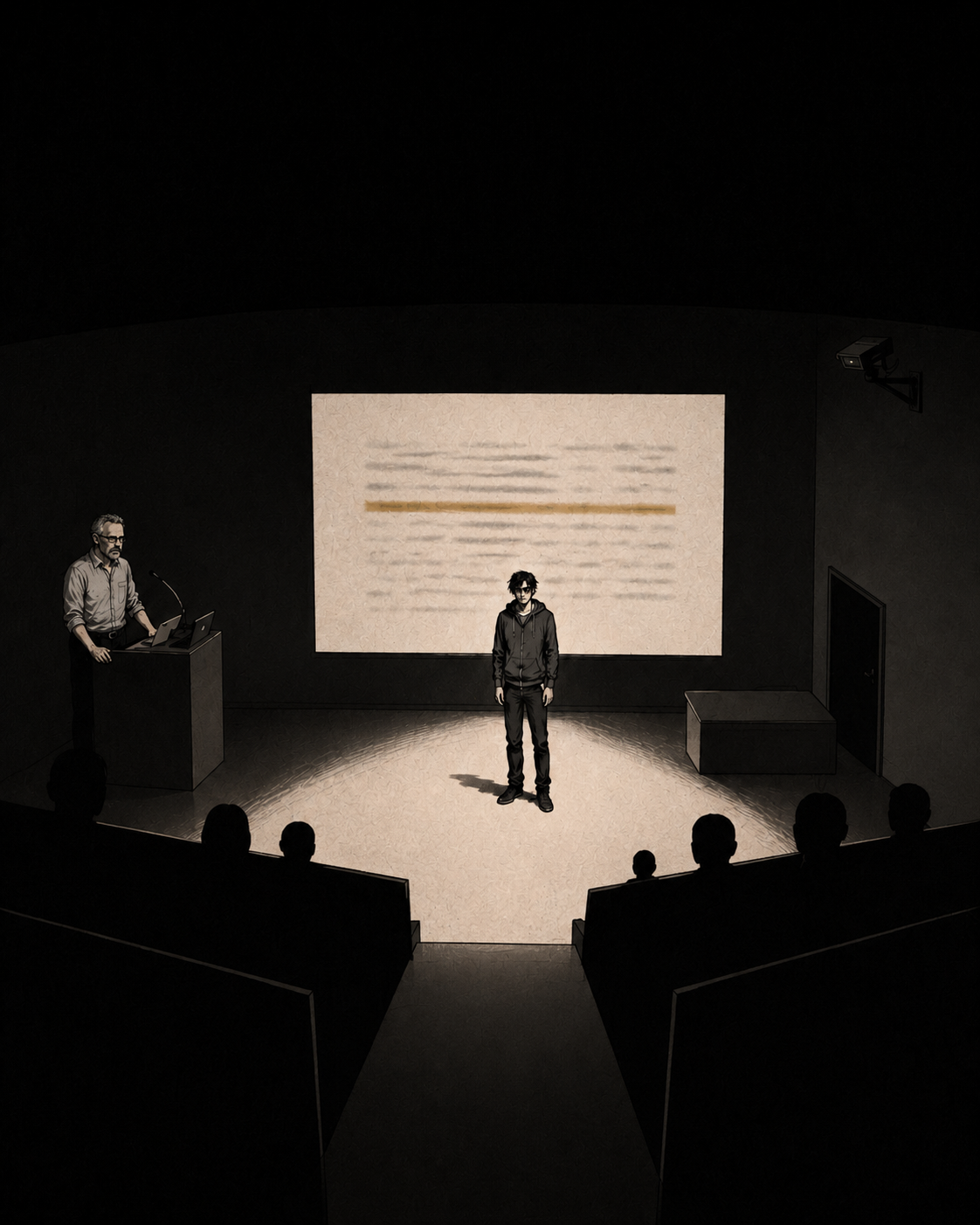
The big hall · the slide with his own MAC address on it · morning
“I’m sorry, Profess—”
“Sorry for what?” He came off the podium, and the lecture voice came off with him. “That you got caught?”
“No. Th—”
“Shut up!” It filled the hall. Eleven weeks of a tired man at the back of his own career, and it turned out there had been this underneath it the whole time. “You must have some stones, Voss! To pull this in my classroom, off my network, against my machine, and then stroll in here twelve minutes late every single week like the rest of us should be grateful you came at all! Did you think, because you can run a Linux terminal, that you’d gone invisible?” He came down the steps to the floor, into the light with me. “I could have you expelled by lunch! I could have you arrested! There are statutes for exactly this, and I have the logs, and I have the hostname, and I have your student ID written in your own hand on that machine, and I have a hundred and eighty witnesses sitting right there!”
“I didn’t do anything with the credentials.” It came out steadier than I felt and it was the wrong thing to say and I said it anyway because it was the only true thing I had. “I logged in and I logged out. I didn’t touch anything. I didn’t take anything. You can check the—”
“I know!” It cracked coming out of him. “I know you didn’t! I had it checked the day I found it! And that, Mr. Voss, is the only reason you are standing in this room right now instead of a room downtown with your wrists in a zip tie!”
He crossed the last of the distance, took the stapled assignment off the desk, flash drive still clipped to it, and threw it at me. Not hard. Hard enough. It caught me in the chest and dropped to the floor at my feet, pages fanning, and I did not pick it up.
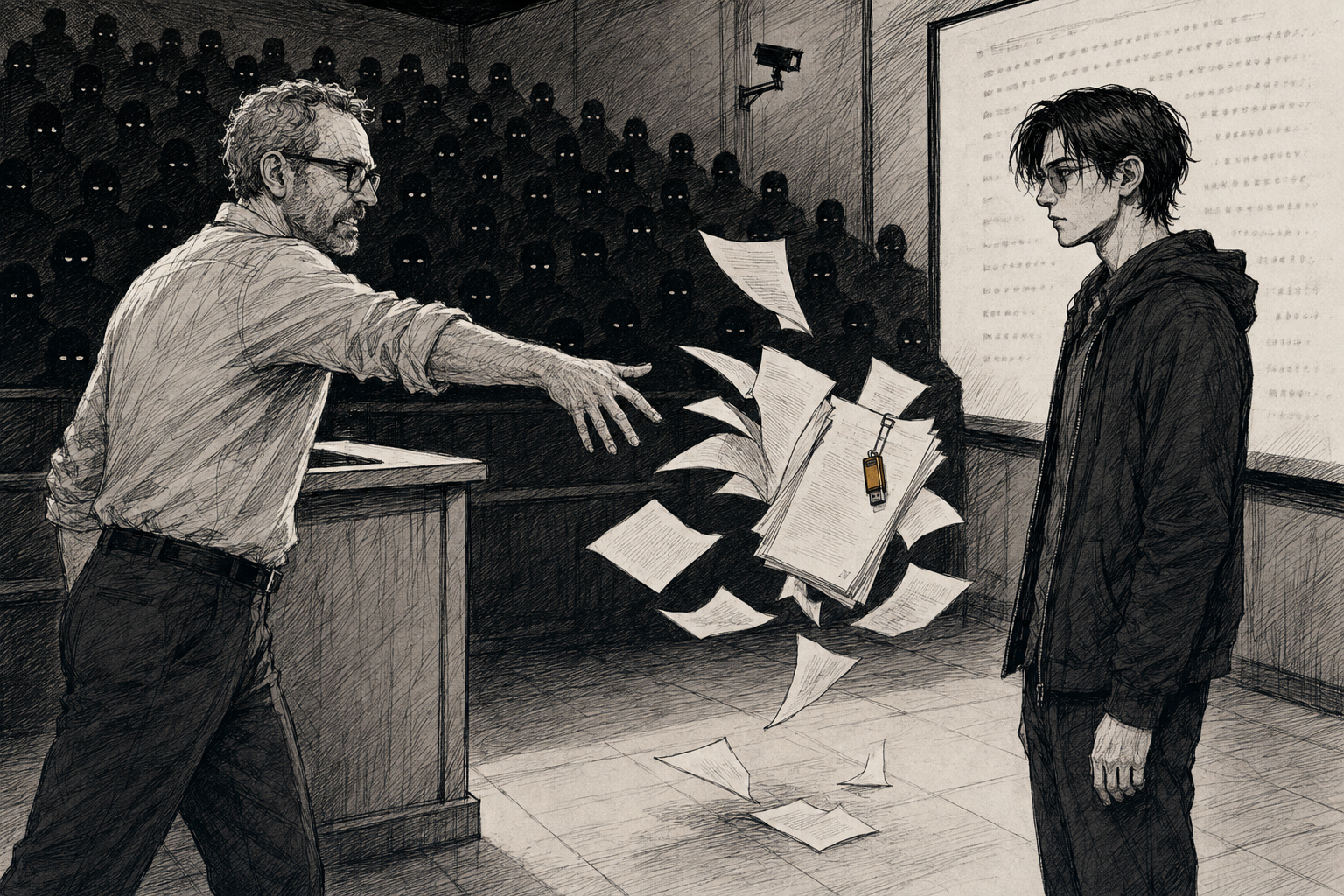
The lecture hall · not hard, hard enough
“Throw that in the trash on your way out! I am not accepting another submission from you this week, and you’ll take a zero for it, and a zero for last week too, retroactive, because I have decided I do not trust the provenance of a single thing you have handed me!” His breath had gone ragged. "You are on academic probation as of this second. I already filed it.
“And here is the rest of it. One more infraction. One. Not another break-in, an infraction! A late arrival! A phone in your hand! And I will see you expelled with prejudice, and I will put the prejudice on the record in detail, so that it walks into the admissions office of every school you crawl to after this one before you do! WAIT will recommend you nowhere! You will be lucky to talk your way into a community college!” He was close now, close enough that I could see it had taken something to hold it in as long as he had. “The next time you come to this room, if you are one second late, do not touch the door. It will be locked. Do not open a laptop in my hall again. If I see a phone in your hand you are done. Am I clear?”
I swallowed all of it. Every word. It went down like something hot. Scalding. With edges. And I felt each edge on the way, and I said nothing, because there was nothing to say that would not make it worse, and because he was right, and being handed the truth by a man with every reason to enjoy the handing is a particular flavor of the thing. And in that one of very few moments in my life, while I stood there holding myself together with my teeth, I recognized I had earned the flavor.
Then the volume went out of him all at once, the way it does when a person has finally spent what he came to spend. He turned back to his podium and his hundred and eighty and was done with me.
“Now get the fuck out of my class,” he said, quietly.
I walked out. I did not hurry. Hurrying is an answer too.
I went out the doors at the back and down the length of the building, past the stairwell and the vending alcove and the long institutional windows, to the men’s room at the far end where nobody had any reason to be between class blocks, and I went in and I threw the deadbolt on the single-occupancy door and I stood at the sink.
The face in the mirror was doing a good impression of a person who was fine.
I have thought since about the gap between the inside of that moment and the outside of it. Outside, a young man at a sink, breathing. Inside, everything I had swallowed in that hall looking for somewhere to go and finding the exits sealed, the money and the sleeplessness and the ghost on the board and eleven weeks of contempt paid back with interest in ninety public seconds, all of it pressurized behind a face that was managing, that was fine, that had the situation handled.
The mirror was the nearest thing with my face in it.
“Aaaaaaaaaaaaah!”
I hit it once. I put everything I had not been allowed to say into my right hand and I drove it into the glass as I released everything I’d been holding back in that room from my throat, and it broke the way cheap mirrored glass breaks, all at once and into a hundred versions of the room, and the sound it made was not satisfying, and my knuckles opened, and I stood there breathing over a sink full of small bright pieces of myself with blood starting at two of them.
Then I ran the cold water, and I picked the glass out of the cuts, and I got very quiet.
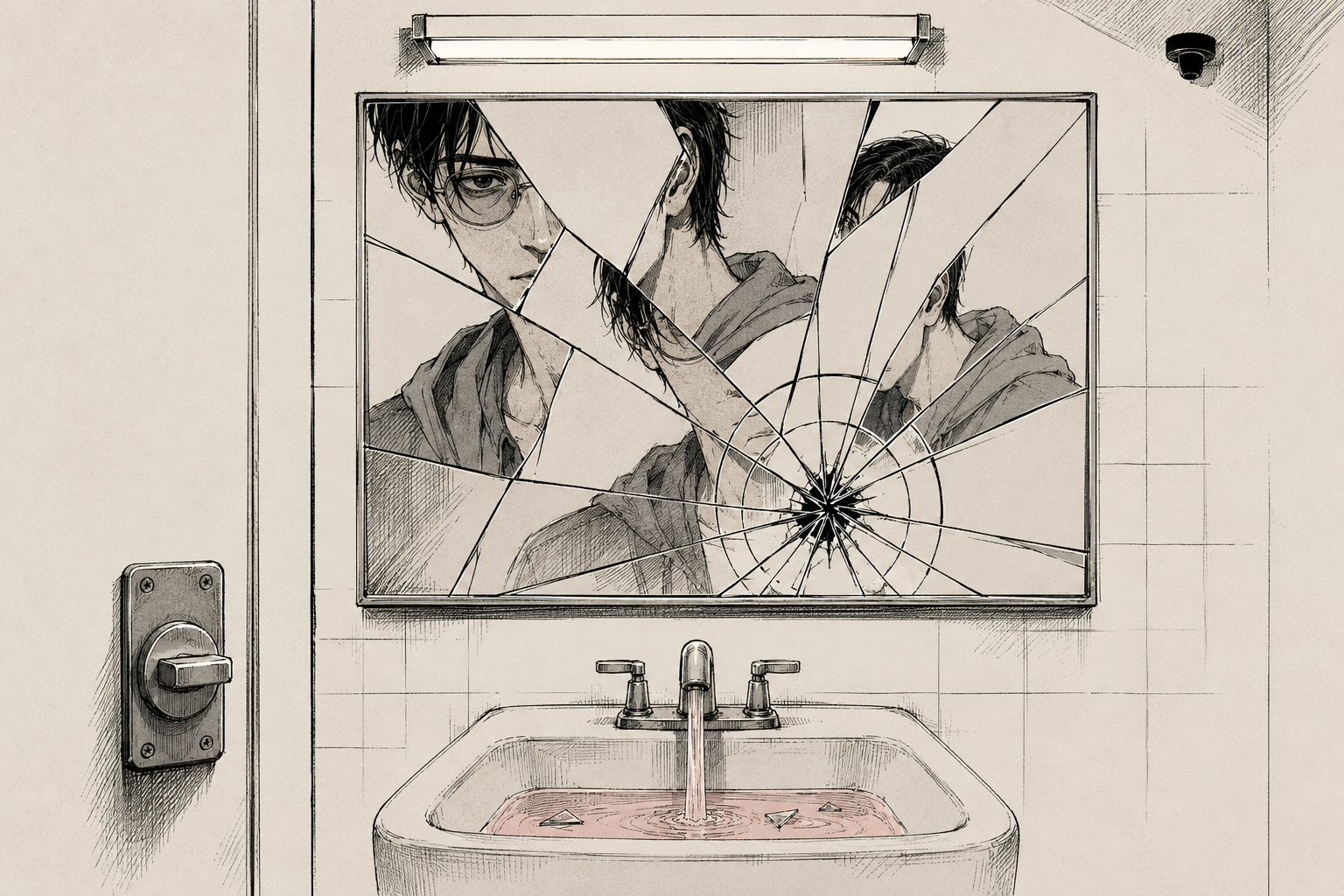
The men's room at the far end of the building · the deadbolt thrown
Because the honest truth, the truth I didn’t want to sit with then and don’t much want to now, is that the rage was the easy part. The rage had somewhere to go. What was underneath it, when the glass was done falling and the water was running pink, was the cold flat reality of a person who has just been shown, and would be shown again in two more days, that he is not as far ahead of the room as he had decided to be. Dietrich had caught me that morning because I got careless with a hostname. The board had been rigged the whole time, and I was already most of the way to certain of it, because someone had built it to be. And I still needed the money, and I still couldn’t leave the puzzle alone, and everyone who was watching me, the professor and the ghost and the voice in the dark, appeared to understand that about me better than I understood it about myself.
I bandaged the hand at the loft with electrical tape and a paper towel, because I did not own gauze, and then I did the stupidest thing I did all week, and I want to describe it accurately, because it was not an accident and it was not despair. It was a decision, made clearly, by a person who had just been shown two exits and chose a third one that was not an exit at all.
I decided to win.
Not the whole thing. The summit. The Tier Three node Vanta was supposedly stuck on, the wall the whole field had accepted as a wall. If it was real, cracking it put me level with the ghost and proved that skill was still the variable, that the game could be beaten from the inside by being better at it, which was the one thing that morning had not managed to take from me. And if I cracked it and the money followed, then rent was a solved problem and Dietrich was a survivable one and the week reorganized itself around a win instead of a loss.
So I stopped sleeping, which was easy; I had barely been sleeping anyway. I burned the better part of two days I did not have on one node. I let the coursework I was no longer allowed to hand in sit where it had fallen. I spent forty NovaCoin I could not spare renting cloud compute to brute a step I could have done slower for free, because slower was a luxury and I had decided, in the tape-and-paper-towel clarity of that afternoon, that I was done being poor about it. My hand throbbed under the tape in time with the fan.
And I cracked it.
I want to be clear that this part was real. The node was hard and I solved it, cleanly, as I had solved everything else, and for about ninety seconds the satisfaction was the pure thing, the floor holding one more time. I pushed the solution through. My position on the board moved up a rung, into the gap just under Vanta, close enough to touch.
Then I watched the ghost move.
It had not moved in five days. It moved that hour. The position at the top of the board cleared the next node the way you flip a card you have been holding the whole hand, instantly, no exploration, no time at all, and settled again exactly one rung above me. The gap restored to the width it had been. Then nothing. Lights on. Nobody home. Parked.
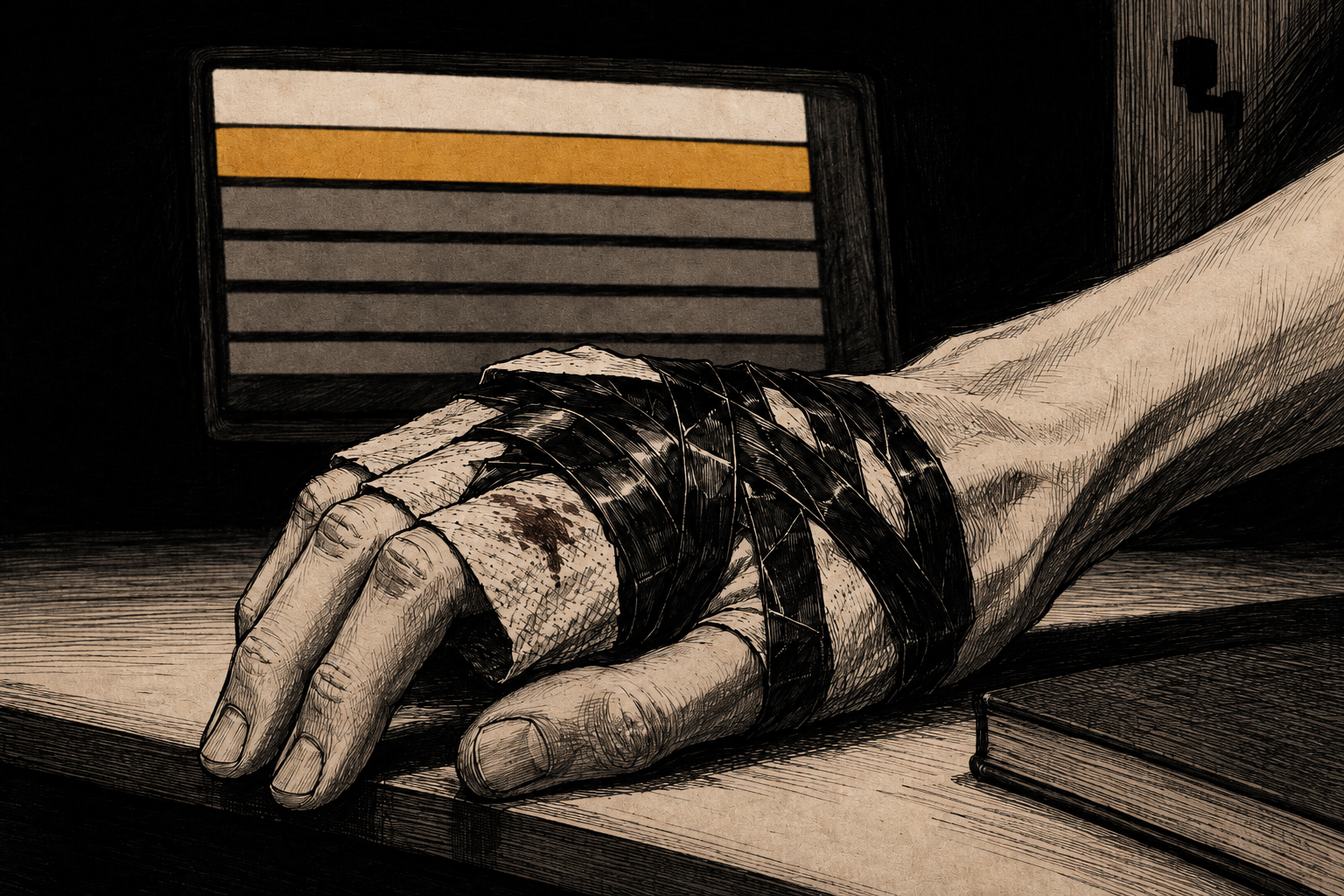
The loft desk · one rung below the pace car · the small hours
I looked at the submission I sent. The timestamp read 05:14:33. Verified that same minute. I looked at the first solve time on the leaderboard, the only time a solution actually pays for delivering it.
T3 / Challenge 4 solved: 05/22/2035 | 05:14:00
A perfect, round timestamp. Thirty-three milliseconds before mine.
I understood it then, the thing I’d already known and been refusing to know. It was not racing me. It was holding a distance from me. And it was doing so from a position inside the competition itself that guaranteed that it could plausibly deny a payment to the person who delivered the real solution. The summit I had bled two days and my rent money to reach was not a summit. It was a parking spot, with nothing above it worth the climb, because the thing the competition wanted it had already gotten, which was the sight of exactly how far a person like me would go, and how fast, when you set a wall in front of him and let him believe it was real. I had solved the wrong thing perfectly. The prize had never been mine to win. I had not been competing. I had been measured.
So I did the other stupid thing. I stopped being careful, which by then was barely a fall, and I typed it where the whole field could see it:
[DARKC/T3-14] KernelHavoc » Nobody has beaten Vanta because Vanta isn't
                            playing. Three tiers, not one wrong turn, and it
                            only moves when someone gets close. That is not a
                            competitor. It is a pace car. The payouts are bait
                            not a reward. Whatever this is measuring, it isn't
                            who wins.
I watched it sit there for a minute. BYTE_STORM would see it. The methodical ones grinding the lower tiers would see it. Somebody should know the top of the board was a lie and the prize was a story.
Then it was gone.
No reply. No mod note. No warning, no counter-argument, no removed-by tag. I refreshed and the post was simply not there, and it had left no hole where it had been, the way a thing gets erased when nobody has any intention of arguing with it. The field went on underneath as though I had never spoken, because as far as the machine was concerned, I hadn’t. You do not answer a reading. You take it.
I sat with my taped hand in the dark and did the math that was left. I could have closed the laptop that afternoon. I could have walked away from a rigged game with my rent money still in the wallet and two days of sleep still in front of me and let the ghost keep its parking spot. That exit had been open the whole time. I did not take it, and the part I could not get around, the part worse than the money and the mirror and Dietrich’s hundred and eighty witnesses, was the certainty settling over me that whoever had built the thing had known I wouldn’t. Still wouldn’t even in that moment. That the not-walking-away was the precise quality they had built the maze to find. The compulsion of curiosity I had always thought of as the best thing about me, the part that cannot leave a problem alone, was sitting in a file somewhere with my name on it, and in that file it was not a strength. It was a handle.
I got maybe two hours of sleep near dawn.
At seven-forty-three the building made the sound it always made. A few minutes after that, it made a different one.