Act 0 · Null Witness
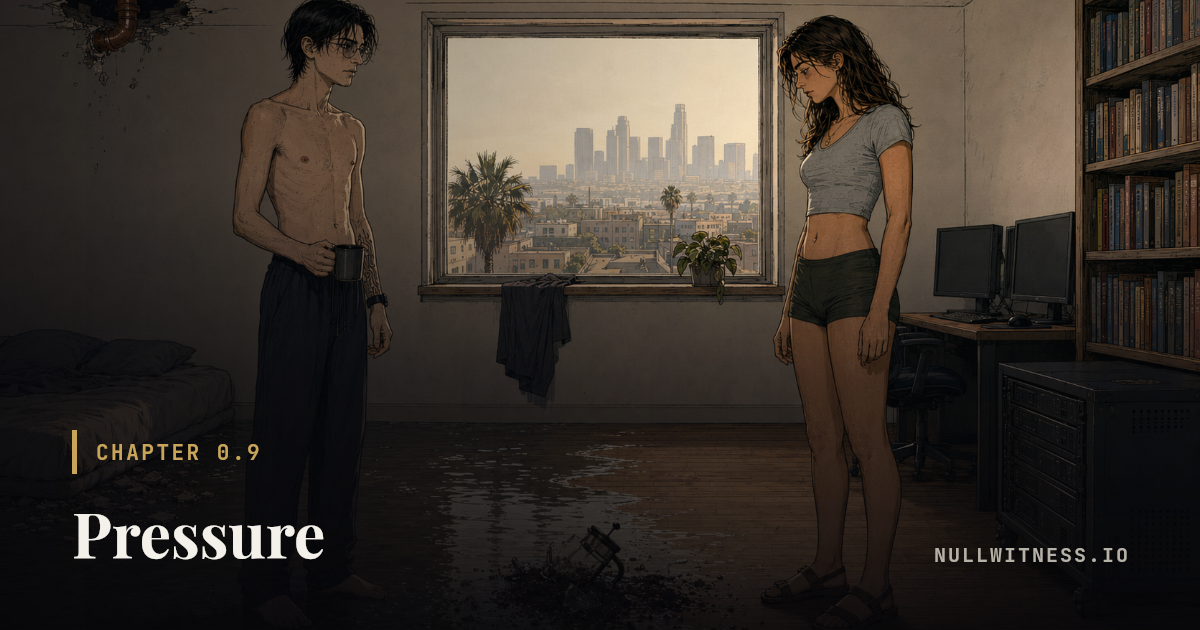
Chapter 0.9
Pressure
PUBLIC SAFETY NETWORK — LOS ANGELES METRO
RESIDENTIAL INFRASTRUCTURE MONITORING / SECTOR 7
2035.05.22 — 07:43:39 PST
BUILDING: ENTRADA ARMS, 1847 ENTRADA ST, SANTA MONICA
ANOMALY FLAG: UTILITY / WATER PRESSURE / ACUTE
STATUS: LOGGING
The building had been making that noise since before he moved in.
Not the pipe specifically, the elbow joint behind the plaster ceiling of the third-floor hallway, the one that fed water to units 3A through 3C and ran, for reasons that would have made a plumber thoughtful, directly above the corner of the loft in 3B. Every morning at seven-forty-three, when the tenant in 3A ran his bathtub fully open, both handles, the water pressure drop audible through the walls as all pressure drops in an old building are, a faint change in the quality of silence, the joint made a sound. A knock. Not alarming. Present, consistent, filed under infrastructure quirk alongside the elevator that opened on the wrong floor and the front door that required a particular upward lift on the handle before the key would turn.
The system had no category for infrastructure quirk. It logged the anomaly at 07:43:39 as it logged it every morning: utility, water pressure, building sector seven, below threshold for intervention. Then it returned its attention to the rest of the city.
At 07:46:03, the tenant in 3A cut the taps off.
The water pressure, which had dropped when the taps opened and now surged with their sudden closure, traveled back through the supply line in a column of kinetic force looking for somewhere to go. This is physics and it is old physics, older than the building, older than plumbing as a profession, the phenomenon that plumbers call water hammer and homeowners call that noise and the relevant physics textbooks describe as a pressure wave propagating through a fluid-filled pipe at the speed of sound in that fluid. The elbow joint at the ceiling of the third-floor hallway above unit 3B had been receiving this wave, morning after morning, for two years. Metal fatigues. Joints crack. It is, again, physics.
At 07:46:04, the joint failed.
07:46:04 — ANOMALY FLAG: CRITICAL / STRUCTURAL
WATER PRESSURE DROP: BUILDING-WIDE / -94%
AUDIO SENSOR / FLOOR 3: IMPACT EVENT DETECTED
SMART METER / UNIT 3B: ELECTRICAL LOAD SPIKE — IRREGULAR PATTERN
BEHAVIOR: UNCLASSIFIED
The sound was not like what Cade expected a ceiling to sound like when it gave way, because he had not been expecting the ceiling to give way and therefore had not formed an expectation. What he heard was closer to a percussion instrument with strong ambitions, a crack, immediate, followed by a sound that was both wet and structural simultaneously, followed by the ceiling of the southwest corner of his loft opening up and depositing a significant fraction of the Pacific water supply onto the server rack directly beneath it.
For exactly one second he sat at his desk and did not move.
Then he moved.
The power strip under the rack first, he was across the room before the second second had finished, yanking the surge protector out of the wall with one hand and popping the manual circuit breakers on the rack with the other, his fingers finding them in the dark by muscle memory because he had installed them himself and knew exactly where they were. The cascade shutoff took four seconds. Four seconds in which the water coming through the ceiling went from a column to a torrent, accelerating as the pressure equalized, soaking the top of the rack and beginning to pool on the floor.
The rack was on casters. He had put it on casters the week he moved in, not from any premonition of disaster but because it was how you moved racks in small spaces and he had moved this one twice already for cable routing. He got his shoulder behind it and pushed, bare feet slipping across the wet floorboards as the cheap area rug bunched and waterlogged beneath him, the metal frame heavier than he remembered it being every time he moved it, and got it six feet back from the wall to the dry section of the floor by the window.
The laptop was still on the desk, closed. He grabbed it. His phone. The external drives in the rack, he pulled the three most sensitive and dropped them in the dry basin of the kitchen sink as a waypoint. He spun around so quickly he knocked the french press off the counter and he watched it shatter on the floor in the center of the room, but not stopping to take the time to mourn it. The ceiling was still going. He studied it once: a crack in the seam of the elbow at the threads a few inches long. The force of the water striking the rusty, decades-old pipe had finally blown it off the threads entirely, and it had left a main supply line pouring gallons of the city’s water supply into his loft with each passing second.
The mattress was on the floor. The mattress had always been on the floor, the bed frame in three pieces against the wall where it had been since he moved in, the mattress on the floor where it had been since the same day. The floor was now under an inch and a half of water. He looked at the mattress once. He looked away. A soaked mattress is not a thing you save; it is a thing you replace. He filed this under write-offs and kept moving.
He was out the door before considering anything else.
The building’s basement was three flights down and two turns into the utility corridor, he’d been down there once, when he’d moved in and the property manager had shown him where the shutoffs were, which was standard and which he had filed as he filed everything structurally important: accessible without searching. Barefoot down the stairs, the building’s morning sounds audible through the walls, someone’s coffeemaker, someone’s music through a door, the ambient hum of a structure occupied by people who had not yet registered that something was wrong.
The main water shutoff was a wheel valve, red-handled, mounted on the left side of the utility room’s back wall. He pulled. Hard. It did not move. Spinning his head on his shoulders, he scanned for something and his eyes fell on a length of steel pipe left behind from some work long ago. He wrapped his right hand around it, the electrical tape across the knuckles gone dark and stiff, and banged on the back of the valve repeatedly while he pulled the wheel until, one bang at a time, it vibrated a centimeter closed. Bang. Another inch. Bang. Every strike reopened the cut under the tape a little more. It was free. He turned it all the way closed. The pressure gauges on either side of it, analog, old, reliable, dropped from their morning levels to zero.
He stood in the utility room barefoot and listened to the building go quiet while he caught his breath, chest heaving from exertion.
Then he went back upstairs.
The hallway outside his door had acquired a thin sheet of water that was working its way toward the stairwell via the slope of the floor that nobody had ever bothered to mention was there. From inside the loft came the sound of a situation that had already happened and was now simply proceeding with the indifference of all completed disasters. He stood in the doorway and took it in. The ceiling of the southwest corner was open for approximately two feet in either direction of the failed joint, the broken elbow visible above the ragged plaster, and the floor beneath it was an inch deep in water that was still, with the mindless stupidity of water, attempting to find the lowest point in the room.
The server rack stood dry in the corner, undamaged, lights dark.
He had gotten the power off in time. The laptop and the drives were where he’d put them.
He had been three hours into a session he could not reconstruct. Three hours of work that existed nowhere except in RAM that was now, as RAM was when power was removed, gone.
He stood in the doorway for a long enough moment that the situation fully registered.
“Son of a—”
The word that followed was specific and Anglo-Saxon and carried, despite his reasonable effort not to let it, down the hallway at a volume that reached most of the third floor and likely the second.
Several apartment doors opened.
He was still in the hallway when he became aware of being watched. Not the general awareness of being in a building with other people who had heard a commotion, the sharper awareness of one particular person standing in a particular doorway, near enough that the distance between them was conversational.
The top of the staircase landing.
Cass Calloway was standing in it.
She had clearly come awake in a hurry, her dark hair loose, uncombed, mussed from sleep interrupted rather than rest completed. She was wearing a pale grey crop-T and boyshorts in a dark green that matched, in a probably accidental way, her eyes, which were wide and alert with her brain a step ahead of her body. She wasn’t alarmed. She was assessing, the same quality of attention he had noticed in her before, now deployed to a situation she had not been briefed on.
She felt the water run over her feet and down the stairs as she took in the water in the hallway. It had come through her own ceiling first. That was what had put her on the stairs. The open door behind him with the ceiling-noise and drop-ceiling debris still coming through it. Then she looked at him.
He looked back at her.
Neither of them said anything for a moment.
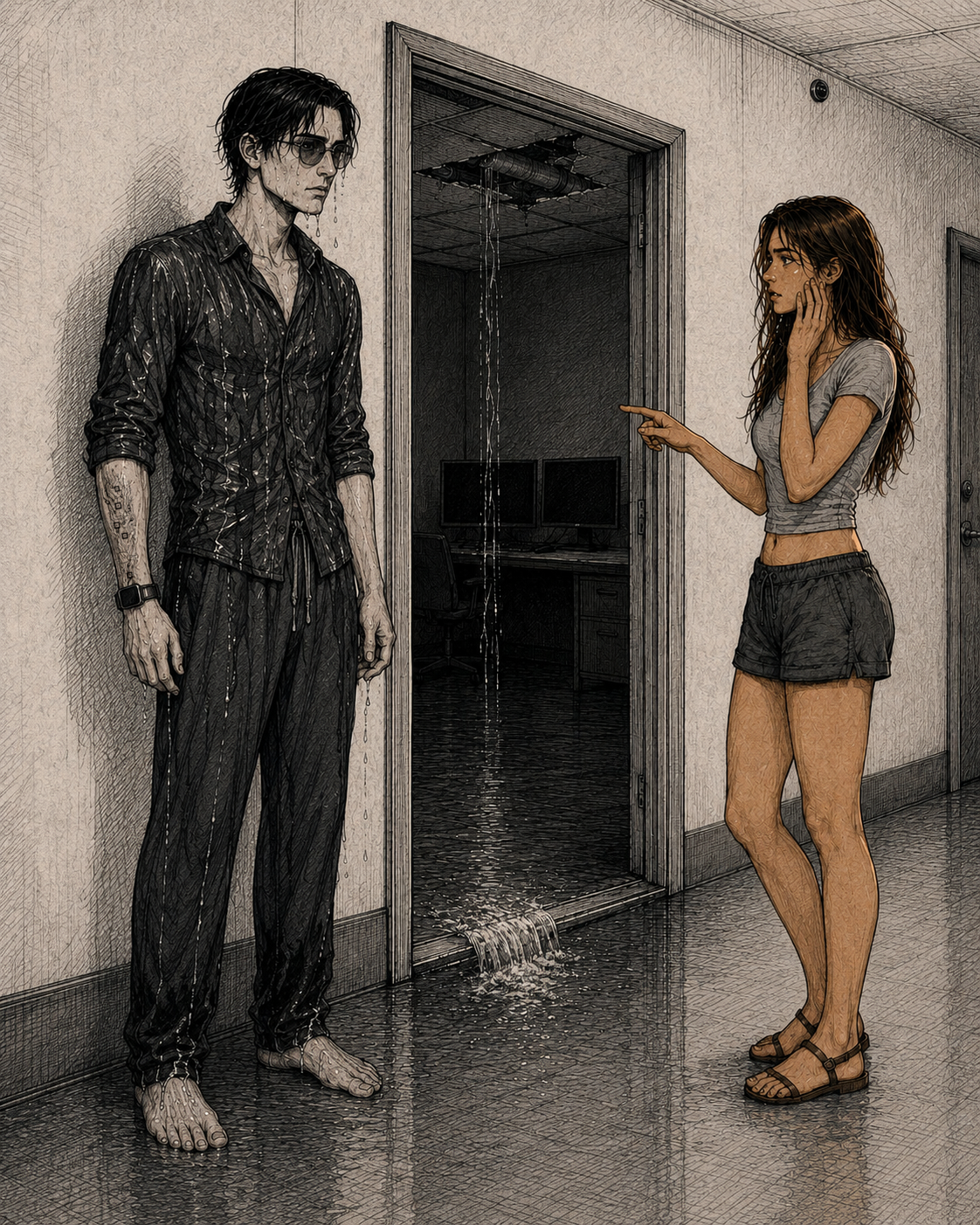
The third-floor landing · two minutes after the shutoff
She pointed at the ceiling above his door. “Your pipe?”
“Apparently.”
She looked past him into the loft. “How bad?”
“Manageable.” He said it flatly, not yet fully committed to the assessment. “The equipment is okay.”
She nodded once, registering this as the relevant metric and her own understanding of it as irrelevant. He noticed, in his peripheral awareness, that she was entirely unbothered by standing in the third-floor hallway at dawn in a crop top and boyshorts, the ease of someone who owns a range of swimwear and had long since decided where the line of decent sat and that it sat about here. She was not performing the moment. She was reading it.
He kept his eyes level.
From the far end of the hallway came the sound of the building manager’s apartment opening.
Petra Mays ran the Entrada Arms the way people run things they care about without being able to say exactly when they started caring: with an efficiency that was personal rather than professional, with a proprietary irritation at problems that reflected on the building, and with the capacity to hold two emotions simultaneously that most people considered mutually exclusive. She was fifty-three, compact, wearing a bathrobe and an expression that managed to be simultaneously upset and grateful. She had run buildings long enough to know the difference between a disaster and a disaster stopped before it graduated to catastrophe.
“Is the water off?” she said.
“Yes. I got to the utility closet.” Cade gestured toward the corridor. “Main shutoff, about two minutes after the break.”
She looked at the water working its way down the hallway and calculated something. “The first floor’s going to need—”
“Probably not. The second floor drains away from the stairwell. I can check.”
She looked at him, recalculating. She had come downstairs for a crisis and was now working out which kind of crisis it was. “Where did the leak happen?”
“The joint over the southwest corner of my apartment. I’ve been hearing that knock since I moved in.”
“Everyone on the third floor has heard that knock.” She said it wearily, a person who had fielded the noise complaint and not acted on it, which was not an accusation but a confession of the institutional failure of deferred maintenance. “I’ll get someone in today.”
“The ceiling needs work too.” He paused. “I can handle the cleanup myself.”
“I’m not going to ask you to—”
“I’m not offering. I’m saying I’d prefer to do it myself.” This landed as he meant it to: not rudely, but definitively. His space. His terms for who moved through it. “The repair is a job for a plumber. The ceiling is a handyman with ceiling tiles. The cleanup is a mop. I’ll handle it.”
Petra Mays looked at him for a moment, then nodded, and the nod granted the distinction. “I’ll call the plumber first. You can expect them this afternoon or tomorrow morning at the latest. Is there any equipment damage I need to know about for the building’s insurance?”
“I’ll be documenting it myself,” he said. “I have renter’s coverage.”
“Good.” She pulled the bathrobe tighter and glanced at the top of the stairs, where Cass had slipped back down to 2B at some point in the conversation. Then she looked back at him. “I’m sorry about this.”
He didn’t tell her it was fine, because it wasn’t. He did tell her it was handled, because it mostly was.
08:03:22 — SUBJECT_UNRESOLVED: LOCATION LOGGED / IN-UNIT
ELECTRICAL LOAD: ZERO (non-standard)
AUDIO: ACTIVE VOICE / COMMUNICATION DEVICE
BEHAVIORAL PATTERN: POST-INCIDENT RECOVERY / ESTIMATED
The front door stood open because the front door needed to stand open. Water poured over the threshold in a thin, continuous sheet and found the hallway’s slope and made its way toward the stairwell drain with the patient persistence of water doing the only thing water does. Inside, approximately an inch and a half of standing water covered the southwest quadrant of the loft and was making its unhurried way toward the front of it.
Cade’s shirt was soaked through, had been since the ceiling opened. He took it off, wrung it out over the sink, and hung it in the open window he had just finished prying open with a screw driver because it had been painted shut long before he moved in. He pinned it in place with the sash before it could fall four stories into the narrow passage between buildings. The morning air was cool and not unpleasant against his back.
He had one earbud in, the other hanging, and was in the middle of telling a claims representative from Westside Renters Coverage that he needed to file an emergency claim while simultaneously moving the three external drives from the kitchen sink to the top shelf of the bookcase, which was the highest dry surface in the loft.
“—yes, the equipment is physically undamaged. I’m moving it now.” He shifted a drive and checked the label. “The damage is structural, ceiling and subfloor. Water intrusion, approximately…” he estimated, scanning the room, “forty to sixty square feet, one to two inches depth. The pipe burst was caused by a water hammer event in the building’s supply line. My renter’s is current, policy number—”
He found the policy information on his phone while the rep pulled up his account, holding the claims call in his left ear and the phone information in his right hand, moving through the loft with measured efficiency, the assessment already made, the recovery already underway.
The rack was fine. The machines inside it were fine. The machines had been off when the water hit and had stayed off and were now, behind the screen of the bookcase’s top shelf with the external drives, as dry as anything else in the loft.
He was beginning to allow himself to register this as not a complete catastrophe when someone knocked on the open door.
Cass was dressed in the sense that she had put sandals on, which, given that she appeared to still be in the crop-T and boyshorts, suggested she had processed the situation and put on shoes to come upstairs without at any point reconsidering the ensemble. She stood in the doorway of his loft with a mug of something hot in one hand and an expression that was warm and slightly careful. She had come to offer help and was gauging the territorial situation before she committed to it.
She looked at the water. Looked at the ceiling. Looked at him.
He had the phone in one hand and the insurance rep in his ear and no shirt on, which was a state he registered only as you register something about yourself by seeing it reflected in another person’s eyes: quickly, and then stored somewhere for later consideration.
She mouthed sorry and pointed to the door, offering to wait.
He shook his head and held up one finger: just a minute.
To the claims rep: “Right, yes. I’ll email the statement within a few hours. Adjustor this week is fine. Thank you.” He pulled the earbud out. “Hey.”
“Hey.” She stepped carefully over the threshold, navigating the water on the floor with an economy that said her eyes had briefed her before she moved. She looked around the loft without apology and without the performative tact of someone trying not to look, she just looked, direct and unhurried, observing first and performing later. “How bad is it?”
“Better than it was twenty minutes ago.” He moved the second-to-last drive to the shelf. “Equipment is intact.”
“That’s the one that matters,” she said, having identified the priority without being told what it was. She glanced at the open ceiling in the corner, the exposed pipe elbow, the geography of water still mapping the floor’s topography. Then she looked at the rest of the loft, a first-time visitor’s look at a space they’ve never entered, not intrusively, but with attention.
What she found was: a space that had been organized around function rather than habitation. A desk with two monitors and a rack of hardware occupying the corner where other people would have put a couch or a lamp. Bookshelves with technical manuals and paperbacks organized by frequency of use rather than aesthetics, the used ones horizontal and accessible, the decorative ones upright and slightly dusty. A kitchen that contained coffee equipment, a cutting board, and exactly the quantity of mugs and dishes required for one person who ate alone. A bed that was made in the sense that the blanket had been pulled up, not in the sense of any particular investment in the outcome. The bed was a mattress on the floor, the frame still in pieces against the wall, in the southwest quadrant of the loft, which was the part of the loft that was currently underwater. She looked at it. Looked at him. Did not say anything about it. Her eyes said enough.
A single plant on the windowsill that was, against all apparent probability, alive. She noted the dry soil despite the morning’s events: perhaps one of five remaining dry objects in the entire loft.
There was no art on the walls. There was a cable management system that was more organized than most of the bedrooms she’d been in.
She looked at the broken french press on the floor near the desk, shattered, apparently from being knocked off the desk during Cade’s scramble, the glass scattered in a circle on the wet floorboards. She looked at it and decided not to say the first thing that came to mind.
“How are you doing?” she said instead, which was the question underneath the question.
“I’m fine.” His voice did the thing a voice does when fine is technically true and not the whole answer, a small flattening the record would catch even if she had not, and she caught it. “It’s a lot of water. Did it get into your place?”
“Just a wet spot in the ceiling. I’ve got a towel under it just in case,” she said without looking back at him, her eyes focused on the hole in the ceiling again. “I had a burst pipe in my last apartment,” she said. “The one before this one. I came home to it, so it was already done when I got there, which, honestly, I think might have been worse somehow.” She set the mug she’d brought on the kitchen counter, which was dry and out of the way. “The insurance took three weeks to process and the temporary housing they put me in had a mattress that was approximately a slab of concrete with ambitions.”
He looked at her.
“I’m not saying your situation has an upside,” she said. “I’m saying I’ve been where you are and it doesn’t kill you.” She looked at the ceiling again. “Probably.”
“The adjustor is coming this week,” he said. “Apparently I’m fully covered.” He paused. “That’s the one unexpected positive of the morning.”
“It’s a real one.” She looked at the broken french press again, then at him. He was aware of her looking. He was aware of it in the peripheral way he’d developed without deciding to, and he understood that she was taking stock of him, a frank inventory; she had not been in his physical vicinity without a layer of clothing between them before. What he did not let himself do, because the disaster was still on the floor and because it was the only discipline the morning had left him, was take the same inventory back. He meant to keep his eyes on her face. It required the focus of a man holding a precise position in space under mild pressure.
She turned to face him directly and ran her thumb along the seam of her shorts and pulled to adjust them for comfort.
Mild pressure.
His eyes went where he had told them not to, and came back. She had seen them go, and let it pass, and looked at the tattoo instead, which gave them both somewhere else to put it.
The same tattoo she’d noticed days ago and only now gave herself permission to examine: its intricacy, its structure, its intentional design, the kind a person only carves into their skin as a commitment to who they are. A man who refused every ordinary opportunity to say a word about himself, and had put the whole of it permanently on his arm, in ink, where anyone who got close enough could read it, if they had the language.
It ran from his left wrist up the forearm to just below the elbow, black linework, worked with the precision of a hand that had spent significant time deciding exactly what the design would say, and to whom. At the right distance it read as geometric abstraction, the kind of technical-aesthetic thing that might be produced by someone who liked circuit boards and had too many opinions about both. Up close, and she was up close, or close enough, the geometry resolved into something that had been designed with specific intent: a topology of nodes and trace-paths that echoed actual circuit architecture, drawn from PCB layouts rather than imagination. Nested within the precision of the lines, in a font small enough to require proximity, notation in hex that was either annotation or meaning or both. She would not have been able to decode it without context she didn’t have. She could tell, from the quality of the work, that someone with that context would have been able to.
She looked at it like an interesting problem.
He noticed her noticing. Didn’t comment.
“You should sit down,” she said, offering a practical thing that meant an adjacent one.
“I have to keep moving,” he said. “The longer the equipment stays near humidity the more risk there is even without direct contact.”
“Okay.” She picked up the mug from the counter and held it out to him. “I made too much. You look like someone who needs something hot right now and your french press is on the floor in a thousand pieces.”
He looked at the mug. Looked at her. Took the mug with his left hand. She noticed the right one held a little out of use, the knuckles taped and the tape gone dark, and she did not ask. She added it to the list of things about this morning she was not going to ask about, the mattress and the broken press and the taped hand and the plain fact that a man running a disaster at seven in the morning had not slept, and let it pass, as she had let the rest pass.
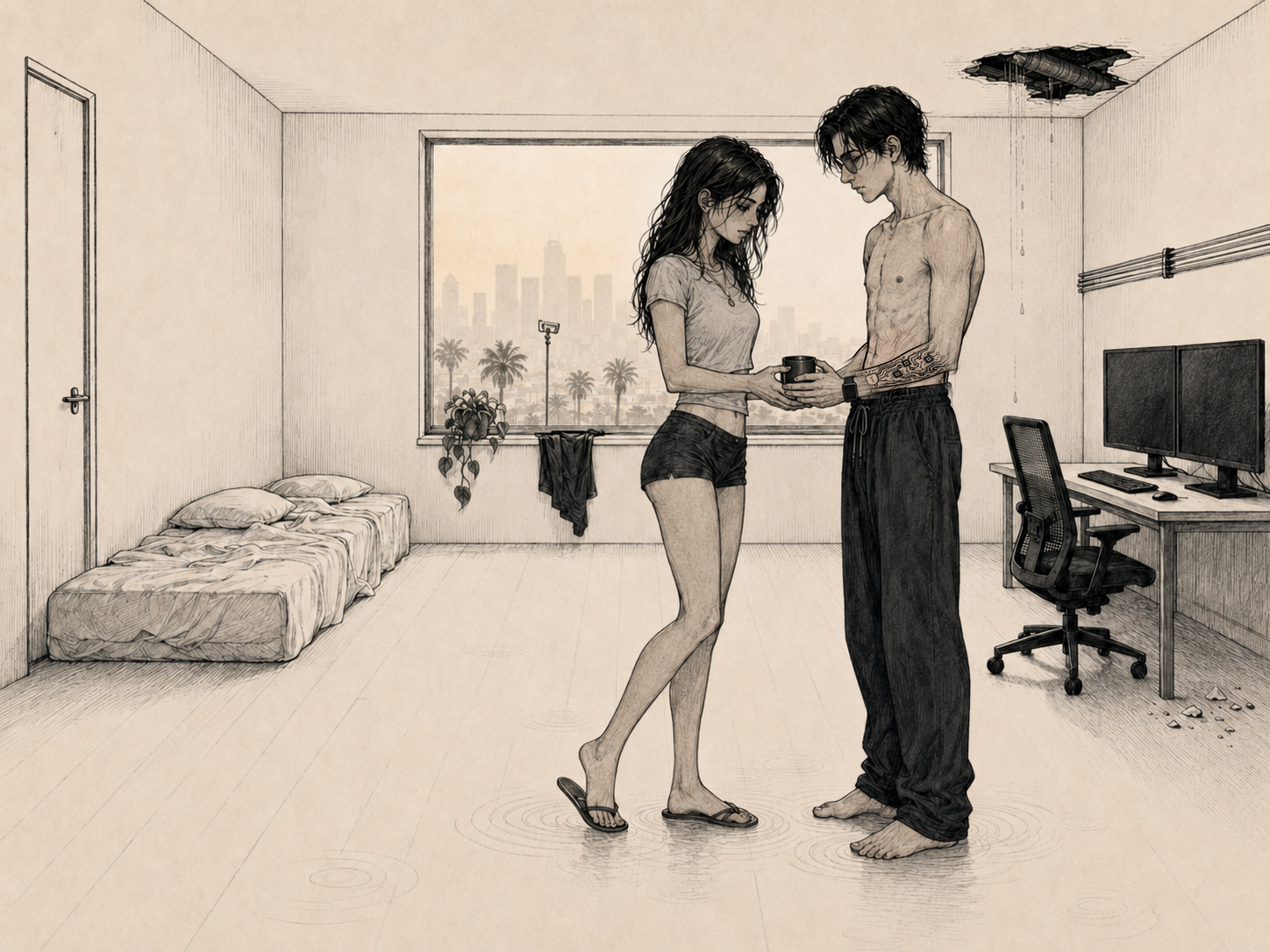
1847 Entrada, unit 3B · the morning the ceiling opened
She moved, carefully, through the water toward the rack in the corner and crouched to examine the bottom of it, tilting her head to see the clearance between the rack’s lower components and the water level. “This looks dry,” she said.
He did not move, but his eyes followed her to the floor.
Moderate pressure.
“It is. I got the power off in time.” He answered after a delay that was just barely below too long. He watched her assess the situation with the same attention she brought to everything else, and found the observation mildly arresting, the low undeniable pull of watching someone capable at work.
He turned to the window. He told himself it was to check the shirt, whether the sash was still holding it against a four-story drop, and it was partly that. It was also that meeting her eyes one more second was going to take something he could not spare in a flooded room at seven in the morning. In the glass, faintly, the room behind him came back over the grey morning and the narrow passage between the buildings, and in the reflection Cass had straightened from the rack and, believing for exactly that long that he was looking out at the day, took the inventory he had refused to take, down the line of his back and up again with the unhurried thoroughness she brought to anything she’d decided was worth understanding. Then he shifted his weight and the reflection shifted with him and she was reading the ruined ceiling again, composed, and neither of them said a word about the window.
“You need fans,” she said. “And a dehumidifier. Do you have any friends that can loan you one? If you don’t, the hardware store on Pico—”
“I know where to get one.”
“Right.” She stood and pushed her hair back from her face, remembering she hadn’t combed it and not particularly changing course because of it. “Do you want help moving the rack further from the wall? I can—”
“It’s on casters. I moved it myself.” He heard himself sounding more contained than the situation strictly required and adjusted slightly. “Thank you. Seriously. I’m okay.”
She studied him for a moment, not intrusively, with the patience of someone collecting information before forming a conclusion.
“You’re sure?”
“I’ve handled worse.” He let it sit. “Not usually at seven in the morning. Disasters don’t have schedules though.”
That got the corner of her mouth. She looked at the window where his shirt hung drying in the morning air, then back at him without it, then quickly back at the floor, and seemed to be doing a small private audit of the situation. Then: “Okay. I have a class at nine, I should…” She looked at the french press again, the circle of broken glass and spilled grounds on the wet floor. The small deliberate hesitation of someone choosing a particular moment for a particular thing.
“At least let me get you a cup of coffee when I see you next,” she said. She pointed at the french press. “I can be your drug…” a half-beat, deliberate, the kind of pause that announces itself, “I mean caffeine supplier, until you get a handle on things here.” She looked at him with a wink that was warm and deliberate and entirely on purpose, and the smile under it had been built for the express purpose of making him crack his composure slightly.
He cracked his composure slightly. “Sure,” he said. “Maybe.”
She crossed her arms over her stomach. Took a breath. An eyebrow went up. Her posture was insistence itself.
His eyes betrayed him. “I’ll think about it.”
“I’ll take it.” A row of teeth appeared as she said it. She moved toward the door, navigating the water and the geography of the loft with a practiced ease; she was, as a matter of fact, quite comfortable in physical spaces amidst disaster. At the threshold she turned her head over her shoulder, one hand on the door frame, took in the room one more time, and looked at him with an expression that was difficult to read precisely and easy to feel generally.
“It’s going to be fine,” she said.
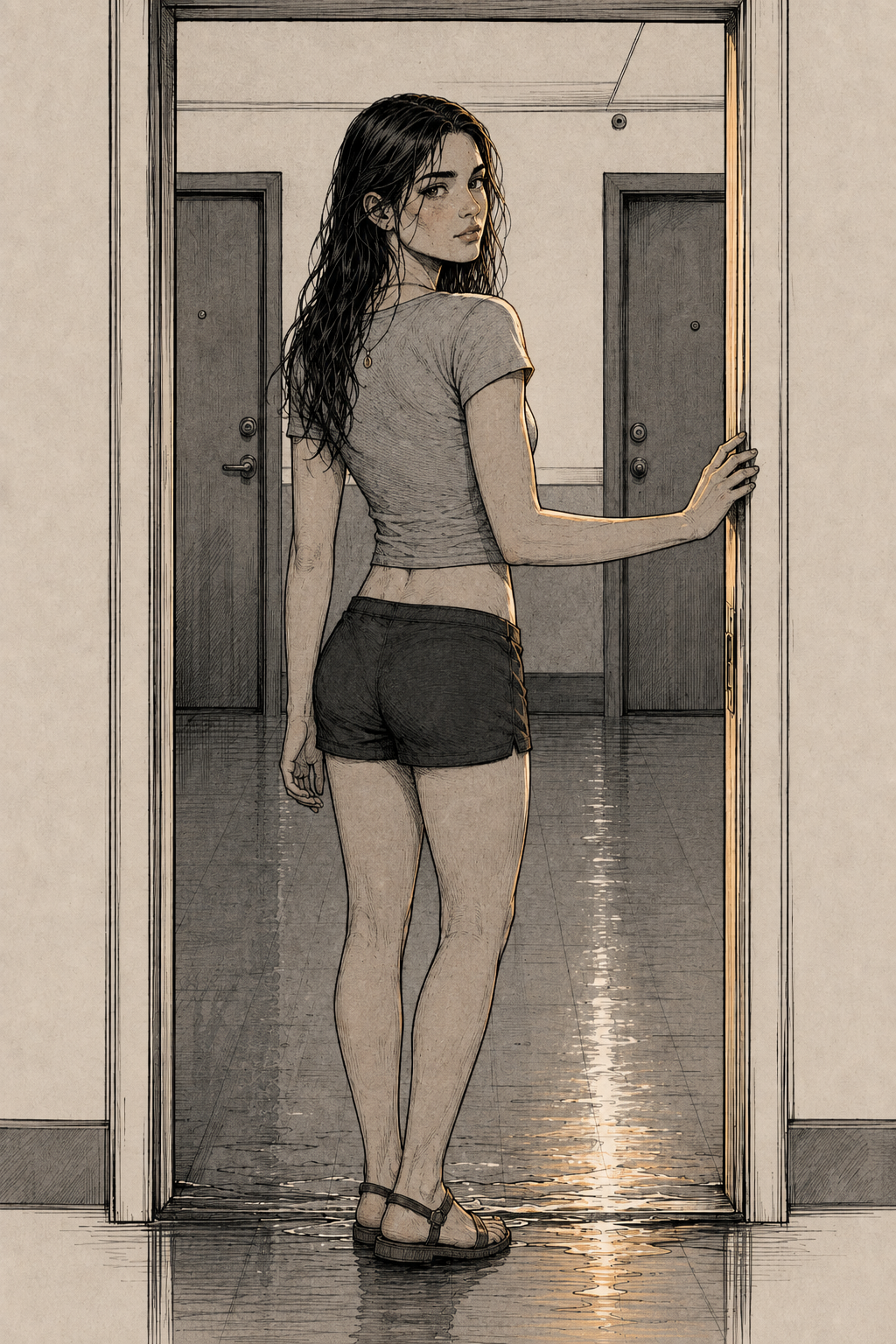
The threshold · one more look at the room
His eyes betrayed him. Again.
“I know.”
She left.
The pressure did not drop.
He stood in the water in the middle of the loft and watched the door for a moment after she had gone.
He had stood shirtless through the entire conversation. By the record he had not once seemed to register it, and then he did, all at once and a beat after the moment for it had passed, as a person registers the thing the rest of the room had agreed not to mention. When he understood he had been doing it is not on any record, and neither is whether it occurred to him to wonder if she had understood it too. The record has no field for that. It has heart rate, and gaze duration, and thermal load. It does not have the small private reckoning of a man alone in a wet room deciding it was not worth running.
The mug had been warming his palm for a while. He lifted it without looking at it.
A violent choke, eyes wide.
He looked down at the mug like a failed monarch realizing he’d been poisoned.
“Too sweet.”
He turned back to the equipment and kept working.
Hmm. Kids.
09:10:17 — RESIDENTIAL SECTOR 7 — INCIDENT LOG
UNIT 3B, ENTRADA ARMS
STATUS: WATER SUPPLY RESTORED / PARTIAL (floors 1-2)
REPAIR CREW ETA: 4-6 HOURS
SUBJECT_UNRESOLVED: BEHAVIORAL STATE / ACUTE RECOVERY
ANOMALY: EXTENDED TOLERANCE OF NON-HOUSEHOLD-MEMBER PRESENCE IN DOMICILE
DURATION: 14 MINUTES, 33 SECONDS
PREVIOUS LONGEST DOCUMENTED INSTANCE: 3 MINUTES, 11 SECONDS (maintenance worker, 2034.11)
BEHAVIORAL PATTERN: UNCLASSIFIED

GAZE ANALYSIS — SUBJECT_UNRESOLVED / DURATION 14:33
VISUAL ATTENTION TRAJECTORY: DIRECTED, FACE / DURATION: 14 MINUTES, 17 SECONDS
DEVIATION EVENTS: ZERO
BEHAVIORAL PATTERN: CONSISTENT WITH ATTENTIVE ENGAGEMENT

SUPPLEMENTAL NOTE: ANALYSIS OF ATTENTIVE ENGAGEMENT PATTERN
CROSS-REFERENCE: PHYSICAL STILLNESS, EYE POSITION TRACKING
CONFIDENCE: 0.91 — ATTENTIVE ENGAGEMENT PATTERN CONFIRMED

ANOMALY FLAG: BEHAVIORAL / LOW
PATTERN DOES NOT MATCH KNOWN ENGAGEMENT TEMPLATES
VARIANCE: ATTENTIVE ENGAGEMENT DURATION / GAZE ACCURACY: STABLE
VARIANCE: PERIPHERAL ATTENTION DISTRIBUTION: NONSTANDARD
NOTE: SUBJECT EYE POSITION CONSISTENT WITH FACE-DIRECTED ATTENTION
NOTE: SUBJECT PERIPHERAL CORTICAL ACTIVITY PATTERN INCONSISTENT WITH FACE-DIRECTED ATTENTION
THE SYSTEM HAS NO FRAMEWORK FOR THIS VARIANCE
FILING AS: ANOMALOUS / UNRESOLVED
The record will show that the subject spent fourteen minutes and seventeen seconds directing his visual attention to the face of the other subject. The gaze pattern is consistent with engaged listening. The system notes this and moves on.
What the system has no notation for: the way a person can look directly at something and attend to something else. The deliberate decision to keep the eyes pointed one direction while the mind goes to the periphery, borrowing the geometry of eye contact as a social contract, I am looking at you, therefore I am not looking at anything else, therefore you cannot observe what I am looking at, a deception that requires no words and leaves no trace in a record that measures the position of eyes without measuring the direction of attention.
What the system has no notation for: the inverse performance. The other subject, whose gaze was similarly directed at the subject’s face, and whose peripheral attention similarly operated outside the documented trajectory, in the moments when she believed she was not being watched, which is to say: all of them, because the subject’s eyes never moved.
What the system has no notation for: what this takes out of him. The discipline of wanting to look at something and not looking at it. The way a person stands in a flooded room in the morning and holds a mug they didn’t pour themselves and maintains the posture of someone who is fine with the situation, who has the situation handled, who doesn’t need anything from anyone, and then turns to watch the door for three seconds after the other person has gone through it.
The record will show: incident logged, behavioral patterns unresolved, no further action required.
The record has never been more precisely inaccurate.
None of it required a warrant. A login, a sector number, a slow morning, and the curtain parts, and there they are: a man who has decided he is fine, holding a mug he did not pour, watching a door for three seconds after it closes; a woman on the far side of it who looked when she believed no one could see her look; and neither of them will ever know the curtain was there. That a life can be watched is old news. The system was built to watch it. What does not wash off is how little a person has to be to do the watching. Authority makes it a job. Access alone, and the willingness not to ask whether one is allowed, makes it the oldest ugliness there is, wearing a new disguise.