Act 0 · Null Witness
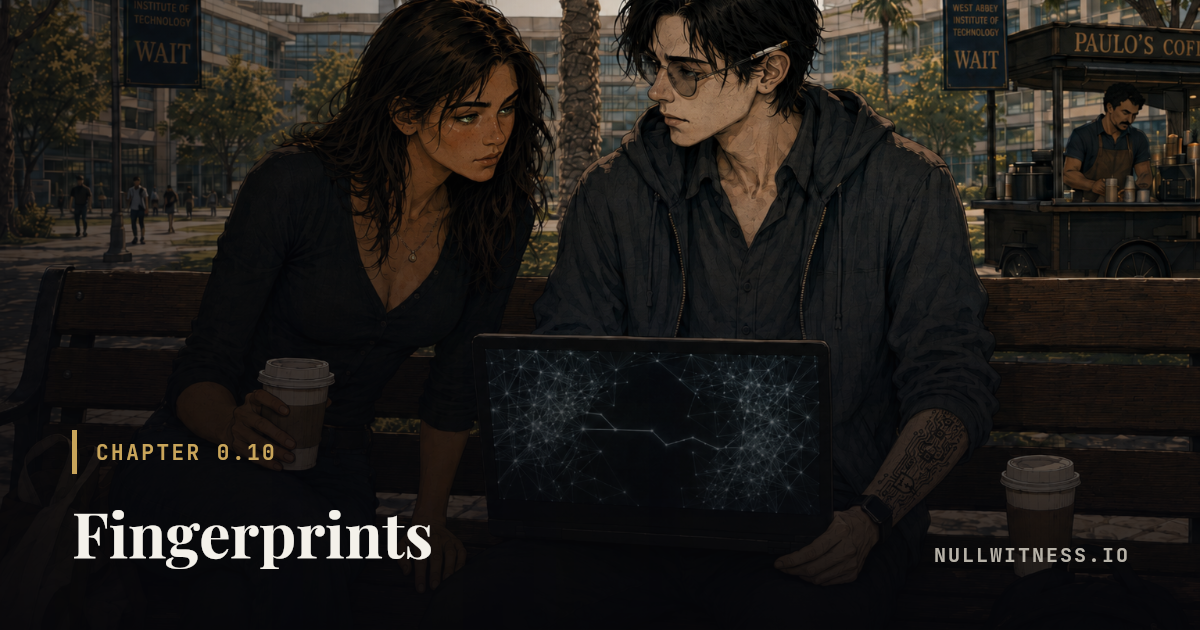
Chapter 0.10
Fingerprints
The dehumidifier was the practical problem, which made it the good kind.
Ki’s shop was on the way to nowhere in particular, but also on the way to everything I needed, which made it simply on the way. I walked from Entrada with a backpack carrying the laptop and two of the three drives. The third stayed in the loft’s dry zone. Some things you don’t carry on your person, not in a city you trust, and not on a morning that has already used up its quota of disasters.
The day had started badly and hadn’t yet decided whether to get better. The Santa Monica morning was clear and bright, announcing warmth without delivering it, the marine layer already burning off to the west, the streets in their mid-morning calm between commute and commerce.
I had been working on a problem. I didn’t want to think about the problem, because the problem was what had been erased, and thinking about erasure is less useful than thinking about reconstruction.
I thought about it anyway.
The shop smelled as it always did, faint petroleum undertone from the flooring’s history, the warm electronics smell of devices being assessed and repaired, something that might have been solder or might have been habit. The front display had been rearranged since my last visit, the consumer-facing merchandise reoriented toward the walking traffic from Arizona Avenue, a small concession to the neighborhood’s steady foot traffic that Ki had made without commenting on and would not make again if it didn’t produce results.
Ki was at the bench when I pushed through the door, and he looked up as he always did, registering, assessing, returning to work, but this time he looked up and then looked again, which was the version of his attention that meant something had flagged.
He set down the multimeter in his left hand and gave me his full attention. His hands were still. A tell. “What happened to you?”
“Pipe burst in my ceiling.” I dropped onto the stool across the counter. “Just before eight this morning.”
Ki studied me. Not with alarm, Ki doesn’t do alarm, but with concentrated attention, taking inventory of the situation. His eyes caught on my right hand, the tape, the dark at the knuckles, a half-second longer than they caught on anything else, and moved on without comment, as Ki files a thing to ask about later or not at all. He was wearing a dark work shirt, untucked, and there were marks on his right index finger from whatever he’d been testing that he hadn’t wiped off yet. He glanced at the backpack on the counter.
“Equipment okay?”
“Mostly. I got the power off before the water reached anything live.” I set the backpack on the counter. “The rack itself took some spray. I don’t know yet. I need the dehumidifier and some time.”
“I’ve got one.” He had already pivoted toward the back room and was moving through it without theatrics, with the purpose of someone retrieving a known thing from a known location, which it was. He returned thirty seconds later with a mid-size dehumidifier in a box, still in its original packaging. He set it on the counter. “Take it, return it when you’re done.”
“What do I owe you.”
“Nothing. Pipe burst is force majeure.” He settled back onto his stool and picked up the multimeter, but didn’t return to what he’d been testing. He was still doing the inventory. “You got to the shutoff in time?”
“Building water main. Yes.” I ran a hand through my hair, which was still faintly damp. “It went better than it could have.”
Ki’s mouth moved in the direction of a smile without completing the trip. “You had to cut the whole building’s water?”
“Only way to stop it.”
“You have friends.” He let it sit a second before he added, “Most of them are probably fine with that.”
“The landlord seems to be managing.”
“I’m sure.” Ki set the multimeter down again and reached for the small mug of tea on the far side of the bench, a habit, always there, perpetually at the wrong temperature. He considered me over the rim of it. “You said you got the power off in time. How much work did you lose?”
And there it was. The question underneath all the practical ones, asked as Ki asks things: directly, without drama, with the understanding that I would answer honestly because it was Ki asking.
“About three hours. Not on the main engagement, on Dark Cypher.” I paused. “I was deep in something. It was…” I didn’t have the precise word for it. A problem that had finally started to yield. Two days of it knocking around in my head, then three hours of it coming clear, and then the ceiling opened up. “It was going to break that morning. I could feel it.”
Ki nodded once. He understood the character of that loss. He’d watched me lose versions of it before, not to pipe bursts, but to the ordinary interruptions of a life that was being lived at the same time as the work. “Can you retrace?”
“Probably. It’ll take longer the second time. The problem is a randomized graph tree traversal that re-shuffles each day. It’ll rescramble in another three hours and I’ll have to restart.” I picked up the dehumidifier box and then put it back down, the physical gesture of not being ready to leave yet. “The Sigil work is still running. I have a milestone review with Pryce, my point of contact, next week.”
“How’s that going?”
“It’s…” I considered the right word. “Strange. The scope is tight in ways that feel deliberate. I’ve been navigating around it.”
Ki held my eyes, having noted the word choice. “Navigating around scope in a contracted engagement.” Not a question. A reflection of the sentence back at me.
“Within the engagement,” I said. “I haven’t violated…” I stopped, because Ki’s expression hadn’t changed and that was, itself, a response. “I’ve found things I wasn’t supposed to look at and documented them. That’s the job.”
“I know what the job is.” Ki set down the tea and turned the multimeter over in his hands, not using it, just having something to occupy them while he thought. He looked at the bench. “Someone I know did some contract work for a firm like that a year or so back. Security engagement, similar setup, scope document, handler, restricted access. He said it was the most controlled engagement he’d ever been in. Paid well.” A beat. “He didn’t talk about it much after.”
“What firm?”
“He never said. He also never took another job like it.” Ki set the multimeter down and picked up the tea again. “I’m not drawing any lines. I’m just noting the anecdote.”
“Noted.”
“As I said.” A pause. “How are you sleeping?”
“Fine.”
Ki’s eyebrow moved perhaps two millimeters. The Ki equivalent of a skeptical noise.
“Adequately,” I amended.
“Is the work interesting enough to be worth the lost sleep?”
“Yes.” Without hesitation. “That’s—yes. It’s the most interesting thing I’ve ever been inside. Which is…” I caught myself starting a sentence that led somewhere I hadn’t decided to go yet and rerouted. “Which makes it hard to disengage.”
Ki let that sit. “And the competition?”
“Also interesting.”
“And the coursework?”
“Also happening.”
“And,” Ki said, with the careful phrasing of someone choosing the ground for a remark, “whatever’s developing with the person in your building?”
I studied him.
Ki’s expression was entirely neutral. “You mentioned her last time.”
Ki has always been annoyingly perceptive.
“The pipe burst was in my loft and apparently leaked through the ceiling into her apartment. She came to check on it.” A beat. “Brought coffee.”
“Mm.” Another annoying characteristic of his, drawing conclusions from things no conclusions are meant to be drawn from and announcing it audibly like an older sibling.
“That’s not—”
“I didn’t say anything.”
We looked at each other. He cracked a smile that said something he didn’t say out loud. Ki picked up the multimeter again.
“Take the dehumidifier,” he said. “Come back when there’s less water in your apartment. We’ll get food.”
The dehumidifier ran steadily in the corner of the loft all afternoon, its low mechanical hum joining the ambient sound of the building returning to normal operational life as the plumber worked on the ceiling above. The repair took four hours, as promised. The cleaning took me another two. By late afternoon the sun had come around to the west-facing windows and was doing what west-facing windows in Santa Monica do, filling the space with a gold light that made even water-damaged plaster feel provisional. The floor was dry. The equipment was unmoved. And the work I had lost that morning was reassembling itself in the ordered filing system I keep for things my brain has processed but not yet examined.
I needed to attend yet another tiresome lecture this evening, and I needed to run.
The run was how I cleared the stack. Not meditation, not sleep. Movement, sustained and uncomfortable, running alongside the problem without competing with it. Two conversations at different volumes. I’d been running since I was fourteen, partly because it was free and partly because the city looked different from inside it at a run than it did from inside a building at a terminal, and partly because the thing I was mostly afraid of was stopping.
I packed the laptop and the two drives. I laced my shoes. I went.
The campus quad in the late afternoon had the character of a place where serious work was being done in a setting that suggested the opposite. Students distributed across benches and grass, in states ranging from genuine academic engagement to an elaborate social performance of it. From outside, the two were indistinguishable. The coffee cart on the Palisades side was Paulo’s territory at this hour. He had been running it long enough to know every regular’s order, and he had the social intelligence of a man whose work puts him at the intersection of everyone’s daily rhythm.
I found a bench in the shaded quadrant, away from the main foot traffic, with a sightline to the coffee cart and a wall at my back. I opened the laptop.
The Dark Cypher challenge I’d been working on before the ceiling intervened was a network analysis problem, topological mapping of an obfuscated graph structure, finding the canonical path through noise that only resolved cleanly if you understood what the noise was hiding. I’d been three hours into it when the morning happened. I had been, I believed now as I had believed then, approximately forty-five minutes from the solution.
I started again.
I was approximately thirty minutes back in when I heard, across the quad, a laugh I recognized.
THE FIRST HOUR
How do I even start this?
I guess maybe it’s best to tell you about that afternoon on the day his loft flooded. I had been bumping into him for a week and a half by then, in various places and ways: the laundry room where he casually confirmed a hypothesis I had been staring at for hours; our stairwell; the shared path behind the arts building. None of them quite hit me the way this day did. I should have seen it sooner, but my friend Sam saw it first.
We’d just arrived on campus, and I had been telling her what happened that morning. The pipe that had been knocking for years before it finally gave up its valiant defense against physics and emptied itself all over his mattress and floor. I had given him the coffee I made for myself and told him I made too much because that’s what you do when a neighbor is contending with what looked like his tenth catastrophe of the week.
I told her what I saw, and I’ll tell you too. He was thin. Not the “fit” kind. The not-eating-as-a-financial-decision kind. He was drying what I assumed was his last clean shirt in the window that the building poured all over him like salt-water in a wound. He was soaked. He was managing more than he admitted. And he was pitiful. A coffee was the only comfort I had so I gave it. And then I told him everything would be okay before I left him to manage things on his own, which I could only assume was his preference.
I thought it was kindness.
Sam drew vastly different conclusions about the events of that morning.
She had been building her case since we left the gym. That’s how she works, she doesn’t defend a position, she adds to it. Every hour she’d turned up one more thing, and by the time we got to the coffee cart she had the whole structure laid out and was walking me through it with what she would call rigor and I would call enjoying herself.
“—there’s a certain kind of guy,” she was saying, “who runs to the basement barefoot—”
“The pipe was affecting the whole building.”
“—and fixes it. Without being asked.” She took her cup from Paulo without looking at it. Same order, every day, for years. “I’m just noting the profile.”
The irritating thing about Sam noting things is not the noting. It’s that she’s usually right.
“You’ve been making this observation since I described the situation,” I said.
“Forty minutes ago. Yes.”
“That’s not analysis. That’s a theme.”
“It’s analysis that’s had time to develop.” She gave me the face she uses when she can see exactly what I’m doing. “You went upstairs in your pajamas—”
“I heard a noise.”
“—at eight in the morning—”
“There was water coming through the ceiling.”
“—and stayed fourteen minutes and then made him coffee.” A beat. “Cass. I’m not doing anything except pointing at facts.”
She was right about the facts. Every one of them, separately. What she was doing, laying them end to end until they pointed somewhere, was also right. I knew it. I had known it since about half past eight that morning, standing in my own kitchen making a second cup of coffee and wondering whether he’d drunk the first one.
I noticed that I was wondering. Then I set it down. I have gotten very good at setting things down.
I picked up my cup from Paulo’s stand and turned around.
There he was. On a bench in the shade at the edge of the quad, laptop open, gone so far into it that his body had stopped complaining about the position. Twenty yards. His sleeves were pushed up. The tattoo was catching the sun.
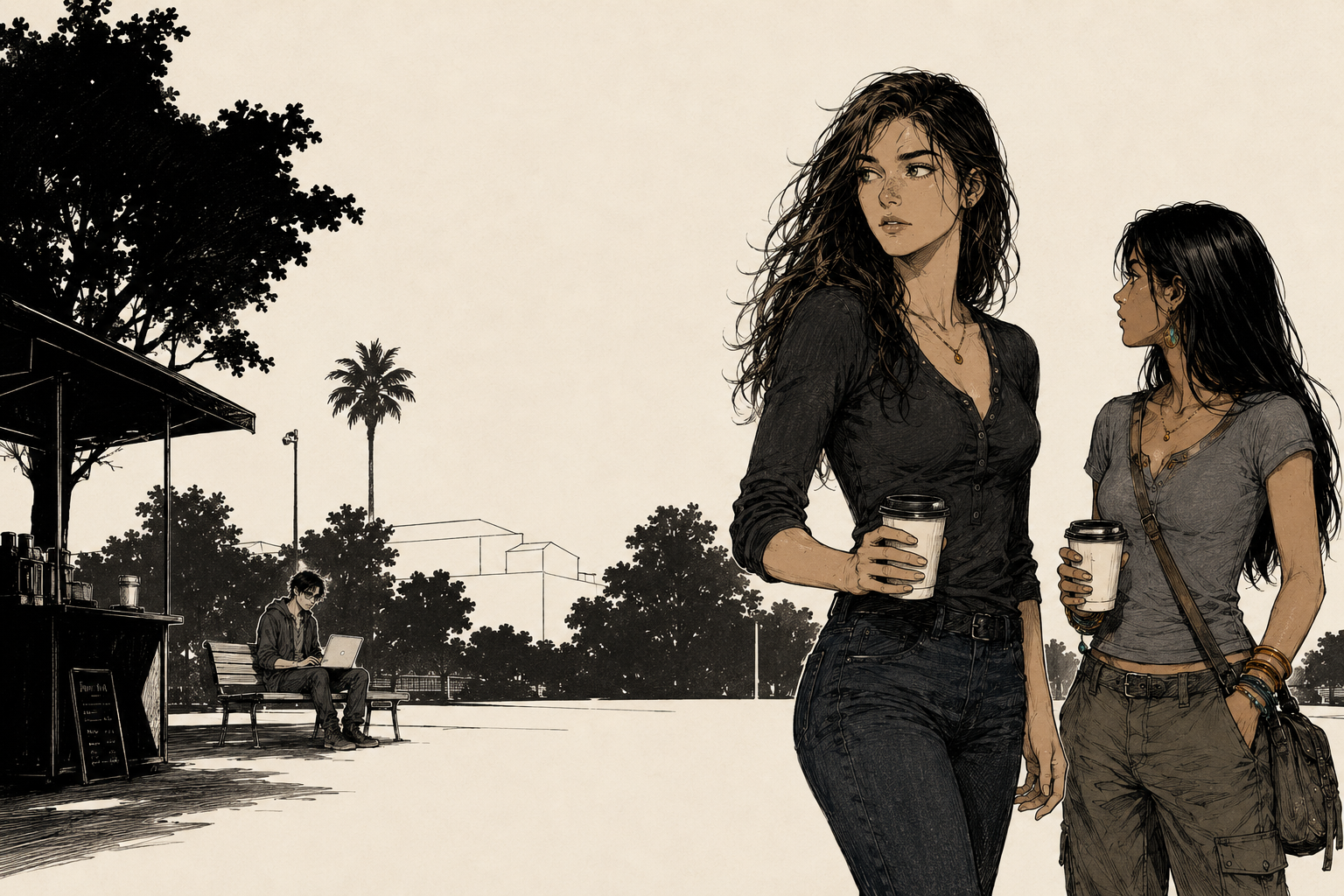
Paulo's cart · twenty yards
Something happened in my face before I could do anything about it. I’m not sure how to describe it. I’m just telling you it happened, because leaving it out would be its own kind of lying.
Sam had already turned to see what I had stopped at. I watched her arrive. She did the math too fast for me to interrupt it.
“Wait. Is that him?”
I shrugged. It was the least honest thing I did all afternoon.
“Oh,” she said, and let the word have its moment. “You did not tell me he was cute.”
“I told you he was a neighbor.”
“A cute neighbor.” She turned back to me. She had just been handed exactly the material she needed and she knew it. “With those eyes and…” she made a gesture that was accurate and unhelpful. “That’s not a neighbor. That’s a situation.”
“There is no situation.” I said it too hard, which I heard as I was saying it.
She went through the inventory again, the pajamas, the fourteen minutes, the coffee, and she wasn’t wrong about any of it. I had an answer for each item. Together they were harder. She knew I knew that, and she kept going anyway, because she had decided to win this before we left the cart.
“He’s cute, though,” she said finally. “You can’t tell me you didn’t notice.”
I didn’t say anything.
Not saying anything is also a way of saying something. I knew that too. I made the choice anyway.
Sam smiled. “Right,” she said. “Okay. Well, I want to meet him.”
“No.”
“Why?”
“He’s busy.” It was the only thing I had.
She made a small sound of air past her teeth that meant I had lost control of this some time ago, which I had.
“I will go over there and I will be perfectly well-behaved and completely normal and I will not say one single—”
“Sam.”
“—thing that could possibly be—”
“I need you to actually behave.”
I asked Paulo something. He looked behind me. Then he set a third cup in my hand.
“I will be a paragon.” She squared her shoulders like someone accepting a commission. “Exemplary. Best I have ever—”
“Walk,” I said, “or I go alone and tell him you had somewhere to be.”
I had told myself, picking up two cups, that we were heading that direction anyway. Toward the administration building. It was a reasonable route.
I had been telling myself that for about ten minutes.
We walked.
He saw us coming with a few seconds to spare. I watched him do the math, two people, one bench, no exit, and decide to be gracious about it.
“Small world,” I said, which is what you say when the world is exactly the size you expected. I set one of Paulo’s cups down in front of him and sat down like I had been meaning to sit there all along. “You look better than this morning.”
“Considerable improvement.”
“Good.” I looked at the laptop without reading it. There are things on other people’s screens they don’t want read, and I have never needed to be told which.
Sam had not sat down. She was standing a little to my left, comparing what she’d been told to the original, deciding which end of the bench served her better.
“Sam,” I said, “this is Cade. Cade, Sam.”
“Hey,” he said.
“Hi.” She sat. On his other side. The bench was not large, and by the time I understood the maneuver it had already worked, Cade between us, one of us on each side, nowhere for him to go that wasn’t toward somebody. He sat up a little straighter. His hands settled on the edge of the laptop, not typing, holding a neutral position. “Cass told me about the ceiling situation.”
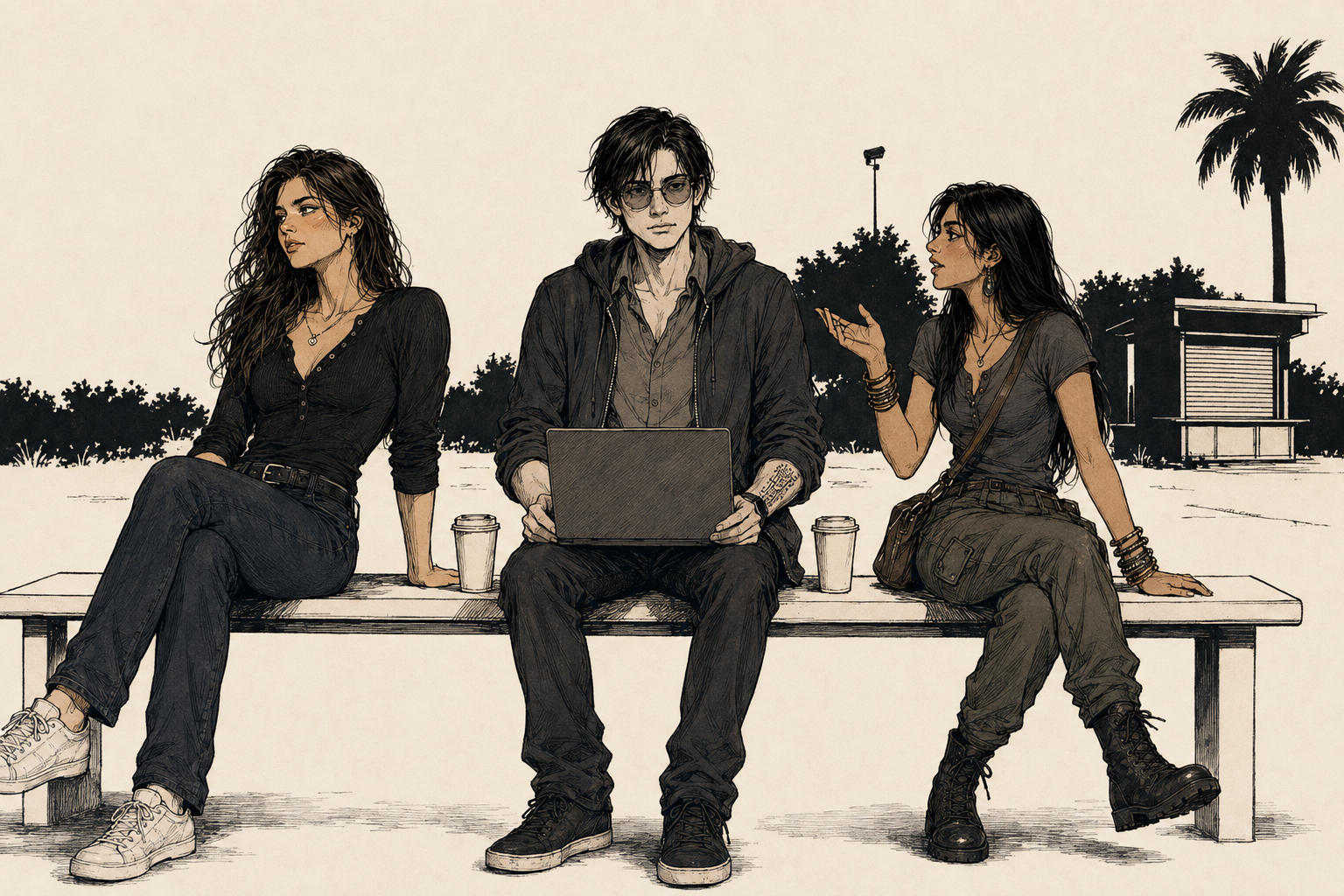
The quad · one bench, no exit
“The whole building was grateful,” he said. The neutrality was a bit forced.
“She said you were in the basement barefoot.”
“Barefoot, yes.” He didn’t ask what that had to do with anything, which I appreciated and Sam did not.
“And,” Sam said, with timing she had clearly rehearsed, “that you—”
“Sam,” I said.
“—were very calm under pressure.”
“Sure.” He agreed to it as you agree to a thing to make it stop.
“She also said—”
“Sam,” I tried to interrupt again, with a little song in my voice to catch her attention. She went on anyway.
“—that the equipment was fine, which I gathered was—”
“That is,” he said, “the part that matters.”
“Okay, but—” Sam glanced at me. I gave her the look that meant I was deciding how much rope to extend. “She said the equipment survived but some work was lost. What kind of equipment? What kind of work?”
“Servers. Competition stuff.”
Her attention sharpened. “Like—”
“Technical challenge. CTF.” His eyes went back to the screen. “I’m reconstructing it.”
“Is it going well?”
“Making progress.”
She looked at the screen, then at him, then at me, then back at him, running whatever calculation she runs. “Can I ask—”
“Sam,” I said, sharply, in a way I had not used yet.
She looked at me.
“His floor is still wet,” I said. “He’s working. You’re doing the thing.”
“I’m being friendly.” She insisted.
“You’re being thorough.” I corrected.
“I,” Sam said, “am getting context.” She turned to him. “She talks about you.” A pause, placed exactly. “As a neighbor. Who she has had interactions with. About—” she appeared to search, which she was not doing, “research methodologies.”
“Her research on Cas9 carrier delivery for Uppsala University,” he said.
“Right. That.” Sam looked at me and mouthed, Oh my God. He remembers Uppsala, as though he were not sitting between us.
“Most people remember things they were involved in,” I said.
“Most people remember their own part of things they were involved in. He remembered the university.” She was calculating again. “Cass mentioned you helped her see something in her data she’d been looking at wrong.”
“She had the answer. I just pointed at it,” he said.
Sam chose the more direct of the two roads available to her from this point, “she said it was the first time in a while that someone asked the right question instead of just—” she waved a hand, “nodding at the right parts.”
He raised his eyebrow. Then said, “Parts,” patiently, and straight through Sam’s infuriating habit of aiming innuendo at me.
“Sam.” It came out quieter than the other times, and more final.
She checked my face. She did the assessment. The assessment came back with an answer, and she spent one more coin anyway.
“Actually—” She turned to him. “The tattoo.” She tilted her head, glanced at his arm. “What does it mean? Cass said it was—” she located the word she had been holding, “intricate.” A beat. “She mentioned it particularly.” She delivered this with the innocence of someone setting a timer. “This morning. When she was in your room.” Another beat. “In her undies.”
My eyes shot open as she finished.
“While you weren’t wearing a shirt.”
I felt my face go hot from the collarbone up, all at once, the way it does, and there was nothing available to do about it in front of either of them.
My voice had stopped managing anything.
“SAMANTHA!”
She faked an innocent smile. I responded to it, maybe harder than I should have.
“Would you kindly fuck off?”
I’m not proud of it.
Sam looked between me and Cade. He was looking straight through her like someone who had kicked a puppy. She completed the pivot. Something real crossed her face. She had gone one step past the line and felt it land. She put her hands up.
“That was—” she said. “Yeah. That was too much.” She faced him, and there was genuine apology in it. “I’m sorry. I went too far.” She glanced back at me. She knew she had earned exactly the response she got. “I have a five-thirty.” It was an exit, and she took it. She picked up her cup, nodded once, to both of us, weighted differently, and walked off with the gait of a woman who has been correctly identified and is fine about it.
I watched her go. I took a breath. I looked at him.
He was already watching me. I was combing my fingers through my hair, trying to get hold of what my face was doing against my will.
“She’s genuinely not terrible,” I said.
“I know.” He turned back to the laptop. “She was making you blush.”
He said it without any edge on it at all, which was somehow worse, and I felt the whole thing arrive again and had to wait for it to pass. Sam had spent forty minutes trying to produce exactly that and had not managed it. He did it in five words and did not appear to know he had done it.
I looked at his screen instead. “What is this?”
“Graph traversal problem. I’m trying to find the canonical path through—” He stopped and reconsidered his audience, not unkindly, just accurately. “It’s a maze,” he said. “A really complicated maze that’s been scrambled so it doesn’t look like a maze anymore. I’m trying to unscramble it.”
“How do you know it’s a maze if it’s scrambled?”
“Because of the specific way it’s scrambled. Random noise has no pattern, it’s just noise. But noise someone added deliberately, to hide something, has to work around what it’s hiding. That constraint is the pattern.” He tilted the screen so I could see. “Think of it as a map. There’s a real road connecting two points. Whoever built this added thousands of fake roads so you can’t tell which one is genuine. You can put a fake road anywhere you like, except directly on top of the real one, because then you’ve destroyed the answer you were trying to protect. So the fake roads cluster everywhere except where the real road actually runs.”
I looked at it. I like problems. This is not a thing I am shy about.
“It’s almost like it was randomized by someone who didn’t want you to find the path,” I said.
“Yes.”
“But they couldn’t fully hide it. The randomizing left fingerprints.”
He went still.
“Fingerprints,” I think he whispered.
“What?”
“Say that again.”
I went back to the screen and worked it forward, because that is what you do when someone asks you to say it again. “The person adding the fake roads can put them anywhere. But they can’t put one on top of the real road without making the real road impassable. So the real road is the one place they had to leave clear. The noise would be densest everywhere except exactly where you need to go.”
He blinked. Stared at it. Something had arrived.
“I’ve been analyzing this distribution for an hour,” he said. He was already pulling up a window. “The fake connections are packed at the periphery and thin out toward the center. I assumed that was the obfuscation working. I was looking at the noise.” His hands were moving. “I should have been looking at where the noise wasn’t.”
He ran it.
The middle of the thing on his screen, the part the person who built it could not touch without ruining their own puzzle, came apart into a clean line. It had been sitting there the entire time, kept clear by the exact mechanism that was supposed to bury it.
“The thing they were trying to hide,” I said, following it to the end, “is the thing they had to protect from their own camouflage.”
“Yes.” He lifted his head. “And protecting it made it visible.”
He sat with it for three seconds. I watched him do it. There is a pleasure in watching somebody go from stuck to unstuck, and I had not expected to be the reason for it.
“That’s—” He stopped. “You found it,” he said. “You didn’t mean to, but you found it.”
“I asked one question.”
“You asked the right question.” He logged something and closed the window.
Then he said, without any preparation at all:
“You keep breaking every model I build of you.”
I have thought about that phrase he gave me more times than I can count since he said it.
Nobody had ever said anything like that to me. Men had told me I was smart. They said it the way you’d compliment a coat. What he said was that he had been paying enough attention to have built something in his head to hold me, and that I kept turning out to be larger than it, and that this was, as far as I could tell from his face, the most interesting thing that had happened to him all day.
I went still. Not the way I go still when I’m thinking. A different way. Very different.
“I’m sorry,” he said immediately. “That came out—”
“No.” It was out of me before he finished. “No, it didn’t.” I was looking at him and I did not have a name for my own expression. “It’s… that’s a nice thing to say.”
And I watched him decide he had said something clumsy and that I was being gracious about it.
I saw him do it. I saw him take the whole moment, file it under awkward sentence, recovered, and close the drawer. And I let him, because the alternative was explaining it, and I was not going to sit on a bench in the middle of a quad and explain to a man that he had just said the truest, sweetest thing anyone had said to me in four years.
I don’t think he ever figured that out. Of everything he read in other people, it was the one thing he missed.
“How do you take your coffee?” I asked.
He found the cup I’d brought, still sitting untouched beside him.
“Black,” he said.
I looked at the cup. Then at him. “Well. You’ve been sitting next to it for twenty minutes.”
Sometime after she left and before I packed up, the afternoon shifted toward evening the way it shifts at this latitude in May, gradually, then with commitment. I had a class at five I was going to make, a loft that was probably now dry enough to sleep in, and equipment that appeared, against the reasonable expectations of the morning, to be fully functional.
The three hours the ceiling had taken from me were back, too, recovered by a question I hadn’t thought to ask and wouldn’t have arrived at alone. I noted that. I didn’t examine it.
I lit a cigarette. I don’t smoke often and I don’t smoke inside and I wouldn’t smoke on campus if I’d had the choice, but I was at the edge of the quad where the buildings gave way to the strip of decorative planting, and the afternoon was warm, and I had earned it.
The coffee she’d gotten me had gone cold. I hadn’t paid for it. I noticed both of these things.
I was three drags into the cigarette when the notification came through the encrypted channel, not the Dark Cypher interface, the other one, the older one, the one that pinged on a pattern of timing that I knew as reliably as I knew my own habits.
Except the timing was off. It was late afternoon. Slash contacted me in the evenings, with the consistency of treating the channel as a professional instrument rather than a casual one.
I opened it.
Heard the Sigil work’s wrapping up well. Good outcome.
Getting there. I typed. Good engagement. Good pay. Interesting work.
That’s the goal.How was the environment?
I took a drag and watched the campus. How to answer that? The NIGHTGLASS cert in the Tier Two dead drop. The same designation in the NDA. The count field arithmetic. The number that hadn’t added up to what the documentation described. Two tracks, the engagement and the competition, converging at the same infrastructure, visible only from where I was standing.
Interesting, I typed. The work was genuinely interesting. But the environment was a little weird.
Weird how?
Can’t put it in a findings report. I took another drag. The scope was deliberately bounded. The system does things the documentation doesn’t account for.
Slash didn’t respond immediately. When he did:
That’s not unusual with these firms. Especially at this level.
I know. I paused, then, because it was Slash, and Slash had been the one to arrange it: I didn’t know it was a Sigil subsidiary until I read the NDA.
I know you didn’t.
The typing indicator blinked steadily.
You would have said no if I’d told you. You would have been wrong to.
I exhaled, not defensive, considering. The access had been real. The findings had been real. The pay was real. The weirdness was real too, but it was the weirdness of a place where things were more complicated than the documentation described, and that was, in my experience, not unusual.
Fair, I typed.
Good. I just pointed someone at the resume you’ve been keeping in that black box on your shelf. The rest was yours. I’m glad it worked out.
Thank you, I typed. I don’t usually write that to Slash. They were the right words for what I meant.
I’d rather you thought about the next one.
I waited longer than usual for the rest of it.
There’s something coming through that has your name on it in a way I’d rather show you than describe. Let me know when the Sigil work is fully closed and I’ll send you the details.
And then, in the voice he used at the ends of certain conversations, the one that had always read as professional caution and on some days read as something with more weight behind it:
Be careful with the Sigil thing until it’s actually done. These engagements have a way of not being fully closed when they look fully closed.
Three times now, he said that.
Noted, I typed.
Good,
His status went away. And then the channel went quiet as it did when Slash was done, finally, completely, a door clicking shut rather than hanging open.
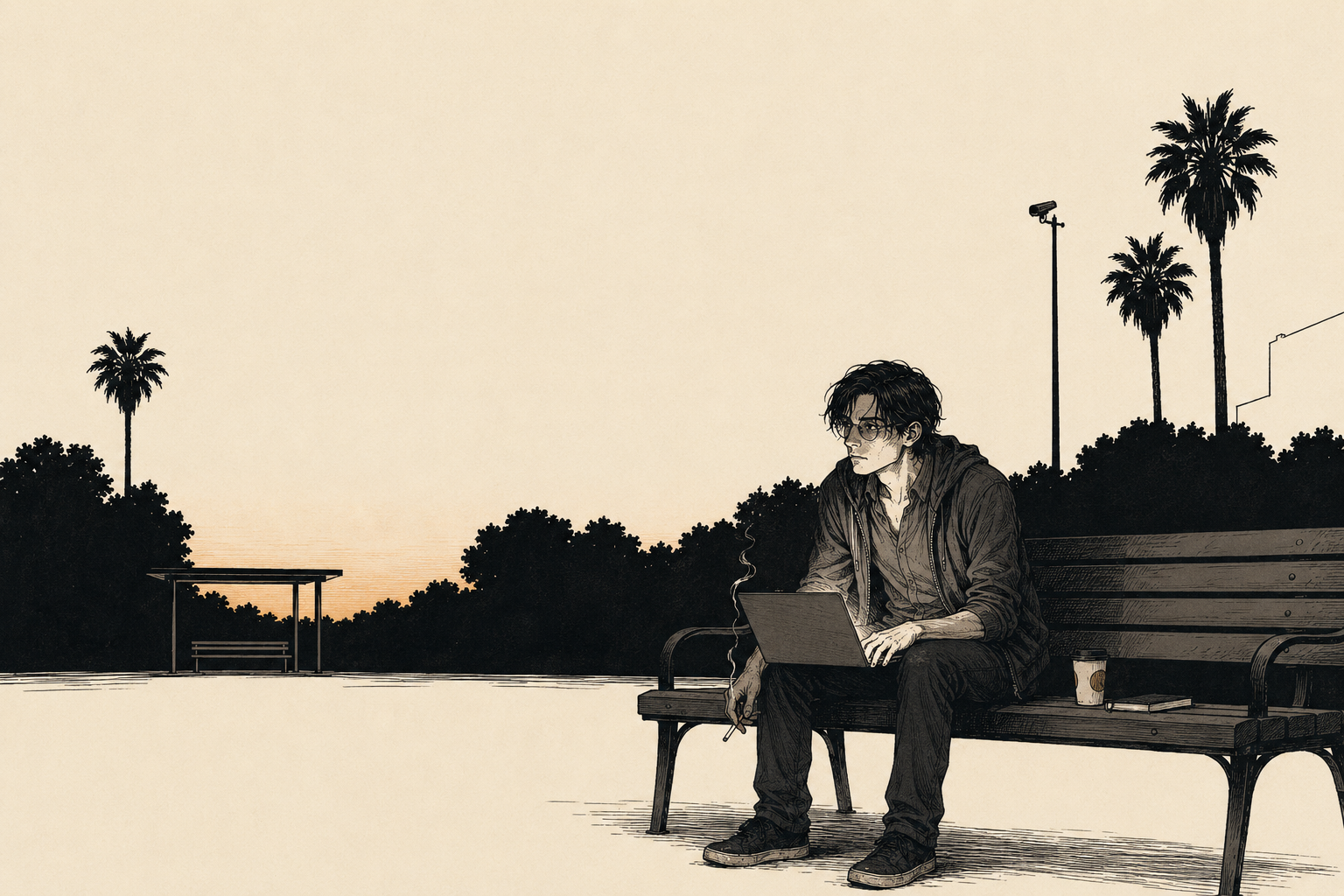
The quad · after the channel went quiet
I finished the cigarette. The cup was still there. So was the space on the bench where Cass had been sitting for thirty-five minutes of my afternoon, thirty-five minutes I had not noticed passing.
The resumé you’ve been keeping in that black box on your shelf.
I turned the phrase over once. Something in it sat wrong and I could not immediately name what. It had been said like an idiom and it landed like a description.
Then my class notification hit my phone. I packed up the laptop, pocketed the drives, and left the bench.
I didn’t think about it again.