Act 0 · Null Witness
Chapter 0.11
Run Forever

22 May 2035, Tuesday, evening
I had just finished attending a lecture on asymmetric key exchange.
I had read the relevant chapter at noon and spent the actual eighty minutes of the class working through a different problem in the margins of the notebook, not Dark Cypher, not the binary, just the problem I’d been sitting with since late afternoon: what it meant that Slash had said the resume you’ve been keeping in that black box on your shelf in exactly those words, in exactly that tone. The lecture was accurate. The lecturer was competent. I had been present for none of it in any useful sense. The most irritating part of the condition Dietrich had set on my continued attendance, no laptop and no phone within reach, was that it gave me ample time to think about all the problems on my plate.
The walk back from campus was the same walk it always was, except I was approximately two-thirds into the problem and didn’t want to lose the thread. The city did what it did in the evenings, the light flattening out to the west, the day releasing its held heat into the mild coastal air, the streets shifting from purposeful to ambient. I walked through it without particularly registering it. My phone was in my pocket. I hadn’t checked it since leaving the bench.
The stairwell at Entrada was dim in its usual way. I was thinking about Slash. I was thinking about what Slash could and couldn’t know. I was on the second floor landing before I registered that I had arrived there, and then I stopped.
There was garlic in the hallway.
Not old garlic, not the trace of garlic past, current garlic, working garlic, the active warm smell of something in a pan with butter and thyme. Under it, something oceanic and clean. The sweetness of rice cooking. A constellation of smells that had no business existing in a building stairwell except that they were, and they had walked directly into my attention and sat down.
I stood there.
I hadn’t eaten since the bagel at noon, which I’d eaten standing up while packing the laptop. I hadn’t noticed this until approximately this second.
The door to 2B opened.
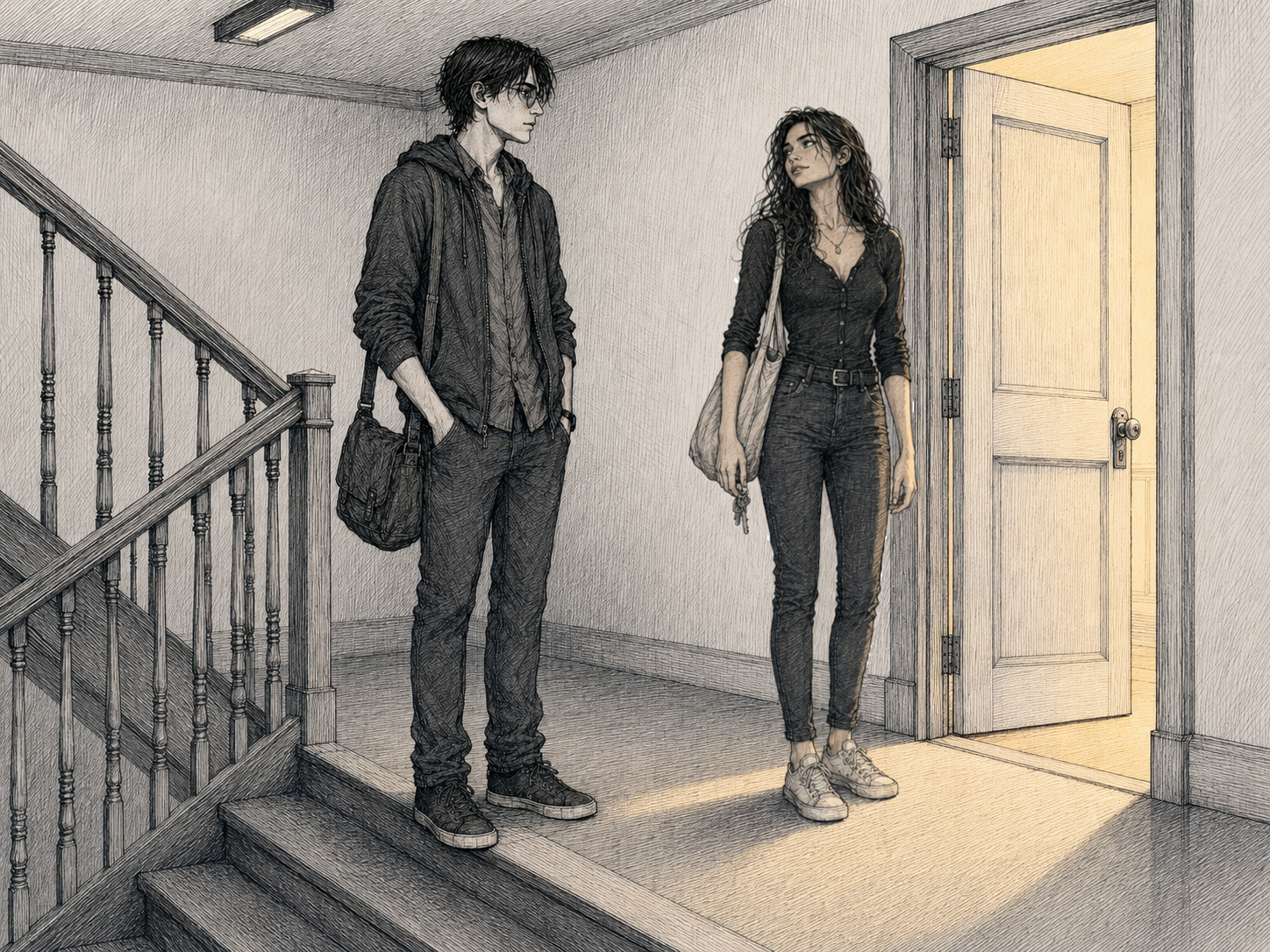
The second-floor landing · nine in the evening
THE FIRST HOUR — AFTER THE INVITATION
That was the afternoon. The evening was the best part of the day, when everything got better. Same day, after dark. I’d spent the walk home telling myself the bench had been the end of it, and then I ran into him again. I had been making dinner when I realized I’d forgotten something, and stepped out to get it.
The thing about garlic is that it makes a hallway feel inhabited in a way that nothing else does. It has weight. It has warmth in it that isn’t temperature exactly, more like the warmth of intention, someone decided to cook, someone made a choice that the evening would have proper food in it, and the smell carries that decision out through the door before anything else does.
I had my keys in one hand and the canvas tote over my shoulder when I opened the door and found him standing on the landing with his bag, as if he’d been walking inside his own head for miles and had just noticed he’d stopped. There was something slightly arrested about him, caught mid-thought.
He seemed better than this morning, which I immediately recognized as a low bar. This morning he was barefoot in an inch and a half of standing water just before eight. Better than that is a wide category. But he seemed more present now, like the walk home had cleared a layer of whatever had been running in the foreground, and now here he was, actually in the stairwell, actually stopped, actually in the world he was standing in.
I noted the thinness again. I had noted it this morning, when he was shirtless in the flooded loft, moving with the brisk efficiency of someone doing triage. I had noticed his ribcage, visible, not alarmingly, just the plain economy of a body run hard on the wrong fuel and never given the chance to notice the deficit. There’s a kind of thinness that comes from absorption, from a life where eating is an administrative task, the first thing deprioritized when anything more pressing arrives, and something is always more pressing. I’ve been that person. I recognize it from the inside. The hoodie he was wearing sat slightly large on his shoulders, not dramatically, just enough that I could tell it wasn’t how it used to fit and that settled into the other observations I’d been making all day without meaning to.
I thought about the morning. The tattoo. The ribcage. The way he’d moved through the loft like someone who didn’t register that he had a body. Then I moved on.
“Hey,” I said.
He blinked. Refocused. His eyes came to mine. “Hey.”
“Coming back from class?”
“Lecture. Yeah.” His eyes went to the door, my keys, the tote. The smell was filling the hallway in the insistent way of smells that have a source directly behind you. “Were you heading out?”
“Corner store. Rice cooker’s running.” I tilted my head slightly. “You got hit by the garlic from downstairs?”
“Second floor landing. Yeah.”
There was something almost funny about the precision of where he’d been stopped. The landing, not three steps earlier, not on the stairs below, the landing, where the smell had apparently achieved critical mass. I assessed him for one more second, his bag on his shoulder, the tiredness that had settled into his eyes, the fact that he was standing in the hallway at nine in the evening having come from a lecture and was probably about to go upstairs and plug back into whatever he’d been running before the lecture interrupted it.
The decision had already formed before I finished assessing him. I would notice this later and decide it was probably the more honest account of how it had happened.
“Come with me,” I said.
“I’m fine,” he said. Which wasn’t an answer to the question I’d asked, and also probably not quite accurate, and I think some part of both of us knew both of those things.
“I didn’t ask if you were fine.” I kept my voice easy. Not insistent exactly, inviting. There’s a difference. Insistence creates resistance to push against. An invitation offered with enough genuine warmth just sits there until refusing it starts to feel more effortful than accepting. “Come to the store with me. Then come eat. I made too much.”
“I’ve got work—”
“It’s nine PM.”
“The work is time-indifferent.”
“So is salmon,” I said. “It’ll keep twenty minutes. Come on.”
He glanced at the stairs, then some middle distance between the stairs and me. I watched the resistance doing the thing resistance does when the underlying reasons for it start to run thin, not collapsing exactly, but losing its structural conviction.
“I don’t want to impose,” he said.
“You’re not imposing,” I answered. I had made more than I needed. I had, in fact, made enough for two. More than I needed, without having examined the reasoning at the time. “If you don’t come I’m eating pilaf alone at nine PM and that’s a different problem.”
A small pause. Then something in his posture shifted, one of those tiny adjustments that signals the arrival of a decision a person reached slightly faster than they expected. “Okay,” he said. “Sure.”
I locked the door behind me.
The corner store on Entrada had been there long enough to have outlasted several waves of neighborhood change, which was evident in the slight exhaustion of its signage and the extremely un-exhausted confidence of its layout. Two of the three overhead fluorescents worked. The refrigerated section hummed at a frequency that had been the same for as long as I’d been coming here, the low steady pitch of machinery that has achieved a kind of philosophical commitment to its function. I liked it in there. There was something honest about a place that didn’t try too hard to be anything but what it was.
I needed butter. I’d discovered this twenty minutes earlier and hadn’t examined the trip as anything other than that.
He moved through the store economically, like he knew exactly where things were and what he’d come for, except that I watched him drift, almost involuntarily, toward the greeting card display near the checkout. He was reading the front of one with an expression of genuine puzzlement.
“Did you know there are sixteen cards in this section for the loss of a pet,” he said.
“That seems about right, actually.” I found the butter. Considered the wine. Selected the wine.
“Sixteen different ways to grieve a dog,” he said, as if lacking a fundamental understanding of something he was searching for an answer to.
“Sixteen different relationships to grieve. The dog is just the occasion.” I set both on the counter then asked, “Do you send cards?”
“No.” He put the one he’d been reading back with the same precision he probably applied to everything, in exactly the position it came from, spine-flush with the others. “My mother does.”
“What kind?”
He thought about it for a moment, and it seemed like genuine retrieval, like he was actually going back to the memory rather than generalizing. “She found one once with a diagram of the circuitry inside a transistor radio. 1958 schematic. She sent it for my birthday when I was eleven.”
I looked at him.
“It’s in a box,” he said. “But I still have it.”
His eyes had drifted while he talked, as they did, and caught on the rack one section over, the one the store hadn’t taken down yet: half-price stickers on the cards that said MOM across the front in the soft fonts stores keep for it. Mother’s Day had been a week and a half ago. I watched him look at it, and I watched something cross his face that I didn’t have a name for and would spend a long while afterward trying to find one.
“I missed Mother’s Day,” he said. He was talking to the rack, or to some point past it, and I understood that I was being allowed to overhear this rather than being told it. His voice did nothing dramatic, and that was the thing about it. “A week and a half ago, and I missed it. I miss it every year.” A second went by. “Three years now, of the one day there is that exists only for her, and every one of them I was somewhere with my head down and my phone turned face-down on the desk, telling myself I would call when the thing I was doing was finished. The thing was never finished.” He nudged one of the cards square with a fingertip, the way he put everything back where it came from. “She found me that card because she pays that kind of attention. Her whole life. And her son cannot manage the one day a year that is only about her.”
I saw his jaw tighten. He had the face of someone biting an invisible thing he was fighting from deep within. Like a patient under the knife. Fully awake.
“She must think I hate her.”
I didn’t say anything. There was nothing I could have said that would have handled what he’d just let out, and he wasn’t asking me to handle it. He had said it once, out loud, in a corner store, to a rack of half-price cards, and I understood that the saying was the only thing he needed. Sometimes a thing gets too heavy to keep carrying, and you finally just leave it wherever you happen to be standing.
The clerk rang up the butter and the wine. He set a boxed French press on the counter beside them, still in its packaging, collected somewhere in the aisles while I was deciding between two nearly identical containers of butter and not paying attention to what he was doing. I looked at it for a moment.
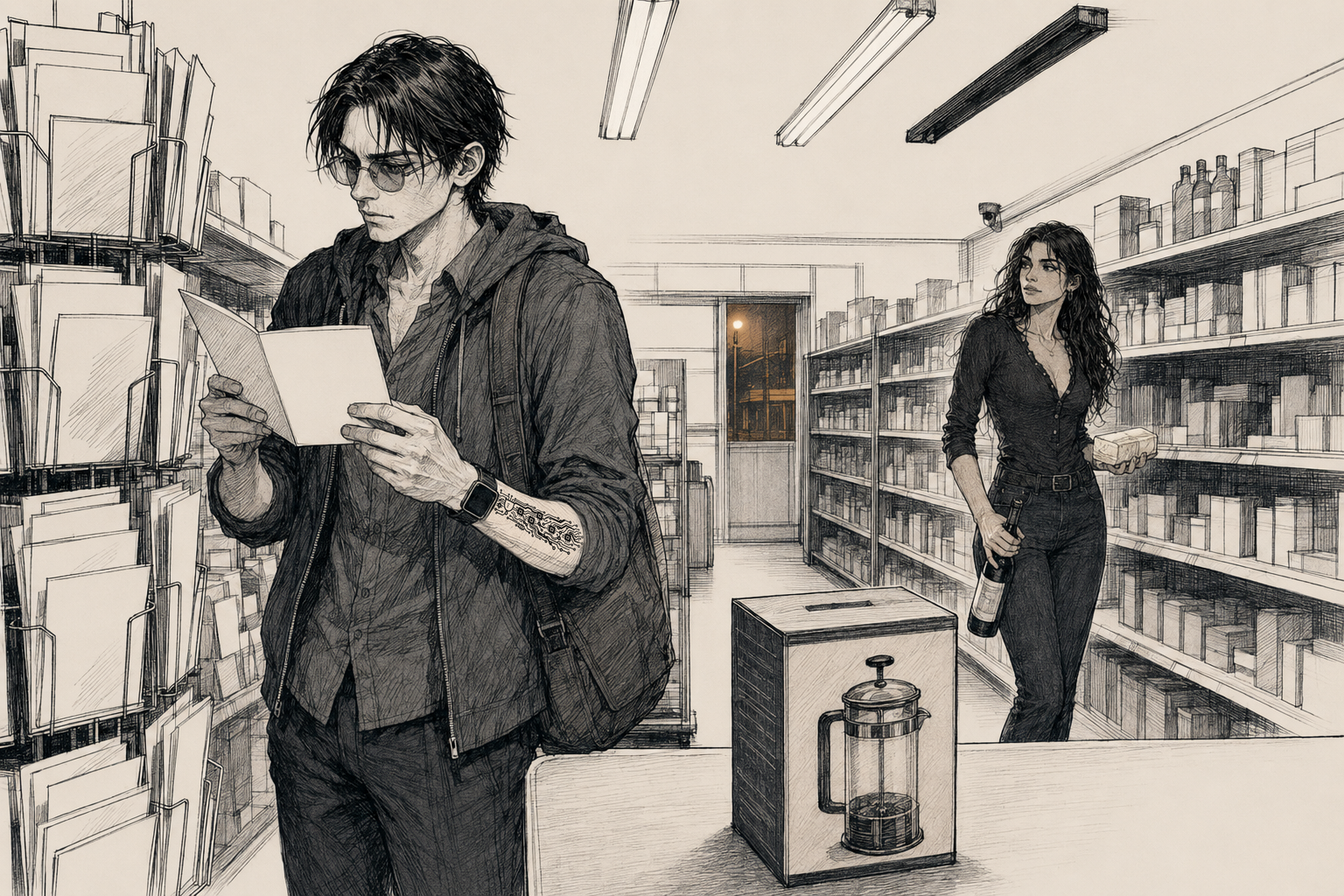
Entrada Street · sixteen ways to grieve a dog
A sign of a hard day finally settling into order.
I didn’t say anything. I paid. Outside, the Santa Monica evening had completed its transition to actual night, the marine layer had arrived and softened everything, the streetlights fighting their warm battle against the fog and darkness. We walked back toward the building without hurrying.
“My mother keeps cards,” I said. “I found a drawer once at her house. Cards people had sent her over forty years. Every one of them. In order.”
“In order.”
“Chronological. I think.” I thought about the drawer for a moment, the softness of old envelopes, the smell of paper that had been kept rather than discarded. “I don’t know what she does with them. I don’t think she does anything. I think she keeps them because knowing they’re there is the point.”
He was quiet for half a block. Not absent, I was learning the difference between his absences and his presences. This was presence. Something being turned over carefully.
“My mother sends cards too,” he said finally. It was the first thing he’d volunteered to me directly about his family in the time I’d known him. He said it the way you say something you haven’t decided to say, discovered only after it had been said that you’d decided. It’s… hard to explain. But he seemed to accept every decision that way.
I didn’t make anything of it then. “Does she?”
“Every birthday. Specific ones. She hunts for them.” A pause, and then something that was almost an afterthought, which meant it probably wasn’t. “She’s where I got the habit.”
“What habit?”
He didn’t answer immediately. We turned onto Entrada. His eyes had gone to the middle distance again, but the warm kind, not the working kind.
“Keeping things,” he said.
My apartment feels different in the evening than it does at any other hour. Something to do with the reading lamp on the kitchen table. I’d moved it there my first week because the overhead was wrong. Too harsh, the wrong color temperature, and the lamp made the kitchen feel like a room worth being in rather than a room for accomplishing tasks. The light it made was amber and close, and it made everything in its reach seem slightly more inviting and cozy than it was.
He stood in the middle of the room when we came in and took it in as he had the hallway, with attention that wasn’t the polite acting of a guest pretending to appreciate the decor. Just simply his attention given equally and deliberately to each and every accent that the room spoke with to him. I watched him register the bookshelf, the table, the three plants on the sill, the window behind them. The marine layer had come in from the ocean and the full moon was somewhere behind it, not visible as a disc, but present, the fog itself luminous with it. He stood there for a moment in that light. Then he turned back to the room.
“You have a bookshelf,” he said.
“Is that a surprise?”
“I’m noting it.”
I took his jacket. He let me take it without the awkwardness some people produce when someone takes their jacket, a small trust extended without commentary. I hung it on the hook by the door and went to the kitchen.
The rice cooker had gone to warm. The salmon was resting. I put the butter into the pan with the greens and let the heat come up slow, unhurried, wanting to do it right, and the kitchen filled with the smell of it, the green bitterness of the leaves softening, the richness of the butter, the thyme coming back alive in the warmth.
He sat at the kitchen table without being told and watched me cook. I was aware of him watching with the peripheral consciousness that a cook develops for the room behind them. His attention was still, not intrusive, simply present. Like someone sitting in a room where work is being done and understanding that the work doesn’t need their commentary.
“What can I do,” he said.
“Sit.”
“I could—”
“Sit.” I said it lightly. Not as a dismissal. More an invitation to stay in the room, from someone who didn’t need the help.
He sat.
The salmon came off cleanly. I plated both portions with the slightly self-conscious care of someone cooking for more than one for the first time in a while, the doubling felt good in a way I didn’t examine. I put a plate in front of him and sat down with my own.
He considered the plate. He paused before he picked up his fork, a pause I didn’t have a word for exactly, something between arrival and surprise, like a person who has just been reminded that they are, in fact, a person who needs to eat. Then he ate.
I watched him how I watch things when I’m thinking about something else, which is to say I watched him with most of my attention. He ate without putting on a show of it, the same absence of display I’d noticed in other contexts, the clean directness of not thinking about being observed. The salmon went first. Then the rice. He cleaned the plate. He was, in fact, very hungry.
I confess, it was hard not to laugh at that.
I refilled it before he could say anything about it.
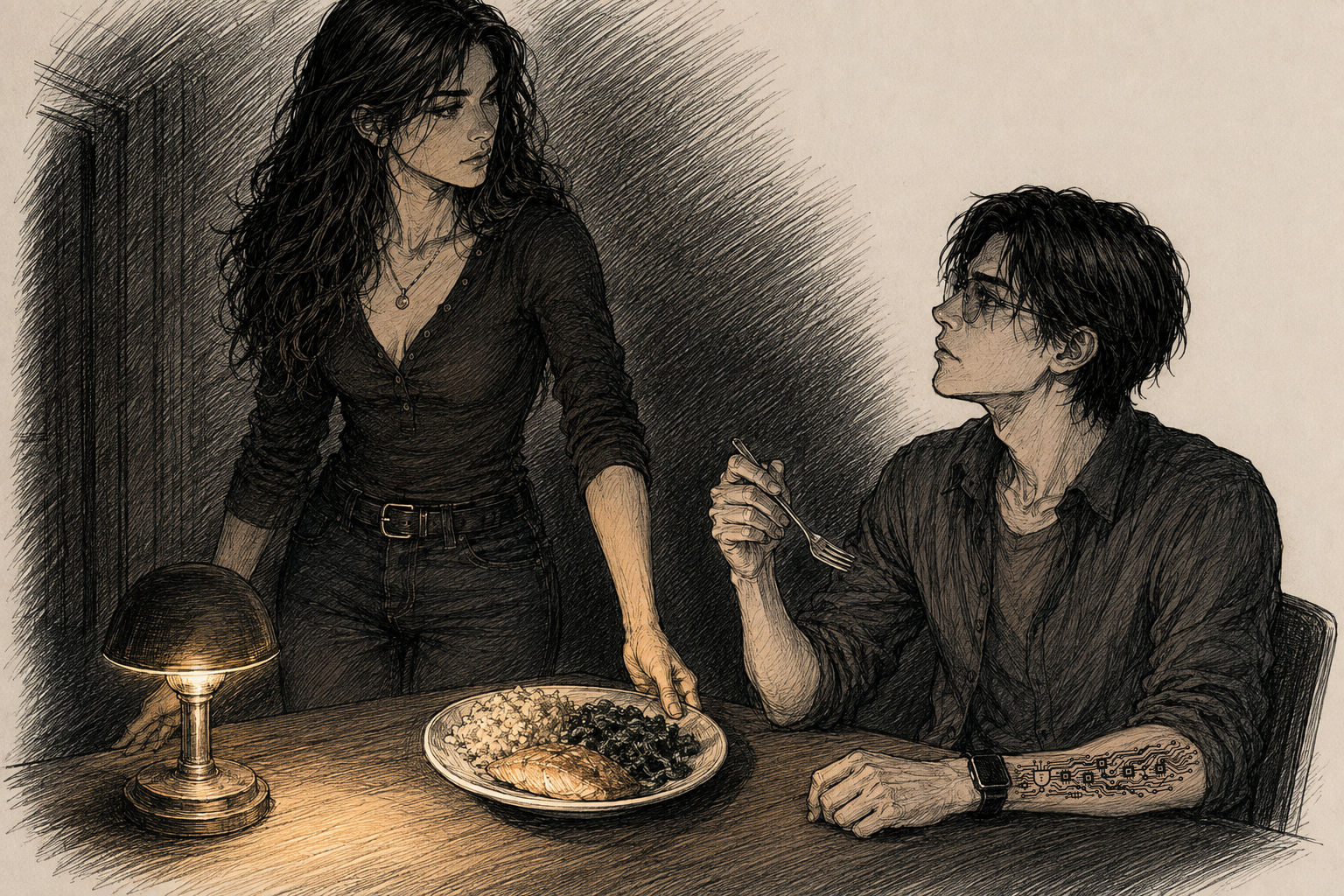
Unit 2B · you need it
His eyes flicked to the second plate, then to me.
“You need it,” I said, and picked up my fork, and that was the end of that conversation.
His sleeves were rolled up to the elbow.
I had been trying not to look at the tattoo for approximately twenty minutes, with the success rate you would expect from trying not to look at something that occupies a third of someone’s forearm. It was doing what it had done in the morning light earlier, catching the lamp now instead of the sun, the fine black linework rendering the circuit with the precision of wanting it to look like the real thing because it was the real thing. From the wrist up to mid-bicep: trace-paths, nodes, IC semiconductors, and the compact shorthand notation of an actual schematic, and in among the linework the small hexadecimal annotation that I’d noticed this morning and hadn’t asked about.
I looked up and found him watching me.
Not with the neutral look. The other one, the one where he has actually seen something rather than processed it.
There was a beat. Long enough to be honest.
“Go ahead,” he said.
“I wasn’t…” I started. Then I didn’t finish that sentence, because we both knew.
He held his arm slightly toward the lamp without making a production of it. An accommodation. I looked properly.

Unit 2B · it does not have a terminal condition
His other hand was on the table between us, and the knuckles had the tight, shiny gloss of a cut two days into closing, skin that had split and been made to hold anyway. I’d seen it taped that morning and not asked. I didn’t ask now. Some things a person hands you when they are ready to, and not before.
The circuit was dense without being cluttered, the deliberate density of something designed, where every element was there for a function rather than an effect. In biomedical engineering you learned enough basic electronics to understand that a schematic was a language, and that languages had grammar, and that this one was being spoken fluently. It was real. It was exact. It wasn’t decoration pretending to be engineering. It was engineering, chosen to live on a person’s arm because of what it meant.
“What is it?” I said. There was a curiosity that had been scratching at me from the first time I saw the ink, and I wanted to know in spite of every iota of courtesy I had learned to respectfully restrain it. And here he was, offering up what I could only assume was an intimate piece of himself and inviting the curiosity like someone who appreciated someone’s genuine, real desire to know things.
He turned his arm slightly, following the trace with one finger without touching it. Like he was reading it. “This is a NAND gate at the center. It takes the signal it is given and passes it through as long as something is given to it,” he said. “Then a counter feedback loop, the output feeds back through the counter to the input, passes through the IC chip that acts as storage—like memory. It increments every cycle.” A pause. “It doesn’t have a terminal condition.”
Something shifted into focus, the click you get when you’re handed the right word for a thing you’ve already seen. A loop with no stopping point. A thing built to keep going. Incrementing, but toward what? Into what?
“So it just…” I said. “Runs.”
“Forever. Yeah.”
I sat with that for a moment. There was something in it that I felt rather than understood, a commitment that didn’t have an end condition built in, that trusted the incrementing itself to be enough. I thought about how unusual that was. How much easier it was to organize your life around a destination rather than a direction.
I studied the hex annotation. Small type, neat and deliberate alongside the counter circuit and the memory chip.
“What does the hex say?”
“It’s a name.” He said quickly.
“Who’s name?”
He didn’t answer right away, and i couldn’t tell whether it was embarrassment or uncertainty that took him do long to say, “Mine.”
I had some limited exposure to hex, and while I couldn’t recall anything useful from memory, I could at least tell there were eleven characters, not four or eight that would have fit his name.
“But… there are too many letters.”
He looked back at the hex and he let the air out of him.
“Not my legal name. A different one. I gave it to myself.”
I waited for something to follow, but nothing arrived. So I let my curiosity push me, and I pressed.
“You still haven’t told me what it is.”
“Because it’s stupid.” Resistance again. I was becoming familiar with his resistance. Comfortable, even. My fingers gently landed on his arm before I had realized I reached out to touch him and turned his arm closer to look at the characters more closely.
“If that were true, it wouldn’t be on your arm.”
And like before his face did the thing it did when the reasons for resisting ceased to exist.
“KernelHavoc”
I felt lighter having heard it come willingly from him, and I felt a smile cross my face when I looked back up at him while his gaze was down at his other name, encoded in small print.
Then I asked the thing I actually wanted to know.
“What’s the i?” I said. “What are you counting toward?”
He met my eyes for a moment. The question had landed differently than I’d aimed it, not intrusively, but precisely, going straight to something deeper. His eyes went to the annotation, then the counter circuit, then some point between the table and the lamp.
“I don’t know,” he said, which surprised me less than I expected. “The version of yourself you’re working toward, you can’t see it from here. You just know the counting is the right thing.” Something shifted in his expression, a very slight drop in whatever he kept managed. “You pick a direction. You keep going.”
He wasn’t looking at me when he said it. His eyes were on the circuit. I had the sense it was something he’d thought clearly but hadn’t said aloud to anyone.
“When I was deciding on the handle,” he said, quieter now, moving toward it this time instead of away from it, “I needed something I wouldn’t want to walk away from. Not a word I liked. A word I’d have to keep becoming.” The meaning was in the gesture, not the exact numbers. A choice encoded and carried. Permanent. Incrementing. No terminal condition.
I thought about the drawer in my mother’s house. About the transistor radio card in a box in his apartment that had never been unpacked. About the difference between people who kept their commitments in drawers and people who put them on their bodies so they couldn’t be lost in a move.
“It’s beautiful,” I said. I meant it as an observation. The word landed heavier than I’d intended. He looked at me, the real look, the full one, the one that took a second to put back, and then he dropped his eyes to his fork and picked it up.
“It took three sessions,” he said. It did not answer what I had said, and it answered it completely, and I think he knew that when he chose it.
The dinner conversation moved on, but something in the room had changed, like a window had been opened briefly and the air had shifted. He had said something real and I had received it and now there was a kind of permission in the room that hadn’t been there before. I felt it, and I felt myself feeling it, and I found I didn’t want to ignore it.
“Can I ask you something?” I said.
He looked up. Waited. His expression said: you can ask. Whether I’ll answer is a separate question.
“The four AM thing,” I said. “I hear you upstairs. The chair.”
“I know, I’m sor—”
“It’s fine.” I said it clearly enough to close that door. “It genuinely doesn’t bother me. What I’ve been wondering is…” I set down my fork. “Is that just how it goes, or do you actually not notice the time?”
Something shifted in his face, a small recognition, like I’d named something he’d stopped considering unusual. “Both,” he said. “Mostly the second one.”
“You don’t notice.”
“I notice when something external tells me. The light, usually.” He turned his wine glass slowly on the table. “Idle time is—I don’t do well with idle time. I used to think that was a flaw.” A beat. “I don’t think that anymore.”
“What do you think it is now?”
He brought his eyes up to me. He had just been asked a question he hadn’t prepared for and had discovered, in the asking, that he had an answer. “Wiring,” he said. “It’s just how I run.”
I thought about the circuit on his arm. The feedback loop with no terminal condition. The thing that was always going, always incrementing, because stopping wasn’t in the architecture.
I thought: yes. That’s exactly it.
I set down my fork.
“You are slowly killing yourself,” I said. “You know that, right?”
He opened his mouth to say something dismissive. He was trying not to smile. He failed. A short exhale, almost a laugh. He’d heard this before and was deciding how seriously to take it this time.
I waited for it to finish.
“I’m not joking,” I said, “and I’m not being a mother at you. I’m telling you what the research actually says.” I folded my hands on the table. “Your glymphatic system is a waste-clearance mechanism. It runs primarily during deep sleep. That’s when your brain flushes beta-amyloid proteins and tau, the metabolic byproducts of active cognition. Skip enough sleep, they accumulate. You can’t clear them during the day. They deposit in grey matter and they do not come back out.”
He had gone still. The almost-laugh was gone.
“Chronic sleep deprivation is associated with measurable grey matter volume loss in the prefrontal cortex, the part running executive function, decision quality, working memory. The things you rely on most.” I picked up my wine. “And the cortisol cascade makes it worse. Sleep debt elevates cortisol. Elevated cortisol impairs sleep quality further. Which elevates cortisol more. You’re not just tired, you’re accumulating structural damage in a progressive loop that the literature is very clear does not fully reverse. Sleep debt is not a loan you can pay back later. Some of what you spend, you spend.”
The kitchen was quiet. The lamp was doing its amber work. He was watching me, receiving information from a source he couldn’t dismiss.
“Stop it,” I said.
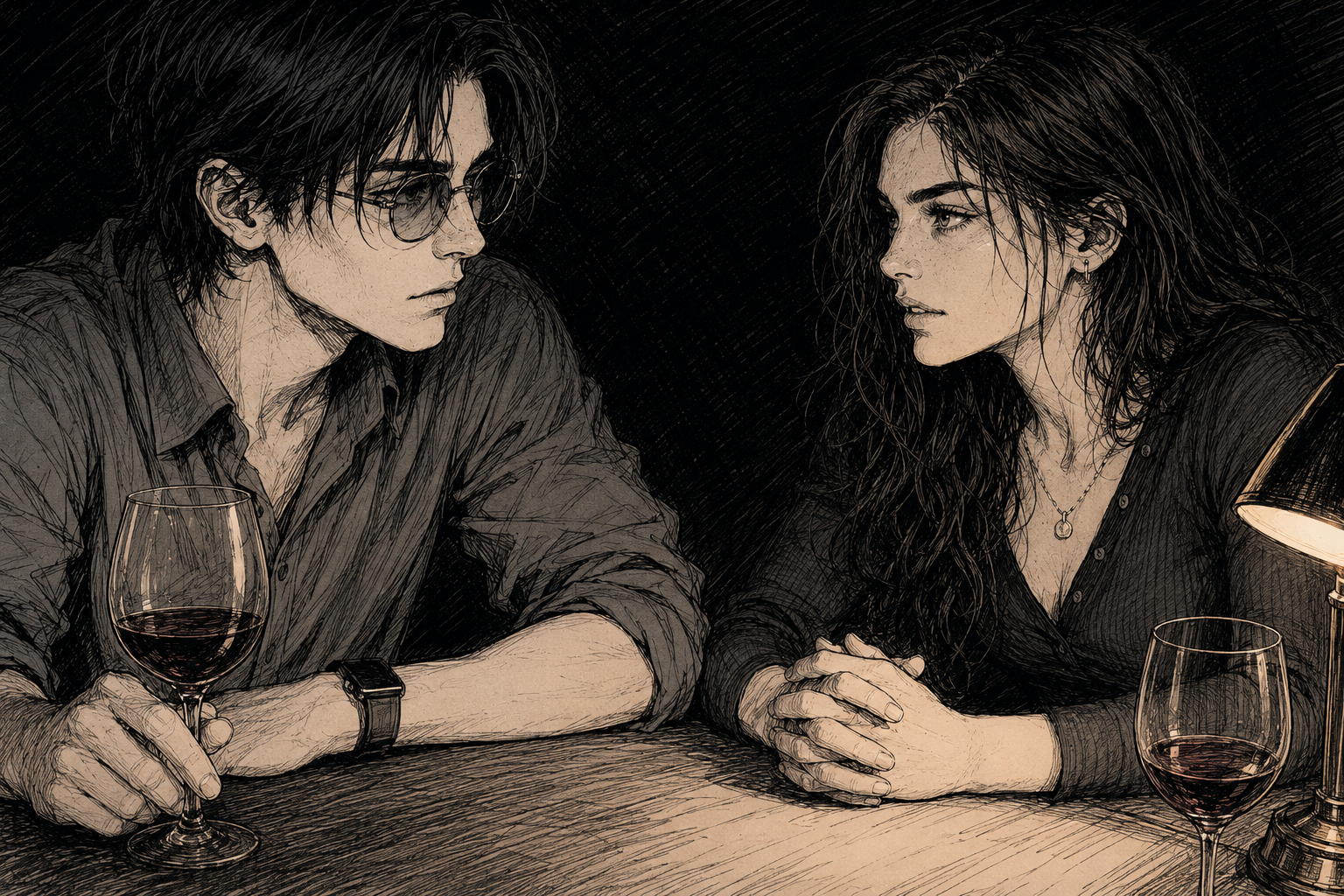
Unit 2B · not a loan you can pay back later
There was no anger in it, and worry is not quite the word either. It came out final. That is what you say to someone you believe is capable of hearing it and doing something with it.
He held my eyes for a moment. Then he dropped them to the table.
“Yeah,” he said.
Not sure or okay, the words people use when they want to end a conversation. Just yeah, the voice of a man who had resigned to something he couldn’t deny.
What I think you may find funny is that I saw him consider my “warning,” let’s call it. Really consider it. I thought in that moment, I sound like his mother. But for some reason he took what I said differently than he usually took being scolded like a child for staying up past his bedtime. I just saw him and what he was doing to himself and the debt adding up in ways he wouldn’t acknowledge. He acknowledged it, I think.
I picked up my fork again. He picked up his.
The wine went slowly. He asked about the Uppsala follow-up. I told him the junior researcher had gone further than I’d expected, hadn’t just run the degradation test but extended it across two additional substrate variables I hadn’t specified, which was both gratifying and slightly humbling. He asked one question about the model. I answered it fully, which took longer than I’d planned, and he followed all of it without my needing to slow down or simplify. There was a real pleasure in that, the pleasure of speaking at full speed to someone who doesn’t need you to slow down.
He told me the lecture had been accurate. I said that was the kindest thing you could say about a lecture. He said it was all he had.
At some point the wine was between us and neither of us had been watching the level. The kitchen had that feeling it gets late in the evening when the lamp is the only light and the room feels smaller and warmer than it actually is.
He’d gotten up for something, more water, I think, and paused at the desk. My seminar notes were spread across half of it, the planner open beside them with tomorrow’s date circled in my most urgent red pen.
“What’s the paper?”
“Seminar. Due tomorrow.” I watched his eyes go to it. “The one I’ve been carefully not thinking about all week.”
He didn’t say anything. He just studied it for a moment, the look that meant he was making a note somewhere.
He noticed the books again. Got up and read the spines the way I was beginning to understand he moved through anything that interested him: eyes first, carefully, not touching until there was a reason to. He stopped at a title on the third shelf and asked about it. I explained. He read the back cover with the same attention he gave everything, and returned it to exactly the position it had come from. Spine flush. Same angle.
I noticed this. I noticed myself noticing it. I was keeping a list I hadn’t meant to keep.
When he stood to go he picked up the plates without announcement or apology and carried them to the sink. I watched him do this from the table and didn’t argue. He washed them like it was practiced, the movements of a man who has washed his own dishes alone long enough that the act had no self-consciousness in it. He dried his hands on the dish towel.
Hung it back in the correct orientation.
I noticed.
He got his jacket from the hook. Put it on, the way he’d taken it off, without commentary, without making anything of it. He was at the door when he turned and found me, and there it was again, the thing I kept not having a name for, the look that arrived and then was managed back down before I could fully read it.
“Thank you,” he said. Plainly. Without the social layer that usually padded the word. Just the word and what it meant, which was acceptance of an invitation and a genuine appreciation for what he had been invited to.
Something moved in my chest. I chose not to name it. I had been choosing not to name things all evening with varying success, and this one I was going to let sit.
“Come back when you’re not running on empty,” I said.
He kept his eyes on mine one more second, not long, just enough to tell me he had heard it as I meant it. Then he left.
I stood in the kitchen after the door closed and let the room settle back around me. The plates were clean. The wine glasses needed washing. The rice cooker light was still on warm. The lamp was doing its amber work in the corner.
There’s a thing that happens in a room after someone leaves it that’s different from what it was before they arrived. Not loneliness exactly. More like the presence of an absence, a hollow space where something had been.
I washed the wine glasses slowly. I thought about the drawer in my mother’s house and the forty years of kept things, and about the circuit on his arm that ran forever without a terminal condition, and about a person who kept things differently from the rest of us, inside work, inside code, inside ink, but kept them nonetheless.
I turned off the kitchen light.
I went to bed.
I did not examine the evening too carefully.
Which meant I was already examining it.